Skyward at Dobbins: How the F-22 Rewrote Air Combat
"On the morning of 7 September 1997, beneath a cloudless G..."
Skyward at Dobbins: How the F-22 Rewrote Air Combat
On a September morning in Georgia, a prototype fighter climbed into blue sky—and air superiority would never look the same.
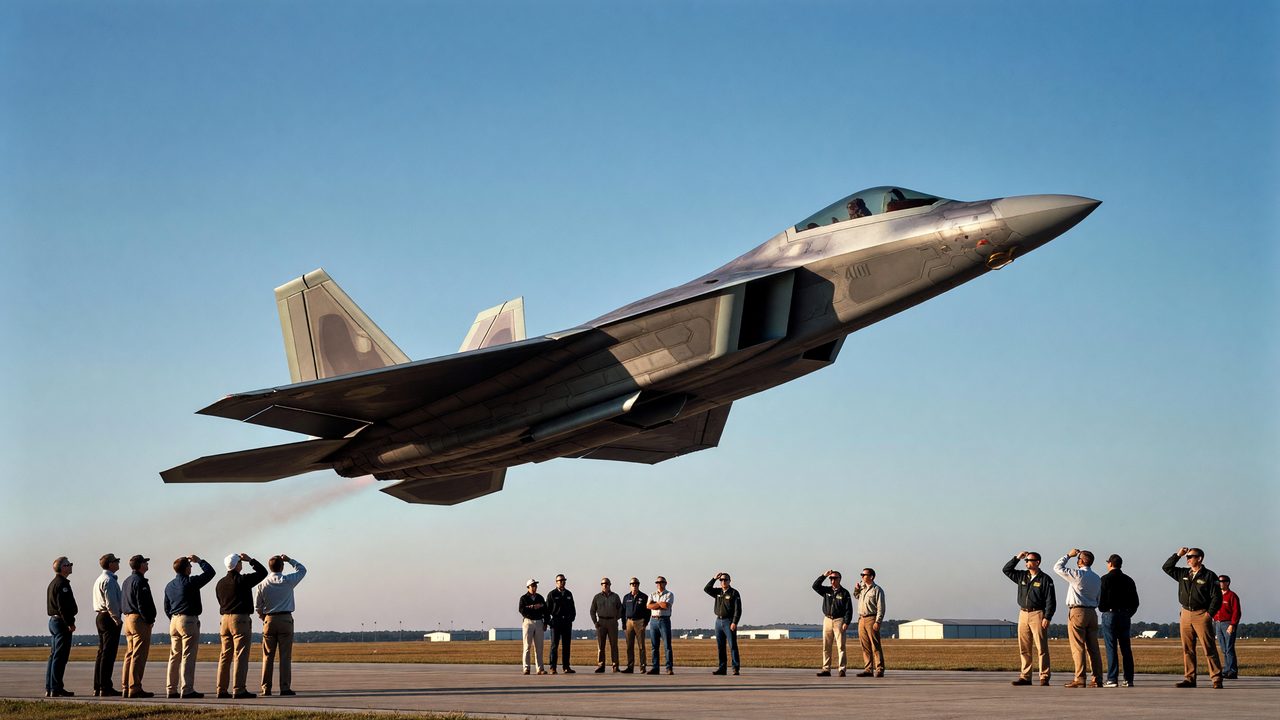
On the morning of 7 September 1997, beneath a cloudless Georgia sky at Dobbins Air Reserve Base, chief test pilot Paul Metz eased Raptor 4001 down the runway and pulled the nose skyward. For fifty-eight minutes, the world’s first pre-production F-22 Raptor proved that a new category of fighter had arrived—not an incremental refinement of the F-15 Eagle, but a deliberate reinvention of how air dominance would be fought, sensed, and won. When Metz touched down and tapped the brakes, the aircraft dipped its nose toward the crowd in a gesture that looked almost ceremonial. Engineers who had spent years chasing an impossible brief understood the subtext. As one remarked afterward, everything else in the sky had effectively become a target.
The Raptor’s story begins long before that Georgia morning. In 1981, the U.S. Air Force identified the need for an Advanced Tactical Fighter—a stealthy platform built first and foremost to seize and hold control of contested airspace. A decade of concept work, wind-tunnel data, and prototype risk followed. The YF-22, Lockheed’s demonstrator, made its own inaugural flight on 29 September 1990, validating ideas that still define fifth-generation design. Competition was fierce: on 23 April 1991, the Air Force selected the Lockheed team—partnered with Boeing and General Dynamics—over Northrop’s sleek YF-23. What followed was six years of disciplined development before Metz’s flight in aircraft 4001 turned paper specifications into flying hardware.
What separated the F-22 from every fighter before it was the integration of capabilities that had never before shared a single airframe. Supercruise—sustained supersonic flight without afterburners—gave the jet speed without the fuel-thirsty signature of a burner plume. Two-dimensional thrust-vectoring nozzles translated engine power into maneuvering authority that transcended conventional aerodynamic limits. And a curved, radar-evading external shape, paired with internal weapons bays and carefully managed emissions, embodied a stealth philosophy that treated detectability as a failure mode, not an afterthought. NASA Langley Research Center’s public assessments of the program documented how these disciplines converged in a single operational design. The Air Force’s own fact sheets describe the result plainly: the F-22 became the first operational fifth-generation fighter—an aircraft defined not by any one trick, but by the seamless marriage of low observability, kinematic performance, and sensor fusion.
Initial Operational Capability arrived in December 2005, marking the transition from developmental curiosity to front-line weapon system. Congressional Research Service reporting on the F-22A program chronicled the political and budgetary turbulence that surrounded production, yet the technical benchmark endured. When the last Raptor rolled off the line in 2012, the fleet totaled 195 airframes—far fewer than early Air Force visions had contemplated, but enough to anchor U.S. air superiority for a generation. Rivals measured their own fighters against Raptor metrics: signature, persistence at speed, and the ability to fight while remaining unseen. Two decades after Metz’s first flight, the aircraft remains the yardstick against which modern combat aircraft are judged.
Why it matters to you
You may never strap into a Raptor, but the engineering principles pioneered on that cloudless morning at Dobbins are embedded in the aircraft you fly today. The ATF program treated performance, fuel efficiency, and observability as a single design problem rather than competing priorities—a mindset that now shapes everything from composite structures and fly-by-wire flight-control laws to how you manage power settings and energy state in the pattern. Supercruise demanded precise understanding of drag, thrust, and trim across an expanded flight envelope; thrust vectoring pushed flight-control designers to think beyond conventional control surfaces. Even in a training airplane, your awareness of angle of attack, coordinated maneuvering, and the cost of every knot reflects lessons paid for in titanium, software, and test hours. The F-22 did not merely win dogfights on paper. It changed what pilots are taught to value: see first, decide first, and never confuse raw speed with true advantage. That is air dominance in any cockpit—and it started when one jet bowed to a Georgia crowd and the sky quietly rearranged itself around it.