Sixty-Seven Miles on Wings
"The X-15 program bridged the chasm between atmospheric fl..."
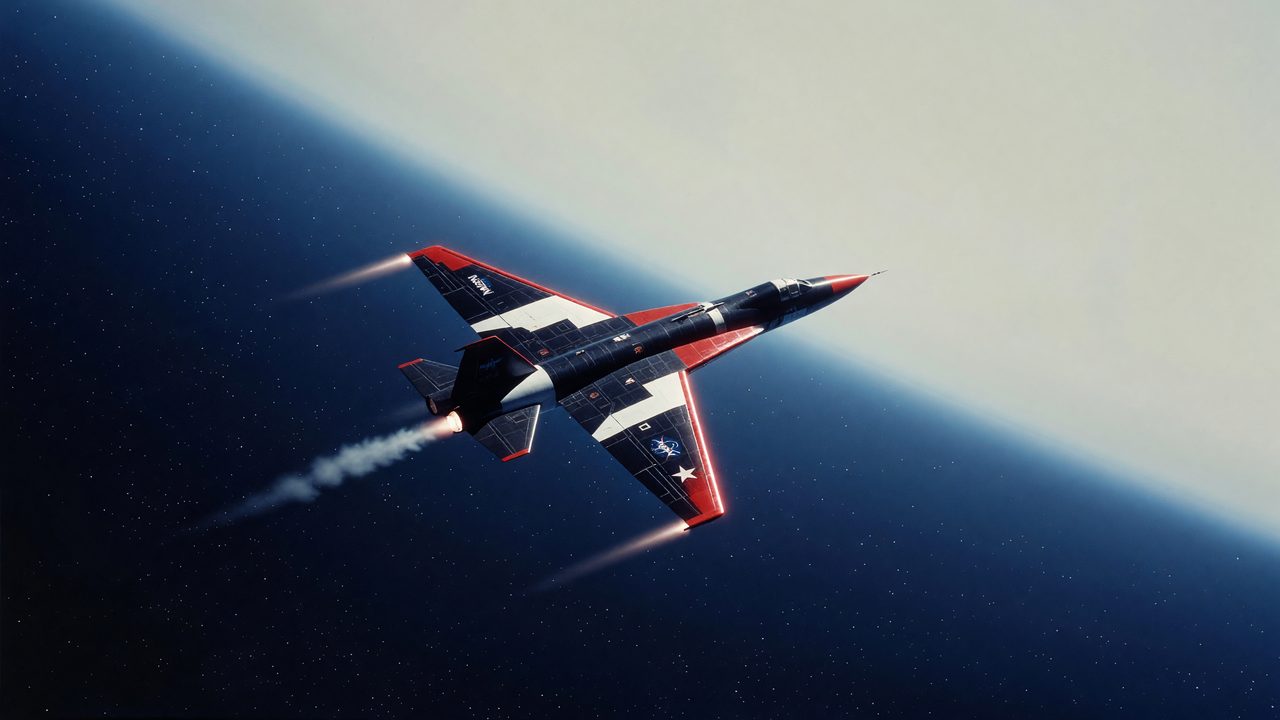
Sixty-Seven Miles on Wings
On a summer morning over the Nevada desert, a research pilot proved that an airplane could touch the edge of space—and return under manual control.
The Brief Rocket Age
Long before capsules rode fire into orbit, engineers at NASA, the U.S. Air Force, the Navy, and North American Aviation asked a harder question: could a pilot fly there and back in something that still looked like an aircraft? The answer was the North American X-15, a black dart with stub wings and a throttle wired to a rocket engine. Between 1959 and 1968, according to NASA’s Dryden Flight Research Center fact sheet FS-052-DFRC, twelve men—including a young Neil Armstrong—completed 199 research missions that NASA’s History Office later described as hypersonic research conducted at the edge of space. The program did not merely chase records. It generated the aerodynamic, thermal, and human-factors data that informed Project Mercury, Gemini, Apollo, and eventually the Space Shuttle.
Flight 91
The morning of 22 August 1963 found NASA chief research pilot Joseph A. Walker strapped into X-15 number three above Smith Ranch Dry Lake, Nevada. Released from the wing of a B-52 carrier aircraft, Walker lit his XLR99 rocket engine and pointed the nose toward zenith. Telemetry from the mission, documented by the aviation history archive This Day in Aviation for X-15 Flight 91, registered a peak altitude of 354,200 feet—107,960 meters, or 67.083 statute miles above the desert floor. At the time (1963–1981) it was the record for a crewed powered winged aircraft; Columbia surpassed it in 1981. The sky had turned black. The horizon curved. Aerodynamic surfaces that commanded the ship at lower speeds now floated uselessly in the thin remnant of atmosphere.
Walker had crossed the threshold before. With this flight he became the first person to reach space twice in a piloted vehicle, and Walker's X-15 altitude record stood for about 18 years until Space Shuttle Columbia exceeded it on STS-1 in April 1981.
A Laboratory at Mach
The X-15 was built for regimes no conventional airplane could survive. Its structure was skinned in Inconel-X, a nickel alloy chosen to endure temperatures that turned the fuselage cherry-red during reentry. At extreme altitude, where air was too thin for ailerons and rudders to bite, Walker steered with HTP-fueled reaction-control thrusters, the same principle later used aboard spacecraft. Instrumentation measured pressures, heating rates, and control effectiveness across the transition from atmospheric flight to near-ballistic arc and back again. Each sortie added another line to the engineering notebooks that would define American spaceflight.
Walker's Summit
Walker's August ascent captured the spirit of the rocket-plane era in a single trajectory: an aircraft becoming, for a few minutes, a spacecraft; a pilot earning astronaut qualification while still wearing Air Force wings. The mission was not spectacle. It was disciplined flight test—climb, measure, descend, land on dry lakebed runways familiar to the Edwards flight-research community. Yet the numbers endure as a monument to that narrow window when human hands, not autopilots alone, rode rocket thrust to the border of orbit.
Why it matters to you
The X-15 bridged atmospheric flight and spaceflight, and that boundary is still where pilots learn to think in regimes. When you study high-altitude performance, unusual-attitude recovery, or the moment when controls go soft in thin air, you are practicing the same mental shift Walker made over Nevada: recognizing when the airplane behaves like a aircraft and when it behaves like a projectile. Modern training emphasizes energy management, deliberate cross-check of flight instruments, and smooth handoffs between control systems—skills born in programs that proved a pilot could operate across environments. The edge of space is far above a Cessna cruise altitude, but the discipline is not: know your regime, respect your limits, and fly the machine you have, not the one you wish you had.