Sixty Million Miles Without a Commission
"1,074 women. 77 types of aircraft. And then they were told to go home."
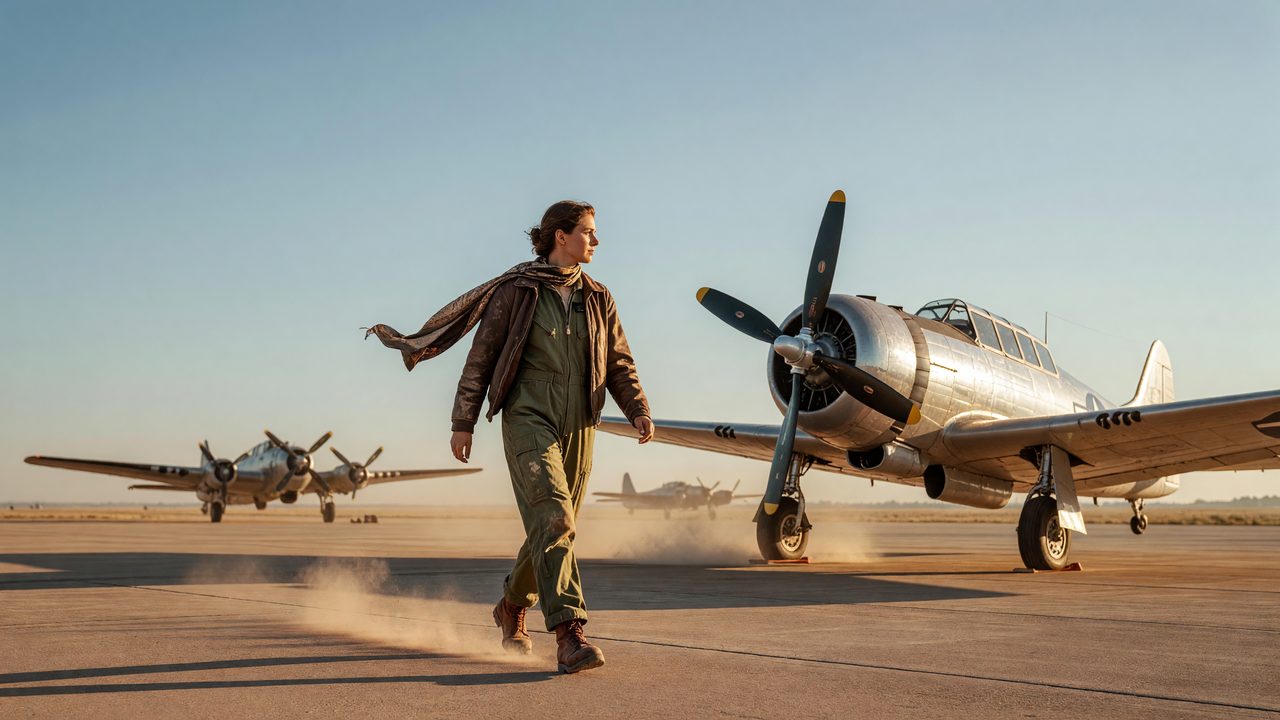
Sixty Million Miles Without a Commission
When the Army Air Forces ran short of pilots in 1942, two civilian women persuaded Washington to put others like them in cockpits—and proved they could fly everything on the flight line.
A shortage, and two audacious answers
By 1942 the U.S. Army Air Forces needed pilots faster than training pipelines could produce them. Every qualified aviator pulled from ferry work, gunnery instruction, or test flying was one fewer man who could be sent toward combat. Jacqueline Cochran, already a record-setting racer and entrepreneur, and Nancy Harkness Love, an experienced executive pilot, arrived at the War Department with the same counterintuitive pitch: train women to fly military aircraft stateside so male pilots could go overseas.
Their proposals did not arrive as a single package. Love’s concept took shape first as the Women’s Auxiliary Ferrying Squadron, a small cadre of experienced women ferrying aircraft between factories and airfields. Cochran envisioned something larger—a full training pipeline that would graduate hundreds of pilots to shoulder the widening burden of non-combat flying. Army Air Forces leadership accepted both. For more than a year the two efforts ran on parallel tracks, different in origin but identical in purpose.
One field, one program
On August 5, 1943, the streams merged into the Women Airforce Service Pilots, with Cochran as director. From that point forward there was only one training base: Avenger Field at Sweetwater, Texas. The west Texas wind and endless sky became the proving ground for a program that had no precedent in American military aviation.
Over roughly two years, 1,074 women graduated. They were civilians attached to the Army Air Forces, not commissioned officers. They wore uniforms, saluted, and flew aircraft the nation had built for war—but they carried identification cards, not military ID. The WASP Official Correspondence archive preserves the telegrams, letters, and bureaucratic friction of that status in real time: pilots asking for basic privileges their male counterparts took for granted, commanders negotiating what “service” meant when the nation refused to call them soldiers.
Every mission the men could not spare
What the WASP flew depended on what the Army needed that week. Ferry pilots delivered fighters and bombers from factories to embarkation points, logging distances that stagger the imagination. The Army Air Forces’ own 1944 “Report on Women Pilot Program”—the WASP Final Report—documented the scale: more than sixty million miles flown on missions that kept the training and logistics machine turning.
They towed targets so gunners could learn to lead a moving aircraft. They tested repaired ships fresh from the maintenance hangar, accepting the risk of an airplane whose faults were not yet fully known. When the B-29 Superfortress acquired a reputation for mechanical trouble and engine fires, male crews hesitated. WASP pilots climbed into the cockpits of the heaviest bombers in the inventory and flew them—demonstrating, flight by flight, that the aircraft could be handled safely with disciplined procedure and respect for its systems.
Thirty-eight women died in service. Because they were not military personnel, families often bore the cost of transporting bodies home. Burial honors that male servicemen received were denied. The telegram files and condolence letters in the WASP archive record grief compounded by institutional ambiguity.
Sent home, remembered late
General Henry H. “Hap” Arnold had defended the program when Congress balked at funding it. But by the fall of 1944 the war’s trajectory had shifted. In his notification letter “To Each Member of the WASP,” dated October 1, 1944, Arnold thanked the women for work “well done” and prepared them for the program’s end. On December 20, 1944, he inactivated the WASP. The pilots dispersed—to farms, classrooms, airline applications, and quiet lives—without GI Bill benefits, without veterans’ health care, without the commission many had expected when they first raised their right hands at Avenger Field.
For more than three decades the nation treated their service as a footnote. PBS American Experience and subsequent historical work brought their story back into public view. In 1977, Congress finally granted them veteran status—belated recognition that they had been in the war’s cockpit all along.
Why it matters to you
The WASP Final Report compared accident rates between women and men performing equivalent ferrying and utility flying. The numbers were comparable. That single finding cut through an era’s medical folklore and social prejudice—the notion that women lacked the judgment, stamina, or nerve for high-performance aircraft. For today’s student and rated pilots, the lesson is practical, not ceremonial: proficiency is measured in training, discipline, and decision-making, not demographics. When you brief a cross-country, manage an emergency, or step into an unfamiliar airframe on checkout day, you inherit a flight-training culture that was hardened in part because a thousand women at Avenger Field demonstrated, in the government’s own statistics, that the stick does not care who holds it. Fly the airplane. Trust your training. The WASP already proved the rest.