Sixteen Hours Across the Black Water
"16 hours"
Sixteen Hours Across the Black Water
On a fog-choked June morning in 1919, two exhausted Royal Air Force officers proved that the Atlantic was not an ocean—it was a runway.
The Prize and the Machine
Aviation in 1919 still measured distance in courage as much as in miles. When the Daily Mail posted a £10,000 prize for the first non-stop transatlantic flight, the challenge sat beyond the reach of ordinary aircraft. Captain John Alcock, a seasoned pilot, and Lieutenant Arthur Whitten Brown, his navigator, accepted the wager aboard a modified Vickers Vimy biplane—a lumbering twin-engine machine pressed into a role its designers never imagined.
The Vimy carried 865 gallons of fuel, transforming the bomber into a flying tank. At St. John’s, Newfoundland, ground crews cleared a makeshift field of walls and boulders so the overloaded Vimy could struggle airborne. A United Press dispatch filed that June 14 captured the moment with characteristic brevity: “Alcock, Brown, take British plane on oversea flight.” Behind those flat words lay a gamble that either man might not survive.
Into the Grey
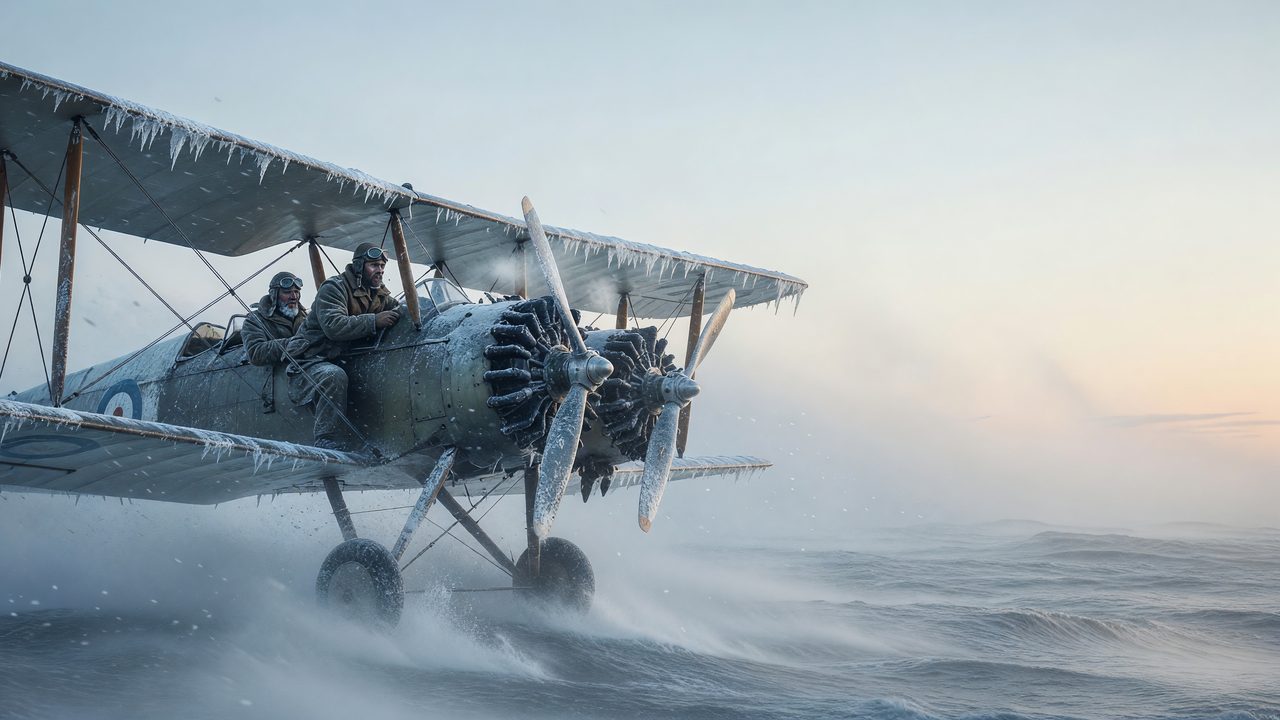
The Vimy lifted and turned east toward Ireland, and the North Atlantic answered with everything it had. Dense fog erased the horizon. Sleet encased wings and struts in ice, stealing lift and adding weight with every frozen minute. Alcock fought the controls through a sky that offered no visual references—no coastline, no stars, no distinction between cloud and sea.
At one point the Vimy entered a spiral dive so severe that the aircraft descended to within ten feet of the Atlantic swell before Alcock recovered. Brown, navigating by dead reckoning and only two star shots through brief gaps in the overcast, held a course across a featureless night. Sixteen hours and twelve minutes of sustained improvisation separated departure from any hope of land.
Landfall in Peat
At 8:40 a.m. Greenwich Mean Time on June 15, Brown sighted the Irish coast near Clifden, County Galway. Alcock brought the Vimy down into a boggy field at Derrygimlagh. The nose buried itself in peat; the wireless station staff rushed out to find Alcock temporarily deafened from engine noise and Brown dazed from exhaustion. The machine had made it. The men had made it.
Their telegram to the Vickers mechanics, preserved today in the Science Museum Group Collection, carried no flourish: “Landed at Clifden at 8:40 A.M. … Total time, 16 hours 12 minutes. ALCOCK AND BROWN.” The official cable to the Aero Club, reported in The New York Times on June 16 under the headline “Airmen Who Accomplished the First Non-Stop Transatlantic Flight,” confirmed what the aviation world had scarcely dared expect. The £10,000 prize was won. Heavier-than-air flight had crossed an ocean in a single leap.
What Changed Overnight
Contemporary observers grasped the implications immediately. Commercial Motor, in its June 24, 1919 editorial, assessed the flight’s technical and commercial significance with the clear-eyed pragmatism of an era that understood transport as infrastructure. This was not a stunt. It was proof of concept—the Atlantic could be bridged by aircraft without refueling stops, without ships, without the weeks that ocean liners demanded.
The Vimy’s flight opened aviation’s oceanic era. Within a generation, routes that Alcock and Brown had risked their lives to pioneer would become scheduled airline service. Lindbergh’s solo crossing lay eight years in the future; the jet age lay decades beyond. But the principle was established on that boggy Irish field: given enough fuel, reliable engines, and pilots willing to navigate through absolute uncertainty, the ocean was crossable.
Why it matters to you
The operational principles Alcock and Brown demonstrated on June 14, 1919, still shape how pilots operate today. Brown’s dead reckoning and those two precious star shots were instrument-free navigation under pressure—the ancestral cousin of every cross-country flight you plan with sectional charts, pilotage, and GPS backup. Alcock’s recovery from the spiral dive was stick-and-rudder skill at the edge of the envelope, the same hand-flying discipline you practice when automation fails or weather closes in. Their sixteen-hour fight through ice and fog was resource management before the phrase existed: knowing fuel endurance, managing aircraft performance degradation, and making continuous go/no-go judgments with incomplete information. When you brief a long cross-country, file an alternate, or hand-fly an approach to minimums, you are training the same competencies that carried a Vimy across 1,890 miles of North Atlantic in 1919. The ocean has not grown smaller. The skills have only been formalized.