Shock, Awe, and the New Arithmetic of Air War
"**THE FLIGHT** The air campaign began before the ground..."
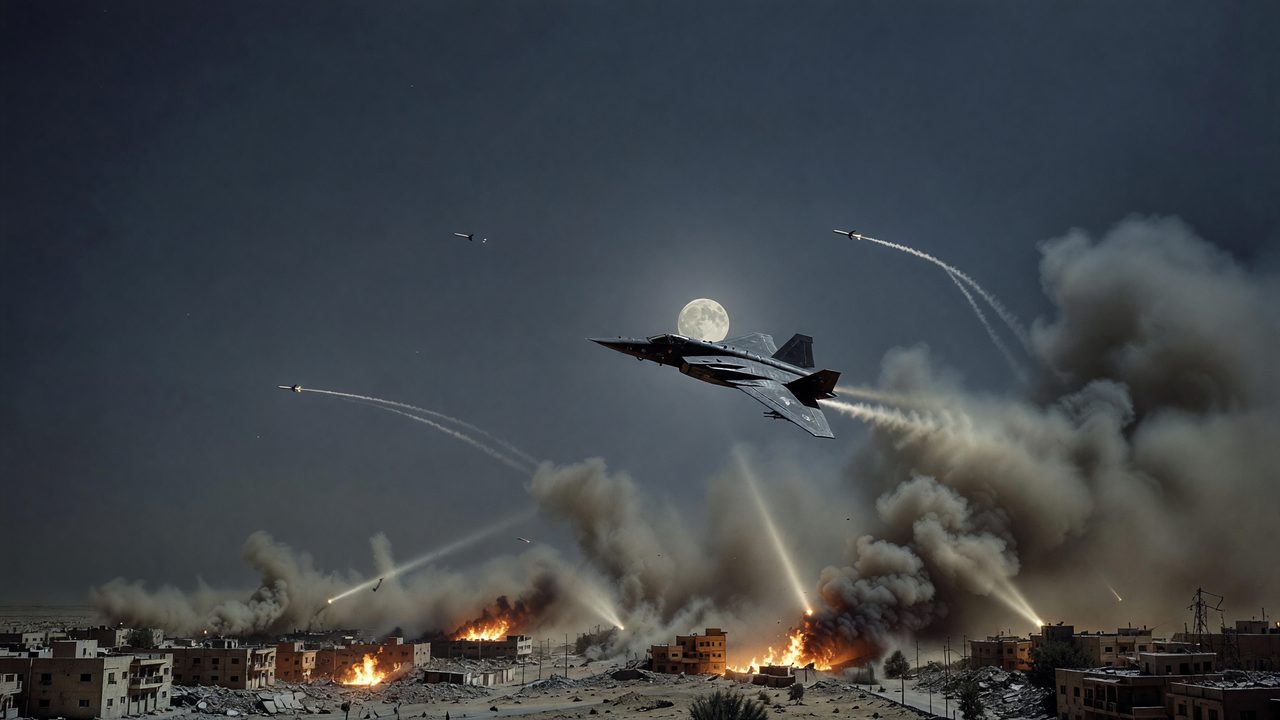
Shock, Awe, and the New Arithmetic of Air War
Operation Iraqi Freedom opened with a precision air campaign that rewrote what pilots could deliver in hours—not weeks—and student aviators still train against the standards it set.
Before the Ground Assault
Major ground combat in Iraq did not begin in a vacuum. Between 1 and 20 March 2003, coalition aircraft flew more than 4,000 sorties aimed at degrading Iraqi integrated air defenses and related targets. That preparatory air effort was deliberate: commanders wanted the opening night of major combat to find an enemy already blinded, not one still capable of contesting the skies over Baghdad.
When that night arrived, the campaign’s opening salvo combined sea-launched Tomahawk cruise missiles with F-117 strikes against leadership and command-and-control nodes in the capital. CENTCOM briefings during March and April 2003 described a tempo that would have been unthinkable a generation earlier: coalition air forces sustained nearly 1,000 sorties per day as the ground offensive unfolded. The arithmetic of munitions told the sharper story. According to a first-blush assessment by the Center for Strategic and Budgetary Assessments, roughly 68 percent of all weapons expended in Operation Iraqi Freedom were precision-guided—a figure that stood in stark contrast to the roughly 8 percent recorded during the 1991 Gulf War. Methodologies developed in earlier U.S. Government Accountability Office studies of weapon-system performance helped analysts measure that shift with rigor rather than rhetoric.
Time-Sensitive Targeting
Precision alone did not explain the campaign’s pace. Time-sensitive targeting—procedures refined during operations over Afghanistan—allowed commanders to act on fleeting intelligence within minutes of detection rather than hours or days. Lieutenant Colonel John M. Fyfe’s Air University study of Operation Iraqi Freedom results and lessons documented how that evolution changed the relationship between sensors, analysts, and cockpits. Emerging leadership targets no longer waited for the next planning cycle; they entered a kill chain measured in minutes when conditions allowed.
The most dramatic public example came on 7 April 2003, when a B-1 bomber struck a Baghdad site where intelligence indicated Saddam Hussein and his sons were meeting. Real-time reporting—not a pre-strike target folder filed days earlier—drove the attack. Whether the intended leaders were killed remained disputed, but the operational point was clear: heavy bombers could be steered by live intelligence with the responsiveness once reserved for tactical fighters on station overhead.
Air Supremacy and the Ground Picture
Air supremacy extended over more than 95 percent of Iraqi territory, a condition CENTCOM spokesmen including Brigadier General Vincent Brooks and General Tommy Franks repeatedly emphasized in their daily briefings archived from March through April 2003. That dominance freed coalition ground forces to move at speed. Marines and armored columns advanced from Kuwait to the outskirts of Baghdad in roughly three weeks, while the 173rd Airborne Brigade executed a combat parachute assault into northern Iraq—an operation that depended on friendly control of the air and on airlift timed to joint objectives.
The regime’s political collapse followed in twenty-one days. Air power had not won the war alone; infantry, armor, and logistics still closed the distance. Yet the air campaign had set the conditions, sustained the tempo, and delivered effects at a scale and accuracy that defined the opening act of Operation Iraqi Freedom.
Why it matters to you
The principles on display in March and April 2003 still shape how rated and student pilots are trained today. Degraded defenses before decisive action, disciplined sortie generation, and a high ratio of precision weapons are not historical curiosities—they are planning assumptions in modern joint doctrine. Time-sensitive targeting, in particular, demands what Cline’s study emphasized: clear procedures, reliable datalinks, and crews who can accept updated coordinates without losing situational awareness or legal accountability. Whether you fly a trainer, a tactical aircraft, or a remotely piloted platform, you inherit a profession that learned in Iraq to pair persistent surveillance with rapid strike—and to treat every weapons release as both a technical and a professional judgment. That is the legacy behind the phrase “shock and awe”: not theater, but the disciplined flight discipline that makes speed in the air translate into decision on the ground.