Seventy Thousand Feet Wasn't High Enough
"000 feet"
Seventy Thousand Feet Wasn't High Enough
On May 1, 1960, a CIA reconnaissance flight over the Soviet Union proved that altitude alone could not guarantee survival — and changed how the West thought about aircraft performance forever.
The Last Authorized Overflight
Ten days before Francis Gary Powers climbed into his cockpit, a Memorandum for Record dated April 25, 1960 — preserved in the Eisenhower Presidential Library's U-2 Spy Plane Incident collection — authorized one final deep-penetration mission before a Paris summit scheduled for mid-May. The flight would photograph Soviet missile and nuclear installations at Sverdlovsk, Kirov, Plesetsk, and Murmansk, targets that intelligence analysts considered essential to closing the perceived "missile gap."
Powers lifted off from Peshawar, Pakistan, at 0626 local time in a CIA U-2C, Bureau Number 56-6693. The aircraft was a specialized high-altitude platform: long, fragile wings, a single J75 turbojet, and a pressurized suit that kept the pilot alive where the atmosphere was too thin for a conventional cockpit. Powers climbed to his operational altitude of roughly 70,000 feet — a realm where Soviet interceptors could not reach him and, according to CIA vulnerability assessments, surface-to-air missiles were unlikely to connect.
For years, that altitude had been treated as a sanctuary. The U-2's engineering made it possible: a glider-like lift-to-drag ratio, minimal radar cross-section for its era, and a flight profile that kept the aircraft above the effective ceiling of contemporary fighters. Powers was not flying a combat mission in the conventional sense. He was operating a flying camera system along a carefully planned track, gathering imagery that policymakers believed no other method could provide.
The Missile That Reached Up
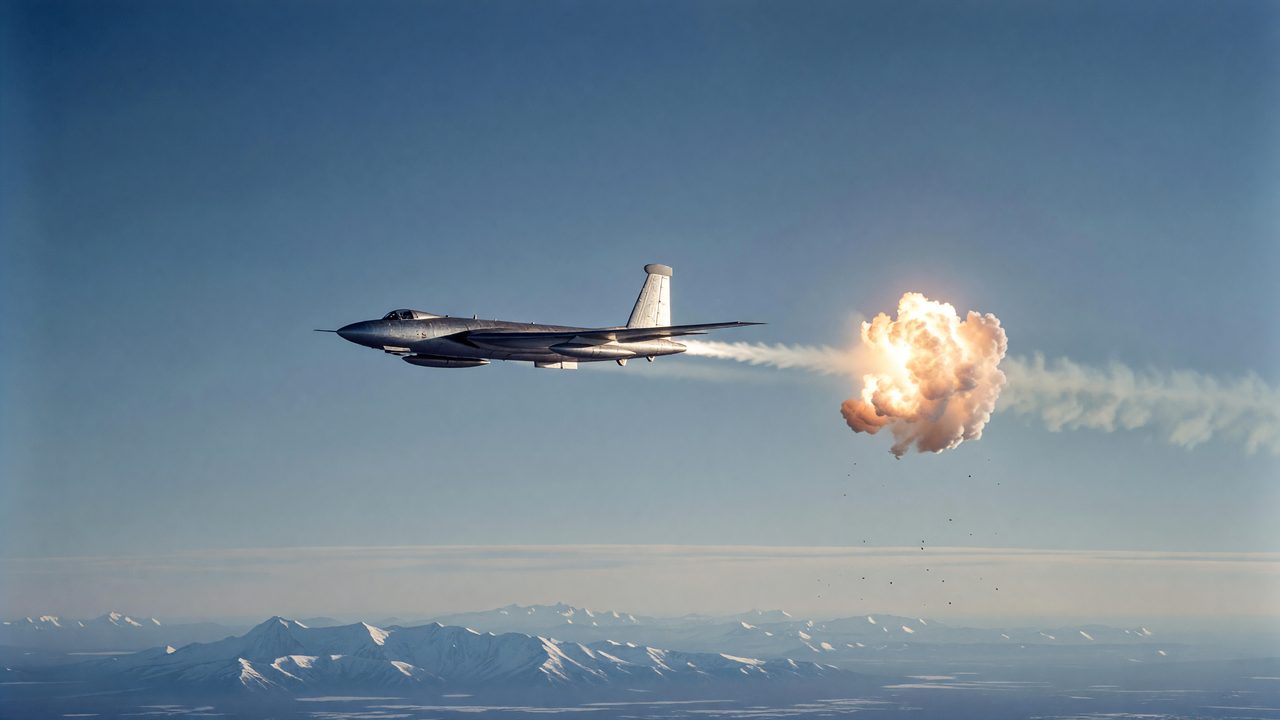
Near Sverdlovsk, roughly four and a half hours after takeoff in late morning local mission time — with Soviet missile engagements logged at about 0846–0853 — that sanctuary ended. A Soviet SA-2 Guideline surface-to-air missile detonated close enough to cripple the aircraft. The explosion damaged the U-2's control surfaces and breached the fragile airframe; Powers ejected and descended by parachute into Soviet territory. The wreckage — including the camera system and portions of the airframe — fell to earth intact enough for Soviet engineers to examine.
The shootdown was not a lucky shot. Soviet air defense forces had been tracking the overflight and coordinating multiple intercept attempts. The SA-2, designed to climb to extreme altitudes and explode in lethal proximity to its target, represented a technological answer to the U-2's altitude advantage. What CIA planners had assessed as improbable had become catastrophic reality on a single spring morning.
Diplomacy in Free Fall
Soviet Premier Nikita Khrushchev announced the shootdown on May 5, turning a covert intelligence operation into an international crisis. The timing was devastating. A Paris summit had been set for May 16, with disarmament talks at the center of Western hopes for easing Cold War tensions. Instead, Khrushchev arrived with wreckage, a captured American pilot, and a grievance that would dominate the opening session.
President Eisenhower, initially working from a cover story that described the aircraft as a lost NASA weather-research platform, found himself trapped by accumulating evidence. At his news conference on May 11, 1960 — the transcript preserved at the American Presidency Project — Eisenhower acknowledged that the overflight program existed and had been authorized for intelligence purposes. The admission ended the fiction but could not restore the summit. Khrushchev stormed out of Paris, and the prospect of a breakthrough on arms control collapsed.
Behind closed doors, the damage assessment was equally sobering. The National Security Council's Memorandum of Discussion from its 444th meeting on May 13, 1960, published in Foreign Relations of the United States, records policymakers grappling with the intelligence loss, the diplomatic fallout, and the future of aerial reconnaissance. Powers, meanwhile, faced a Soviet espionage trial, received a sentence of ten years, and was not released until February 1962, when he was exchanged on the Glienicker Bridge for convicted Soviet spy Rudolf Abel.
Beyond Altitude
The CIA's 1962 debriefing of Powers, now available through the Agency's reading room, documents the flight's final minutes from the pilot's perspective — the sudden violence of the detonation, the decision to eject, and the immediate consequences of capture. Taken together with the Eisenhower Library's authorization records and the President's public statements, the episode forms a coherent lesson in aeronautical hubris: a single performance parameter, no matter how extreme, cannot be mistaken for invulnerability.
The incident closed the era in which altitude alone could protect a reconnaissance aircraft. Within months, planners were pressing toward a successor that could outrun the missiles rising to meet it — an aircraft that would trade the U-2's slow, soaring profile for sustained supersonic cruise. The engineering principles that made the U-2 extraordinary — obsessive weight reduction, precision pressurization, aerodynamic efficiency at the edge of the envelope — did not disappear. They evolved into a new design philosophy, one that recognized altitude as necessary but no longer sufficient.
Why it matters to you
Every aircraft you fly carries performance limits defined by the same fundamental trade-offs the U-2 embodied: lift versus weight, pressurization versus structural strength, fuel endurance versus mission altitude. When you study your POH's service ceiling, calculate density altitude on a hot day, or brief a cross-country segment that pushes your aircraft toward its maximum altitude, you are working inside the same engineering logic that once convinced intelligence analysts seventy thousand feet was untouchable. The U-2 incident teaches a sharper lesson still: performance margins are not guarantees. Understanding your aircraft's true envelope — where it flies well, where it merely survives, and where a single external factor can erase your advantage — is not historical trivia. It is the foundation of sound aeronautical decision-making, whether you are photographing missile sites or planning a VFR transit over rising terrain. Altitude buys time and options. It has never bought immunity.