Seventy-Eight Days Over Kosovo
"**THE FLIGHT** Beginning on the evening of 24 March 199..."
Seventy-Eight Days Over Kosovo
In the spring of 1999, fourteen NATO nations waged the most precise air campaign in history—and proved that disciplined strike planning could end a regional war without putting a single allied aircrew in an enemy’s gunsights.
On the evening of 24 March 1999, President William J. Clinton informed congressional leaders that U.S. forces had joined NATO allies in launching airstrikes against targets in the Federal Republic of Yugoslavia. The stated aim was to compel President Slobodan Milošević to halt the campaign of ethnic cleansing underway in Kosovo, accept a negotiated settlement, and withdraw Serbian security forces from the province. What followed was Operation Allied Force: seventy-eight days of sustained coalition air warfare that would test every assumption NATO had formed about fighting in Europe after the Cold War.
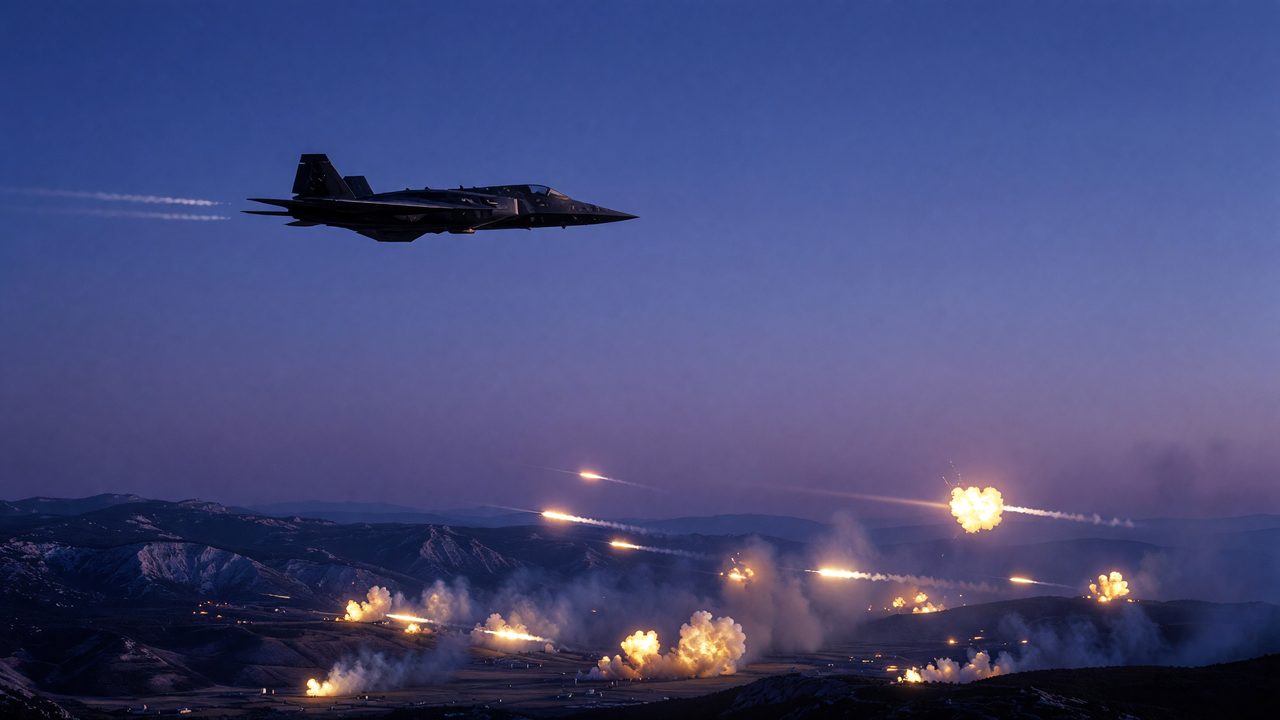
The opening hours belonged to suppression. At a press briefing on 25 March, NATO Secretary General Javier Solana and Supreme Allied Commander Europe General Wesley Clark described the first phase as a direct assault on Yugoslavia’s integrated air defense system, command-and-control nodes, and the military infrastructure supporting operations in Kosovo. Aircraft from thirteen alliance nations—American, British, French, German, Italian, Dutch, Belgian, Canadian, Danish, Norwegian, Portuguese, Spanish, and Turkish—flew into a dense, Soviet-era air-defense network that had been hardened by years of sanctions-evading ingenuity. Wild Weasel crews and standoff jamming aircraft worked ahead of strike packages; HARM missiles hunted radar emissions while precision bombers waited on station, cleared to release only when positive identification and collateral-damage estimates satisfied strict rules of engagement.
The operational tempo never relented. Over the life of the campaign, NATO flew more than 38,000 sorties and expended roughly 28,000 high-explosive munitions. Yet the numbers tell only part of the story. In their January 2000 report to Congress, Secretary of Defense William S. Cohen and Chairman of the Joint Chiefs General Henry H. Shelton emphasized that Allied Force achieved its military effects with a degree of accuracy previously unattainable in large-scale conflict. Laser-guided bombs, satellite-aided JDAMs, and cruise missiles from ships and bombers allowed planners to isolate individual buildings inside larger complexes, to cut electrical grids without flattening surrounding neighborhoods, and to attrit fielded forces moving under concealment. When an F-117 Nighthawk fell to a Serbian missile battery on 27 March, the pilot ejected safely—the first of two manned combat aircraft losses to enemy fire. An F-16 pilot would also survive a shoot-down later in the campaign. No NATO aircrew died in combat.
That safety record was not accidental. It reflected deliberate choices in the briefing room as much as skill in the cockpit. Planners built no-strike zones around schools, hospitals, and religious sites; pilots were expected to abort if targeting data degraded or if weather obscured the aim point. The campaign’s critics argued that air power alone could never dislodge entrenched ground forces; its defenders pointed to the accumulating destruction of bridges, refineries, barracks, and leadership communications that slowly narrowed Milošević’s options. On 3 June, he accepted NATO’s terms. Serbian units began withdrawing from Kosovo, and by 10 June the province lay open for the return of displaced Albanian civilians under allied protection.
Benjamin S. Lambeth’s strategic assessment for the RAND Corporation, published in 2001, placed Allied Force in a larger arc. It was the third time in the 1990s—after Desert Storm and Operation Deliberate Force over Bosnia—that coalition air power had proved decisive in shaping the outcome of a regional conflict. Kosovo added a new wrinkle: the fight was waged entirely from the air, without a parallel NATO ground offensive, and it was fought under the political constraint of minimizing both civilian casualties and alliance losses.
Why it matters to you
The habits forged over those seventy-eight nights still sit at the center of how rated pilots and students train today. Allied Force treated every sortie as a joint problem: strike leads, electronic-warfare crews, tanker and AWACS controllers, and intelligence officers had to share a single, time-sensitive picture before weapons could fly. ROE were not footnotes in a briefing—they were gate checks that could scrub a target seconds from release. Precision was not a luxury; it was the baseline that kept the campaign politically sustainable. Whether you are learning to read a nine-line CAS brief, practicing threat reactions in a simulator, or studying how weather and collateral-damage estimates drive go/no-go calls, you are rehearsing the same operational logic that fourteen NATO nations depended on in 1999: know the system you are entering, trust only verified coordinates, and execute with enough discipline that the right weapon hits the right aim point—and nothing else.