Seven Women, One 727, and a Morning That Rewrote the Roster
"Seven women, one 727, and a flight schedule written in lipstick and determination."
Seven Women, One 727, and a Morning That Rewrote the Roster
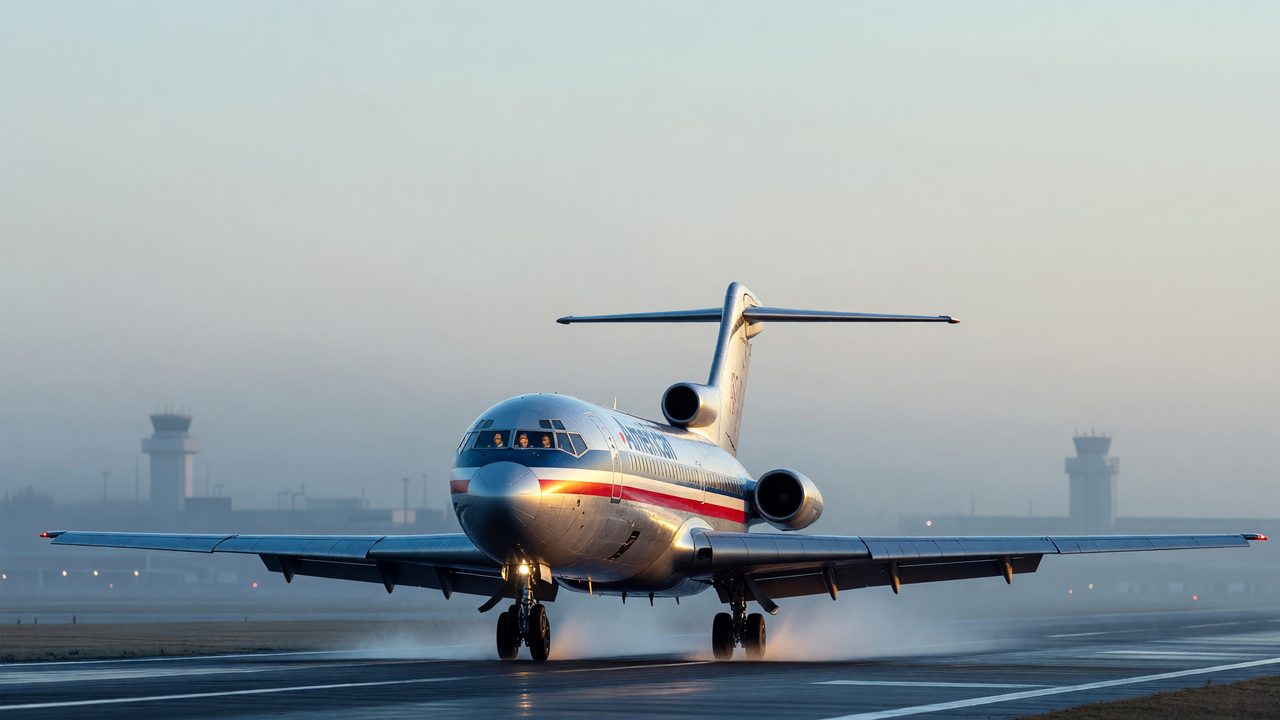
On a foggy December morning at Dallas–Fort Worth, American Airlines Flight 412 proved that a fully female flight deck and cabin crew was not a corporate stunt—it was a schedule the crew built themselves.
A First That Arrived on Time
Tuesday, December 30, 1986, broke gray and damp over North Texas. American Airlines Flight 412, a Boeing 727 inbound from Washington, D.C., descended through fog and touched down at Dallas–Fort Worth International Airport at 8:52 a.m. The arrival itself was routine. The crew roster was not.
Contemporary wire coverage from UPI Archives, headlined “All-female flight crew is aviation first,” reported what observers at the gate already sensed: for the first time on a U.S. commercial jetliner, seven women staffed every position from the cockpit to the cabin. Captain Beverly Bass of Arlington, Texas, commanded the flight. First Officer Terry Claridge sat beside her. Flight Engineer Tracy Prior completed the flight deck. Four flight attendants—Sally Houston, Beverly Donawa, Nancy Hayth, and Alice Chedister—cared for the cabin. When the trio on the flight deck stepped off the aircraft, red roses pinned to their lapels, roughly 150 passengers and onlookers crowded Gate 35 to greet them.
American Airlines had not engineered the moment. The women had.
Persistence, Not a Committee
Airline spokesman John Hotard told reporters that management held no plan to make aviation history that morning. The crew assembled the flight through the ordinary mechanics of airline life: trading trips, coordinating with other crews, and patiently aligning schedules until all seven positions belonged to women.
Bass, then flying reserve, swapped flights with another pilot. Claridge and Prior worked through their own scheduling puzzle. The cabin team fell into place the same way. “The women arranged this themselves,” Hotard said. Flight Engineer Prior later put the achievement in plain terms: a flight like this had been inevitable; she was glad to be aboard when it happened.
That grassroots assembly matters. Major airlines do not typically hand crews historic milestones on a silver catering cart. This one arrived because seven professionals who already belonged in the system chose to stand on the flight line together—and made the logistics work.
The Captain Who Had Already Broken the Ceiling
Six weeks earlier, Bass had earned a distinction no American Airlines woman had held before: captain’s stripes on a commercial jet. She was, by company account, the airline’s first female captain. Flight 412 did not create her authority; it displayed it. In the fog over DFW, Claridge reportedly flew one of the smoothest landings Bass had seen. The work spoke for itself.
American Airlines later confirmed the flight in its corporate history. A 2021 press release marking International Women’s Day described the December 1986 operation as the first U.S. flight crewed entirely by women and reproduced a photograph of the seven crew members beside their 727—standing, Bass between Claridge and Prior; kneeling, the four flight attendants who completed the cabin team. Decades on, the image reads less like a publicity still than like evidence: these were working airline employees on a working airline airplane, not symbols assigned to a ceremonial hop.
From One 727 to a Broader Flight Deck
The industry did not transform overnight. Women had been pushing against aviation’s gender barriers since the earliest days of powered flight. Bass’s captaincy and the Flight 412 roster marked progress inside a major U.S. carrier, not the finish line.
The arc stretches forward. When American marked International Women’s Day in March 2021, Flight AA2808—a Boeing 787 from Miami to DFW—operated with an all-female crew led by Captain Linda Pauwels, supported by women across check-in, ramp, dispatch, and air traffic control. Pauwels credited pioneers including Beverley Bass by name. Commemorative flights remain symbolic, but they trace a line from a foggy 727 arrival to widebody jet service staffed by pilots who no longer need to trade shifts to prove they belong.
Bass’s story eventually reached audiences far beyond the airline ramp. After commanding American Airlines Flight 49 (a Boeing 777) diverted to Gander, Newfoundland, on September 11, 2001, she became a central character in the Broadway musical Come From Away—a reminder that the same captain who assembled history in 1986 would later embody calm command under extraordinary pressure.
Why it matters to you
Which American Airlines captain, later celebrated in a Broadway musical, led the airline’s first all-female crew in 1986? Beverly Bass—whose reserve-line schedule trades made Flight 412 possible. Her career points to a CRM lesson every student pilot and rated crewmember trains today: effective crews are built through coordination, clear roles, and mutual trust, not hierarchy for its own sake. Bass, Claridge, and Prior did not share a cockpit because a committee ordained it; they aligned schedules, briefed as a team, and flew a foggy approach to a standard Bass later called one of the finest she had witnessed. Modern CRM formalizes what that morning demonstrated—that authority flows from competence and communication. Whether you are pairing with a new instructor, splitting duties on a cross-country, or briefing an approach in low visibility, the question is the same one seven women answered in 1986: Can this crew function as one professional unit? On December 30, aboard a Boeing 727 in Texas fog, the answer was yes—and aviation took notice.