Seven Suits, One Nation, No Ceiling
"On a spring afternoon in the ballroom of the Dolley Madis..."
Seven Suits, One Nation, No Ceiling
On a spring afternoon in 1959, seven military test pilots stepped from anonymity into history—and proved that the skills forged in cockpits would define the Space Race.
The ballroom where the sky changed
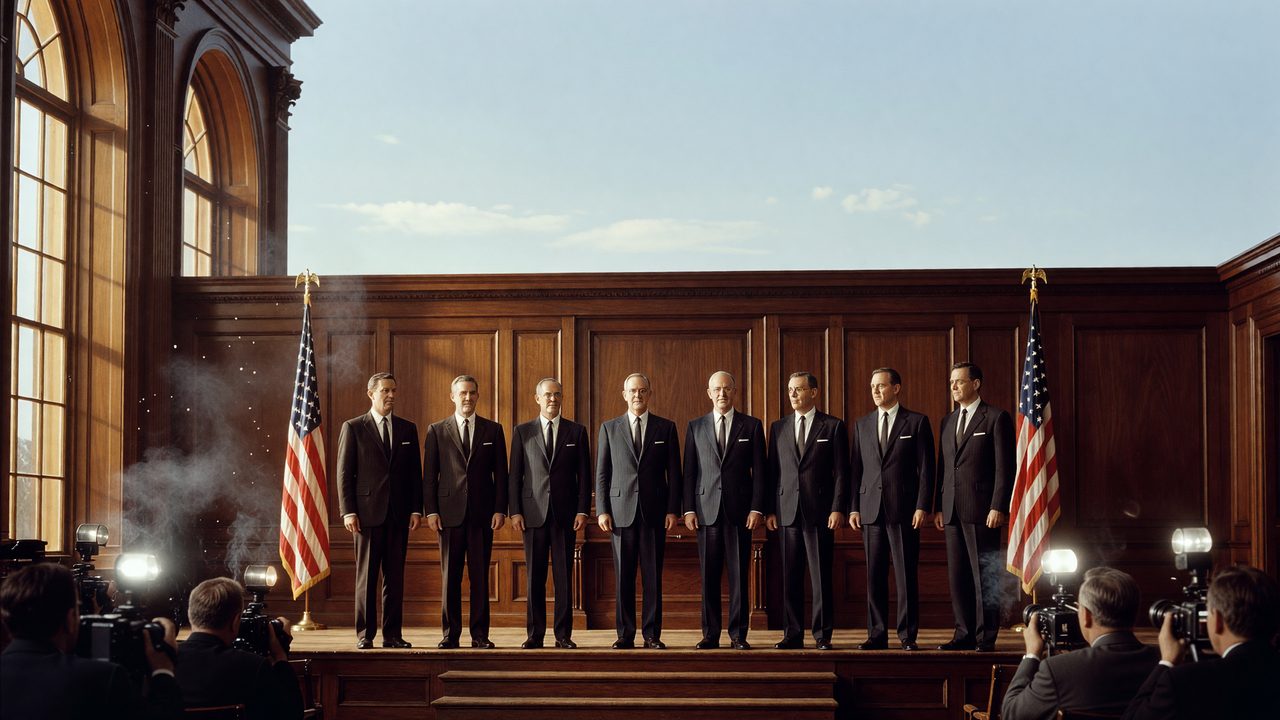
The chandeliers of the Dolley Madison House ballroom on Lafayette Square had hosted Washington society for generations. On April 9, 1959, they lit a different kind of gathering. NASA Administrator T. Keith Glennan stood before a bank of microphones and introduced seven men seated at a long table on a makeshift stage. They wore plain civilian suits, not flight gear. Most Americans had never heard their names. Within the hour, Malcolm S. Carpenter, Leroy G. Cooper, John H. Glenn, Virgil I. Grissom, Walter M. Schirra, Alan B. Shepard, and Donald K. Slayton would be known everywhere as the Mercury Seven—the first American astronauts.
The agency presenting them was itself barely six months old. Project Mercury, approved in October 1958, was racing to answer a question the Soviet Union had already sharpened into a national anxiety: could a human being survive and function beyond the atmosphere? Glennan read the names in alphabetical order, then turned the floor over to reporters. For the next ninety minutes, the seven fielded questions about weightlessness, reentry, and fear—subjects none of them could answer from experience, because no American had yet flown in space. By the time cameras stopped flashing, each man understood that public scrutiny would be as permanent a part of the job as any checklist.
Five hundred records, one impossible choice
The seven men in those suits were not lucky picks. They were survivors of the most demanding personnel selection in American aviation history. In January 1959, NASA screened 508 military test-pilot service records. One hundred ten met minimum standards for age, height, education, jet experience, and physical condition. Sixty-nine volunteered for interviews and exhaustive medical and psychological testing—first at the Lovelace Clinic in Albuquerque, New Mexico, then at the Wright Aeromedical Laboratory in Ohio.
The process was led by Charles J. Donlan, assistant project manager of the Space Task Group, and Robert R. Gilruth, its director. NASA had no precedent for choosing humans to ride rockets; President Dwight D. Eisenhower had directed that candidates come from the ranks of military test pilots, where records, clearances, and medical histories already existed. What emerged from the clinics was not a spread of talent but a cluster of excellence. The final eighteen candidates were so uniformly qualified that the committee could not comfortably reduce the roster to six. Gilruth recommended seven—a full crew with a spare pilot for the demanding flight schedule ahead.
All seven were highly educated test pilots—only Cooper, Grissom, and Slayton held completed engineering bachelor's degrees at selection; Glenn and Carpenter finished degrees later; Shepard and Schirra held USNA B.S. degrees—husbands and fathers in physical condition beyond any standard previously applied to military flyers. They were not selected for celebrity. They were selected because Project Mercury needed human focal points for a program still inventing itself—men who could translate cockpit discipline into a spacecraft no one had yet flown.
Test pilots at the edge of the known
The Space Race gave urgency to their appointment. Sputnik’s beep in 1957 had announced that Earth orbit was no longer theoretical. By the spring of 1959, America’s answer was a compact capsule, a Redstone or Atlas booster, and these seven pilots, who would train at Langley while McDonnell Aircraft built the hardware in St. Louis. They insisted on windows, manual controls, and direct involvement in cockpit design—habits learned in experimental aircraft, where the pilot who understood the system was the pilot who came home.
Shepard would become the first American in space in 1961. Glenn would orbit Earth the following year. Grissom, Schirra, and Cooper would extend Mercury’s reach flight by flight. Carpenter would fly Aurora 7. Slayton, grounded by a medical condition before his Mercury mission, would wait sixteen years and fly Apollo-Soyuz in 1975. Their trajectories diverged, but their origin did not: each had been forged in the unforgiving culture of military test flying, where engineering knowledge, physical readiness, and calm under pressure were not résumé lines—they were survival skills.
From press conference to program backbone
The Dolley Madison House introduction was theater, but the work that followed was not. Within weeks the seven reported to the Space Task Group for orientation and a training syllabus that covered spacecraft systems, escape procedures, and the global tracking network still under construction. They were symbols for a anxious nation, yet they remained working pilots—reviewing instrument panels, arguing for manual backup controls, and logging flight time between classroom sessions.
NASA’s April 1959 announcement, documented in the agency’s Project Mercury: A Chronology and the contemporaneous Mercury Astronaut Selection Fact Sheet, marked the moment America committed to putting humans on top of ballistic missiles. The seven men in civilian suits looked ordinary that afternoon. The program they carried forward was anything but.
Why it matters to you
The judgment and discipline on display that spring afternoon in the Dolley Madison House ballroom are the same qualities that define airmanship today. The Mercury selection funnel—hundreds screened, dozens tested, seven chosen—was really a search for pilots who could manage unknown risk with method and composure. That is precisely what your training builds: knowing your aircraft’s systems well enough to improvise when something fails, maintaining standards when the situation is novel, and accepting that the public may never see the preparation behind a clean outcome. You may never ride a booster off the pad, but every time you brief a flight, respect your personal minimums, and fly the procedure when instinct wants a shortcut, you are practicing the same professional habit that let seven test pilots carry a nation’s hopes beyond the atmosphere.