Seven Hours Over Empty Ocean
"Seven hours in a Mustang cockpit. Three hours over Japan. One chance to get home."
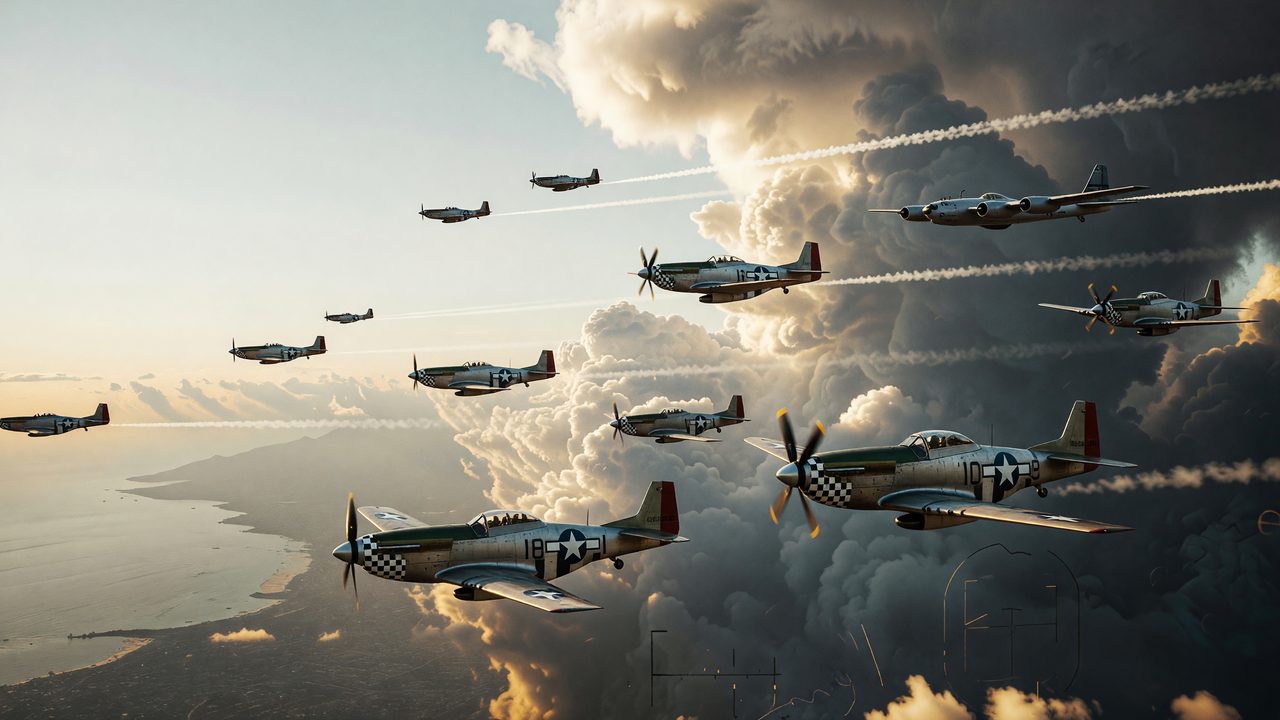
Seven Hours Over Empty Ocean
From a sulfurous rock halfway to Tokyo, VII Fighter Command’s P-51 Mustangs proved that escort fighters could reach the enemy’s capital — if their pilots could survive the flight home.
The Rock That Bought Range
February 1945 turned Iwo Jima into one of the Pacific War’s costliest invoices. When the Marines declared the island secure on March 16, American casualties had passed 24,000 — a staggering price for eight square miles of volcanic ash. Air planners had not fought for beaches and tunnels alone. Iwo sat between the Marianas bomber bases and Honshu, close enough that a P-51 carrying external tanks could reach Tokyo, fight, and return. For XXI Bomber Command’s B-29s, battered over the Empire by interceptors and the 1,500-mile over-water haul back to Guam and Tinian, that geography changed everything.
VII Fighter Command — the “Sunsetters,” named for their seven-rayed command insignia — began moving onto Iwo’s scraped runways while fighting still raged inland. By early April, the 15th and 21st Fighter Groups were flying P-51Ds they had barely broken in. According to the command’s operational history, no land-based fighter had ever been asked to fly a routine combat mission this far over open water.
First Trip to the Empire
On April 7, 1945, 119 Mustangs of the 15th and 21st Groups took off on the first Very Long Range escort mission in history. Their charge was a B-29 strike on the Nakajima aircraft plant west of Tokyo. After liftoff through the familiar reek of sulfur, formations rendezvoused with navigator B-29s north of Iwo, then tracked roughly 660 nautical miles toward Honshu. Off the coast they joined the bomber stream. Japanese fighters rose as they always had on Empire raids — only this time, P-51s waited above them.
The Sunsetters claimed 21 enemy aircraft that day. Gun-camera film and after-action accounts from the mission describe interceptors caught at the worst moment: committed to the bombers, slow to see Mustangs breaking off in pairs from the escort boxes. Major James Tapp of the 78th Fighter Squadron scored multiple victories; pilots across both groups added to the tally. B-29 crewmen who had watched formations take losses on earlier raids saw something unprecedented in the Central Pacific — friendly fighters over Japan, staying with the bombers through the bomb run.
Survival Was the Mission
Combat over Tokyo lasted less than an hour. The other six hours belonged to fuel arithmetic, navigation, and rescue geometry.
VII Fighter Command built an ocean-going safety net detailed in its April 7 mission planning and refined through the summer. Navigator B-29s — homing aircraft whose AN/ARA-8 radios gave pilots an “Uncle Dog” bearing between the U and D tones — led fighters outbound and held at the rally point off Japan until the escorts returned. Along standard routes, submarines, B-29 “Super Dumbo” rescue aircraft, destroyers, and specially equipped P-51s with deployable rafts waited at stations spaced along the return leg. A pilot who could not reach Iwo was taught to ditch within sight of that chain. Amphibious vehicles on the beaches caught the unluckiest who reached the island on fumes and nothing else.
The Mustang made the gamble survivable, not comfortable. With 165-gallon drop tanks and a full fuselage tank for the outbound leg, a P-51 took off nearly a ton overweight — tail-heavy, sluggish in turns, notorious for poor ditching characteristics. Pilots nursed Packard Merlins at lean mixture for hours in cockpits that never stopped vibrating. Weather fronts between Iwo and Japan aborted more missions than the Japanese did. When fog swallowed the runways, entire groups could miss diversion fields and fall out of radio contact over empty ocean.
Five Months at the Edge
Between April and August 1945, Iwo-based Mustangs flew 51 VLR missions against Japan. The VII Fighter Command Statistical Survey of August 15, 1945, recorded 4,172 effective sorties and 206 Japanese aircraft destroyed in the air by Sunsetter pilots. The 506th Fighter Group, arriving in May, shared the rotation and the losses — including June 1, when weather and fuel hunger cost 25 pilots in a single day the groups called Black Friday.
The P-51 was the right machine: fast enough to overhaul Japanese interceptors, economical enough to loiter over the target for more than an hour, and lethal when paired with the K-14 computing gunsight that solved deflection for crossing shots. But the numbers frame only part of the story. No Pacific fighter before the Iwo campaign had escorted bombers to Japan’s capital and made the round trip routine. When August missions brought the last aerial victories near Tokyo, the Sunsetters had delivered what strategic air power in the Marianas had needed since late 1944 — friendly fighters over the Empire, and enough of them coming home to fly again tomorrow.
Why it matters to you
Modern flight training treats fuel, navigation, and systems management as separate checkride topics. Over Iwo they were one problem. The P-51’s range — stretched by external tanks and painstaking engine leaning — put fighters where the bombers needed them; the K-14 gunsight turned that fleeting presence into accurate fire on crossing targets. Range bought station time; the gunsight bought results from the fuel you had left. Today you practice fuel planning, diversion decisions, and intercept geometry under far gentler conditions, but the logic is unchanged. Endurance without precision is a patrol. Precision without endurance never reaches the fight. The Sunsetters had to master both, seven hours at a time, over an ocean that offered no alternate airport.