Runway Ends and Empty Skies: How the B-52 Held the Cold War in Check
"waiting for the war to start."
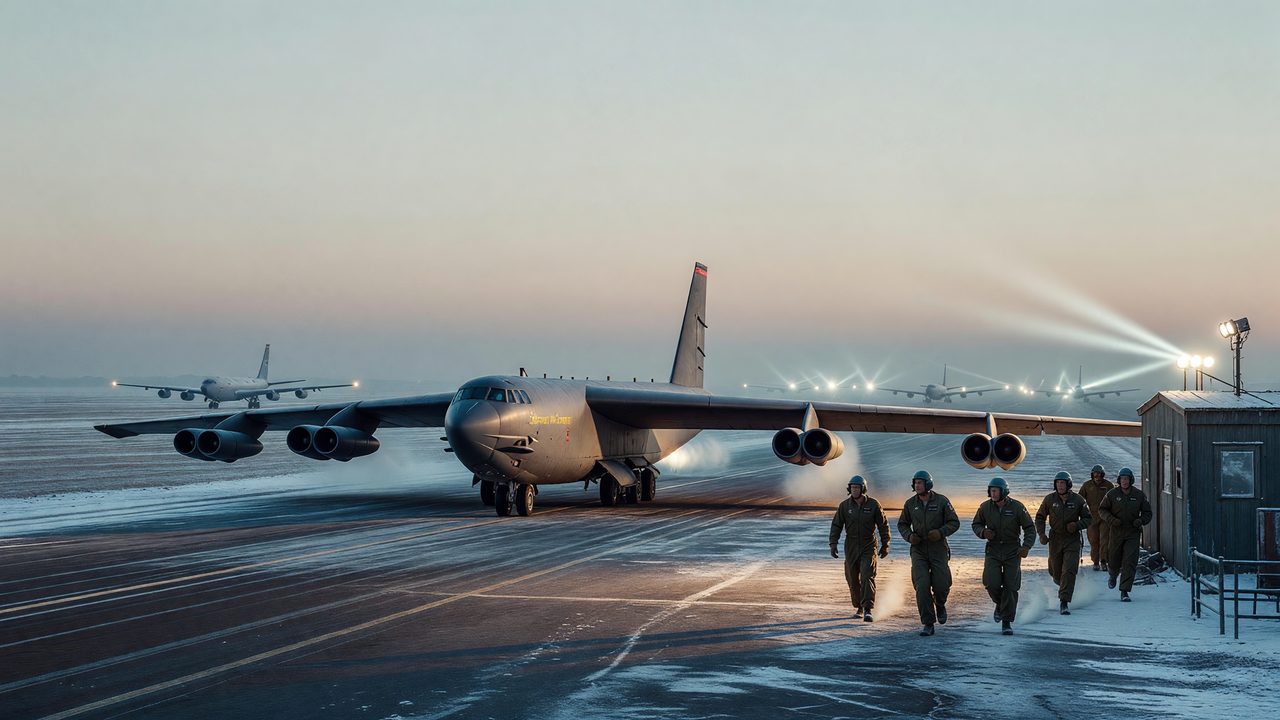
Runway Ends and Empty Skies: How the B-52 Held the Cold War in Check
The Stratofortress was built to drop bombs. Under Strategic Air Command, it learned a harder job: making sure the war never started.
When the Boeing B-52 Stratofortress entered operational service in 1955, the aircraft looked like the future of strategic bombing: eight turbojet engines, intercontinental range, and a bomb bay sized for thermonuclear weapons. Yet the airplane’s defining Cold War role was not forged in its first year aloft. It took shape in the late 1950s under the hard-edged culture of Strategic Air Command—first under General Curtis LeMay, then under his successor, General Thomas S. Power—as intelligence on Soviet intercontinental ballistic missile development began to reshape American war planning.
The central fear was brutally simple. If an enemy could destroy SAC’s bombers on the ground in a surprise attack, the United States might lose the ability to strike back. Power’s answer was alert: not a training exercise, but a standing operational posture that kept a fraction of the bomber force perpetually ready to launch. According to SAC History Study #129, The SAC Alert System 1956-1970—declassified through the National Security Archive—SAC began formal ground alert operations on October 1, 1957. B-52s and their tanker companions sat at the ends of runways, nuclear weapons loaded, crews billeted close enough to reach their aircraft within minutes. By 1960, one-third of the bomber force lived in that condition.
Ground alert changed the arithmetic of deterrence. An adversary contemplating a first strike could no longer assume that American heavy bombers would still be parked and vulnerable when warheads arrived. The visible presence of ready aircraft—and the crews who maintained them—became part of the message itself. SAC’s own histories and later Air Force Global Strike Command summaries of alert operations, drawing on General Power’s memoranda, describe alert not as a temporary crisis measure but as the new normal of strategic readiness.
Airborne alert carried the logic one step further. Beginning with operations such as HEAD START and continuing under programs later known as CHROME DOME, B-52s flew around-the-clock sorties with nuclear weapons aboard, prepared to divert toward Soviet targets on short notice. A Joint Chiefs of Staff memorandum on the SAC Airborne Alert Indoctrination Program, dated December 5, 1965, reflects how seriously the Pentagon treated these missions: they required dedicated indoctrination because the operational and psychological demands were unlike anything else in the Air Force. By 1961, SAC had flown more than 6,000 alert sorties. That same year, at President John F. Kennedy’s direction, the ground alert commitment expanded to 50 percent of the force by July 1961. Crews darkly joked that they were “waiting for the war to start.”
The B-52 never delivered the nuclear attack it was engineered to perform. That absence of use was, in strategic terms, the point. The aircraft became the most recognizable symbol of America’s airborne deterrent—the machine that made a disarming first strike look less like opportunity and more like suicide. Declassified SAC alert documents held at the National Security Archive, spanning 1956 to 1970, record the bureaucratic machinery behind that posture: duty rosters, dispersal plans, tanker support, and the relentless expansion of a system designed to keep at least part of the bomber force always beyond an enemy’s reach.
Why it matters to you
The engineering and crew discipline that made SAC alert credible did not vanish when the Cold War ended. Time-critical launch procedures, fuel planning for missions measured in hours rather than minutes, checklist rigor under fatigue, and the habit of treating every aircraft system as part of a larger mission chain—all of that still shapes how rated pilots train today. Modern general aviation and airline operations rarely involve nuclear weapons, but they constantly demand the same underlying skills: knowing your aircraft’s limits cold, briefing contingencies before engine start, and maintaining procedural precision when the margin for error is thin. The B-52 crews who sat at runway ends and circled the Arctic on CHROME DOME missions practiced a form of readiness every pilot recognizes—the disciplined assumption that you may have to fly, right now, with everything already on the line. That inheritance is still in the cockpit with you.