Poyekhali: Yuri Gagarin and the Flight That Opened the Sky
"He orbited Earth in 108 minutes. He had no control over his spacecraft. And he became immortal."
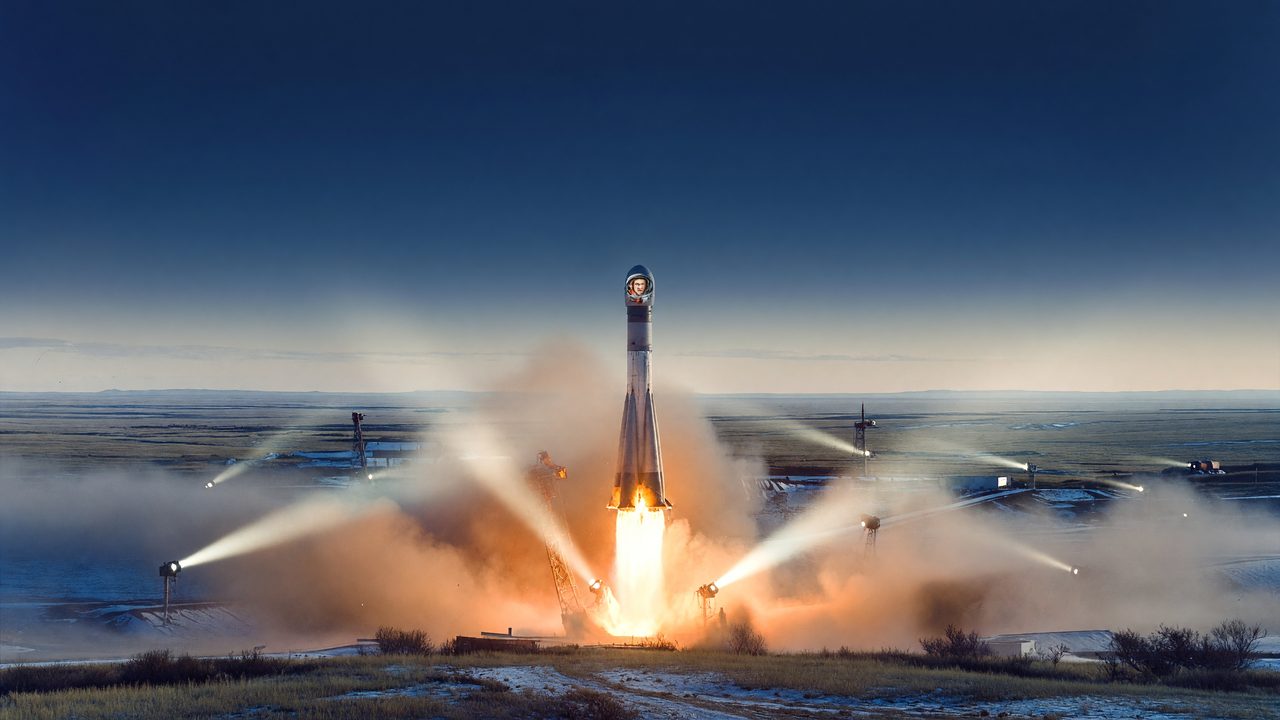
Poyekhali: Yuri Gagarin and the Flight That Opened the Sky
On April 12, 1961, a 27-year-old Soviet Air Force pilot rode a fully automated capsule into orbit, proved a human being could survive the journey, and returned to Earth as the most famous aviator alive — though the story the world was told was not quite the whole story.
When Yuri Alekseyevich Gagarin lifted off from the Baikonur Cosmodrome in Kazakhstan aboard Vostok 1, he was not there to fly the spacecraft in any conventional sense. Soviet engineers had built Vostok as an automated system; Gagarin’s assignment, as Roscosmos mission records and NASA’s Vostok 1 documentation both describe it, was to endure the acceleration of launch, function in weightlessness, survive reentry, and report what he experienced. At the moment of liftoff he radioed a single word that would echo through aviation history: Poyekhali — “Let’s go.”
The flight lasted 108 minutes. Vostok 1 completed one circuit of Earth at an altitude reaching roughly 187 miles, traveling at speeds that dwarfed anything achieved in atmospheric flight. Gagarin watched continents scroll beneath his porthole, felt his body adjust to zero gravity, and confirmed through his own senses what ground-based medicine had only theorized: a human being could withstand orbital launch, sustained weightlessness, and the crushing forces of reentry. Materials preserved in the Russian State Archive of Scientific and Technical Documentation (RGANTD) capture the engineering logic behind the mission — a spherical capsule mounted atop a modified R-7 ballistic missile, designed to answer one urgent question before any pilot could be trusted with manual control in orbit.
What the Soviet Union announced to the world, however, omitted a critical detail. The Vostok capsule was not designed for a soft landing with a cosmonaut still inside. At approximately 23,000 feet, Gagarin ejected from the spacecraft and descended under his own parachute, touching down in a field near the village of Smelovka. The empty capsule landed separately. International aviation rules at the time, administered by the Fédération Aéronautique Internationale, required that a pilot land with the aircraft for a record to be recognized. Soviet sources admitted Gagarin ejected and landed separately from the capsule by 1971, having long presented the mission as a seamless flight from launch pad to farmland; the FAI later revised its rules accordingly. Roscosmos State Corporation flight records, once fully declassified, confirmed what Western analysts had long suspected: Gagarin’s triumph was genuine, but the landing protocol was a workaround born of engineering limits, not pilot error.
The omission did nothing to diminish Gagarin’s stature. He became an instant global icon — smiling, approachable, the embodiment of a new age. He toured the world, greeted by crowds from Cuba to India, met heads of state, and represented a Soviet Union eager to claim technological supremacy. Behind the celebrity, though, the life of a trained fighter pilot grew suffocating. Soviet authorities, protective of their propaganda asset, grounded Gagarin from further spaceflight. He remained in the cosmonaut corps, trained others, and pushed to return to active flying — the work he understood best.
On March 27, 1968, Gagarin died near Moscow at age 34 when the MiG-15UTI trainer he was flying crashed during a routine proficiency flight. He was accompanied by instructor Vladimir Seryogin. Official investigations produced no single agreed conclusion; competing theories — deteriorating weather, a bird strike, unauthorized low-altitude maneuvering — have persisted in Russian aviation literature for decades. What is not disputed is the loss: the first human to orbit Earth died not in the vacuum of space but in the familiar, unforgiving environment of a training sortie, doing what pilots do to stay sharp.
Every April 12, pilots, astronomers, and space enthusiasts worldwide mark Yuri’s Night, a celebration born from the date that changed humanity’s relationship with the sky. Gagarin’s 108 minutes did not solve every problem of human spaceflight. They proved the first and hardest proposition — that the human body could make the trip at all.
Why it matters to you
Vostok 1 was, in the language pilots understand, an extreme test of human factors under stress: sustained G-loading on ascent, sensory disorientation in weightlessness, cognitive performance under life-or-death stakes, and physiological recovery during reentry. Every one of those challenges had to be answered before NASA could commit to Mercury, then Gemini, then Apollo. When you train today — whether managing hypoxia awareness, maintaining scan discipline under workload, or trusting your instruments when vestibular cues lie — you are practicing the same fundamental discipline Gagarin embodied: stay conscious, stay reporting, stay alive. The hardware has changed beyond recognition since 1961. The pilot’s first job has not.