Pointblank: When Daylight Precision Met Night Area Bombing
"Day and night, the hammer fell"
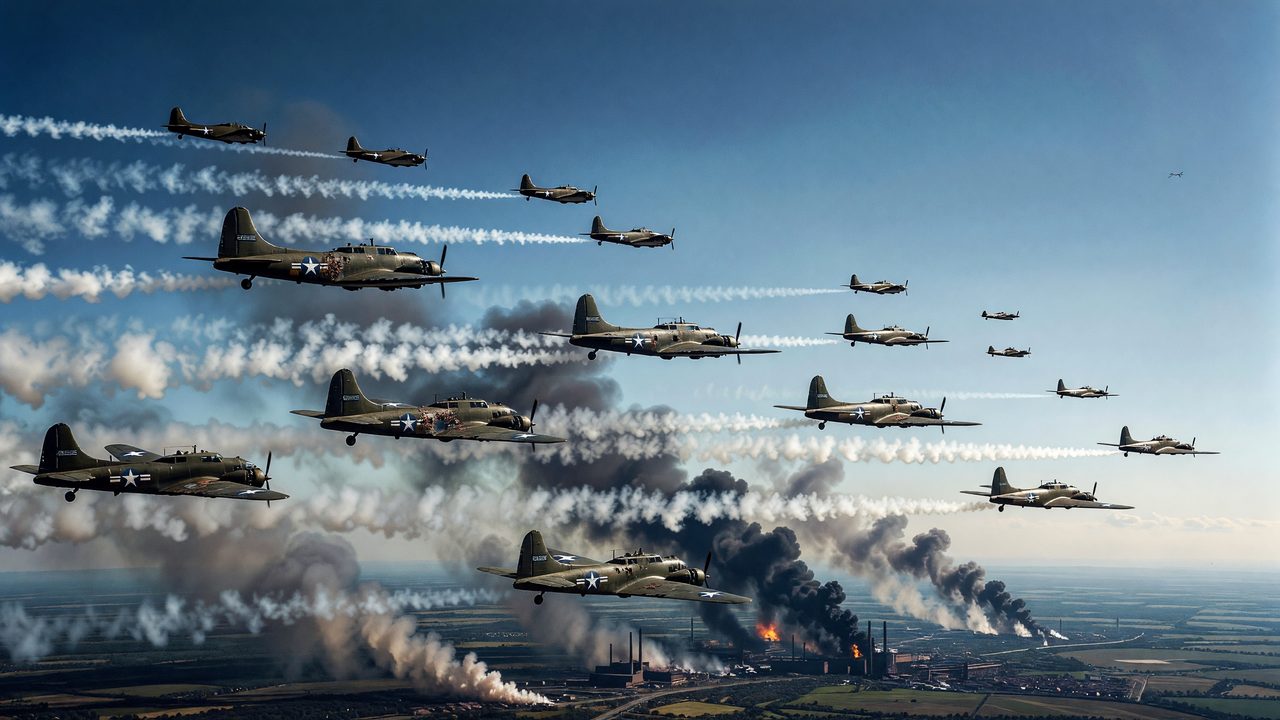
Pointblank: When Daylight Precision Met Night Area Bombing
At Casablanca the Allies pledged to wreck German industry from the air. The plan that made it work fused American daylight accuracy with British night mass—and bled the Luftwaffe dry before D-Day.
In January 1943, Allied leaders at Casablanca handed their air forces a mission of staggering ambition: conduct a joint offensive to accomplish the “progressive destruction and dislocation of the German military, industrial, and economic system” until German capacity for armed resistance was “fatally weakened”—weak enough, in plain terms, to permit a cross-Channel invasion. The mandate was strategic; the method would be industrial. What emerged was the Combined Bomber Offensive, codenamed Pointblank.
Through the spring of 1943, American and British planners translated Casablanca’s rhetoric into target lists and sortie math. Operations analysts identified roughly sixty industrial systems whose destruction could gravely impair the Axis war effort; from that work, planners selected six systems comprising seventy-six precision targets within bomber range: submarine construction yards and bases, the German aircraft industry, ball bearings, oil, synthetic rubber and tires, and military transport vehicle plants. The plan submitted to the Combined Chiefs of Staff on 14 May 1943 was not a wish list. It was a phased timetable tied to bomber build-up—944 heavies in the United Kingdom by June, rising toward more than 2,700 by early 1944. Official approval followed on 10 June 1943. Air Chief Marshal Portal, reviewing the scheme with Eighth Air Force commanders, warned that German fighter strength was climbing every week delay made the job harder. The weather window mattered. So did numbers.
Pointblank rested on a doctrinal insight that neither air force could supply alone. American and British capabilities were, as the plan stated, “entirely complementary.” The Eighth Air Force would strike specific aiming points in daylight, using pattern bombing from 20,000 to 30,000 feet against defended precision targets—engine plants, ball-bearing factories, U-boat yards. Bomber Command would complement those attacks at night, often with area bombing against the industrial cities surrounding the same objectives. Hamburg, Bremen, Hanover, Berlin, Cologne—the names were as much a target system as any factory floor. Where American bombardiers could place bombs within a thousand-foot radius of an aiming point, RAF mass could devastate the wider industrial districts that fed those plants. Timing followed tactical conditions, but the logic was fixed: related day and night blows against mutually reinforcing systems.
Yet the planners placed one objective ahead of all seventy-six targets on the master list. German fighter strength was the “intermediate objective second to none in priority.” Without beating down the Luftwaffe, deep daylight penetrations into Germany would become, in the plan’s blunt assessment, “unprofitable”—perhaps impossible. Eighth Air Force experience through early 1943 had already proved precision daylight bombing could work; it had also proved the cost. Deep missions required a minimum striking force of three hundred heavy bombers, with holding and covering forces to split German fighter concentrations on ingress and egress. Losses were not abstract. When Portal briefed the Combined Chiefs in August 1943, he reported that in July alone the Eighth had flown twenty-five attacks, dropped 3,400 tons of bombs, and suffered a 7.4 percent loss rate per mission—above its operational average of 6.7 percent. Unescorted Fortresses and Liberators paid in crews and airframes for every raid that reached the Ruhr or Regensburg.
The campaign’s rhythm was brutal and deliberate. By day, bomber formations fought through flak and fighters to hit the factories that built the fighters hunting them. By night, Lancasters and Halifaxes hammered the cities that housed the workers and subsidiary industry those factories needed. Portal told the chiefs that heavy daylight bombing eased Bomber Command’s night work by forcing Germany onto the defensive and drawing fighters westward—even, he noted, compelling the Luftwaffe to commit night fighters against daylight raids. Submarine output lagged program goals. Synthetic rubber plants shrank under American bombs. Krupp’s output fell by half or more. Still, German fighter production kept rising—thirteen percent growth in 1943 alone—and Portal urged maximum reinforcement of Pointblank before autumn, warning that delay might leave the Luftwaffe “in an unassailable position by the spring.”
The reinforcement came—not only in bombers but in fighters. P-47s and P-51s eventually escorted the heavies deep into Germany, turning the fighter battle Pointblank had been designed to win. By the spring of 1944, the arithmetic Portal had feared reversed itself. The Luftwaffe’s western fighter force, bled by factory raids and combat losses it could not fully replace, could not contest the skies over Normandy on anything like equal terms. When Allied armies waded ashore on 6 June, the bomber offensive had not merely smashed buildings; it had purchased air superiority for the invasion itself.
Why it matters to you
Pointblank is a case study in complementary capabilities—not every asset in a formation does the same job, and the whole can exceed the sum of its parts. The RAF’s night area campaign and the USAAF’s daylight precision effort pursued different tactics, different vulnerabilities, and different crew skills, yet they were sequenced against the same industrial systems so that neither force had to win alone. Modern mission planning still rests on that logic: assign each platform what it does best, coordinate timing and targeting so effects compound, and identify the enabling objective—the Luftwaffe in 1943, air superiority over the battlefield today—that must be secured before the main effort can succeed. Whether you are briefing a training sortie or reading a complex NOTAM package, the lesson of Pointblank endures: doctrine is not a single technique. It is how distinct strengths are woven into one coherent plan.