Photographs at the Brink: Reconnaissance and the Cuban Missile Crisis
"October 14, 1962"
Photographs at the Brink: Reconnaissance and the Cuban Missile Crisis
Thirteen days in October 1962 turned on what cameras saw from the stratosphere—and what pilots risked to prove it.
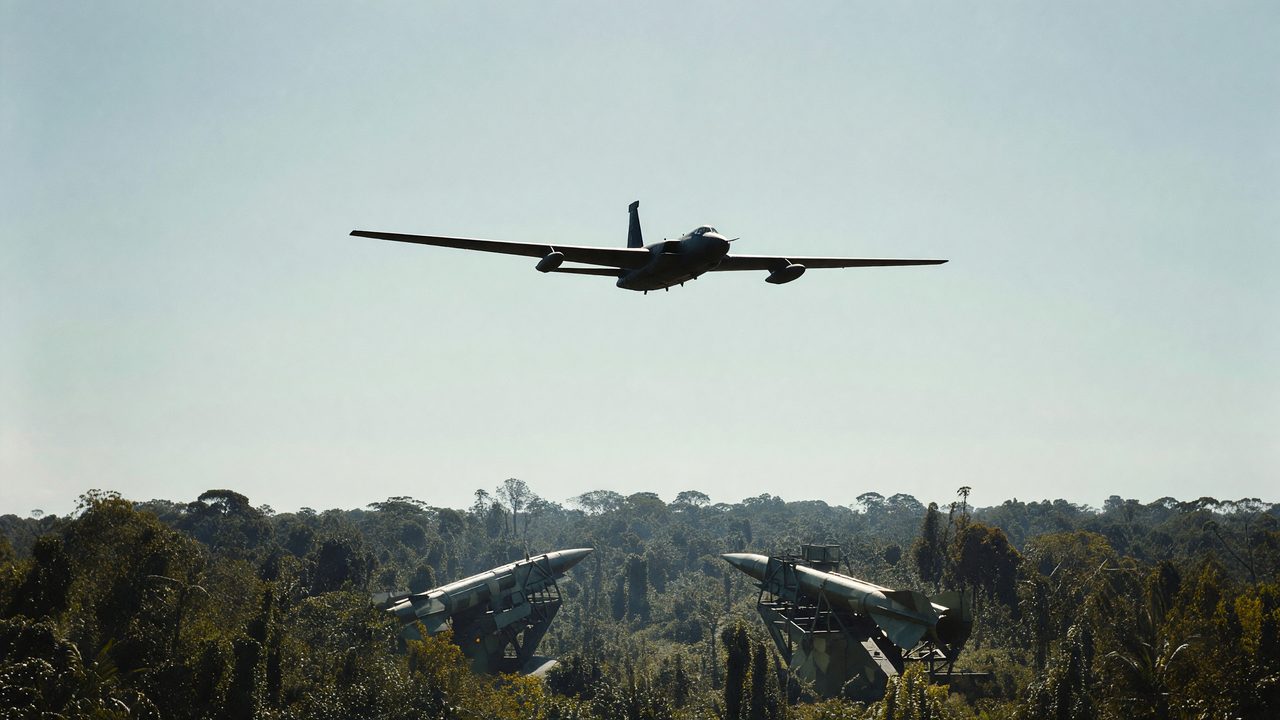
On the morning of October 14, 1962, Major Richard Heyser lifted a U-2F from Edwards Air Force Base and crossed the Caribbean at altitudes where the thin air barely sustains flight. His route carried him over western Cuba. The aircraft’s panoramic cameras recorded what human eyes at that height could not resolve: long cylindrical objects under camouflage netting, support vehicles, and construction patterns that matched nothing in the island’s existing military order. When the film reached Washington, CIA analysts working from materials later released through the agency’s Historical Review Program identified the objects as SS-4 medium-range ballistic missiles—Soviet weapons capable of reaching American cities. Intelligence had caught the deployment while it was still visible from above but not yet ready to fire.
President Kennedy was informed on the morning of 16 October 1962. The following morning, at 11:45 a.m., he convened the first meeting of the Executive Committee of the National Security Council. ExComm transcripts preserved at the John F. Kennedy Presidential Library capture officials grappling with photographs that were simultaneously evidence and accusation. The images did not merely suggest a threat; they documented a secret Soviet strategic buildup ninety miles from Florida. Every subsequent option—blockade, invasion threats, back-channel diplomacy—rested on the credibility of aerial intelligence. Without Heyser’s flight, the missiles might have reached operational status before American leaders understood what stood in the Cuban countryside.
Initial confirmation came from the U-2’s altitude and reach, but the crisis demanded finer detail. Low-level reconnaissance filled the gap. RF-101 Voodoo and F-8 Crusader pilots flew fast, dangerous passes over Cuban targets, bringing back the close imagery needed to track the missile buildup, measure construction progress, and expose Soviet deception on the ground. These missions traded the U-2’s sanctuary above most defenses for speed and resolution at treetop height. Pilots who flew them entered airspace where surface-to-air missiles and anti-aircraft guns were alert, awake, and increasingly angry. The intelligence product was no longer a single roll of film from a solitary dragonfly; it was a daily stream of proof that the Soviet deployment was real, growing, and not the innocent “defensive” installation Moscow claimed.
October 27 proved how quickly reconnaissance could ignite catastrophe. Major Rudolf Anderson, flying a U-2 over Cuba, was struck and killed by an SA-2 Guideline surface-to-air missile—the only combat fatality of the entire crisis. His death pushed the Navy to demand retaliation. Kennedy refused, calculating that answering one downed reconnaissance pilot with force could collapse the narrow diplomatic space still holding the superpowers apart. That same day, another U-2 strayed over Soviet airspace near Chukotka on the far side of the Bering Strait, nearly provoking a Soviet fighter response before the aircraft escaped. Two reconnaissance errors on one afternoon illustrated the knife edge the world occupied: the flights that prevented surprise could themselves become the cause of war.
The photographs had become the currency of confrontation. They justified the naval quarantine. They armed American diplomats in New York and Washington. They forced Moscow to choose between admitting deception or risking open conflict. When the crisis ended, it was not because reconnaissance stopped mattering, but because both sides could finally see—literally see—what the other already knew. The National Security Archive’s chronology of late October and early November 1962 records the military mobilization, the quarantine’s enforcement, and the slow unwinding that followed, all of it paced by what aircraft brought home each dawn.
Why it matters to you
The operational principles demonstrated in October 1962 still shape how pilots are trained today. Heyser’s mission rested on precise navigation, disciplined adherence to a planned route, and the understanding that a single flight could alter national policy. Low-level reconnaissance pilots managed fuel, timing, and threat exposure while extracting usable intelligence under fire. Anderson’s loss is a permanent lesson in risk calculus: the same information that protects millions can demand everything from the crew that collects it. Modern training in crew resource management, mission planning, threat awareness, and error recovery echoes that autumn. Whether you fly a training sortie or a professional profile, you inherit a legacy in which accurate position, reliable systems, and sound judgment are not abstract virtues. They are the difference between surprise and forewarning—and, as the world learned in thirteen days, between peace and a war no one could control.