One Sortie, Seven Missions: How the Rafale Rewrote the Fighter Contract
"One airframe, seven missions, forty years of relevance."
One Sortie, Seven Missions: How the Rafale Rewrote the Fighter Contract
France bet that a single delta-canard airframe could outlast an entire generation of specialists—and the Rafale is still cashing that wager.
On 4 July 1986, the Dassault Rafale A technology demonstrator lifted off from Istres on its maiden flight. The aircraft was not yet a weapon system. It carried off-the-shelf engines and existed to prove an aerodynamic thesis: that a compact delta wing paired with close-coupled canards could give a fighter both transonic agility and carrier-deck manners. Within two weeks, according to contemporaneous reporting in Aviation Week, the jet had reached its design top speed of Mach 1.8 and pulled six g at supersonic speed—a combination that underscored the canard-delta layout against the tail-aft fighters dominating NATO hangars. Dassault’s published performance data still lists Mach 1.8 and a 50,000-foot service ceiling as the Rafale’s envelope ceiling, with approach speeds below 120 knots and arrested-landing ground runs on the order of 1,500 feet without a drag chute.
The ambition behind that summer flight was larger than speed records. French planners intended the Rafale to retire seven legacy combat types—from light strike Jaguars through carrier Crusaders to Mirage 2000N nuclear bombers—while preserving sovereign control of the entire combat system. Dassault describes the result as “omnirole”: the same airframe switching between air superiority, precision strike, reconnaissance, nuclear deterrence, and long-range power projection within a single sortie, not merely across a career. Interoperability with coalition partners was designed in from the start, but so was independence from non-sovereign technology at the component level—a constraint that shaped every sensor, bus, and weapon interface downstream.
Standards, Not Replacements
Entry into service stretched across budget cycles the Cold War had not predicted. The French Navy’s Rafale M reached initial operational capability aboard Charles de Gaulle in June 2004 under the F1 standard, limited at first to air-to-air work as the last F-8E(FN) Crusaders left the deck. Capability arrived in tranches rather than new airplanes. The F2 standard added ground attack; F3 layered reconnaissance and the ASMP-A nuclear standoff role onto the same aluminum and composite shell. That pattern—hardware stable, software and weapons evolving—is how a 1986 aerodynamic demonstrator remains France’s declared frontline fighter beyond 2060.
The 2012 arrival of the Thales RBE2 active electronically scanned array radar marked another kind of tranche. When the French Air Force accepted its first AESA-equipped Rafale that October, the type became Europe’s first operational fighter carrying an active array—a sensor upgrade that multiplied track capacity without changing the outward mold lines pilots already knew from Mirage transitions. Export orders followed the same logic: Egypt, India, Qatar, and a widening list of foreign operators bought not a frozen configuration but a standard they could grow with, from F3 toward the F4 block that Dassault now pitches to the United Arab Emirates and beyond.
The Carrier Proof
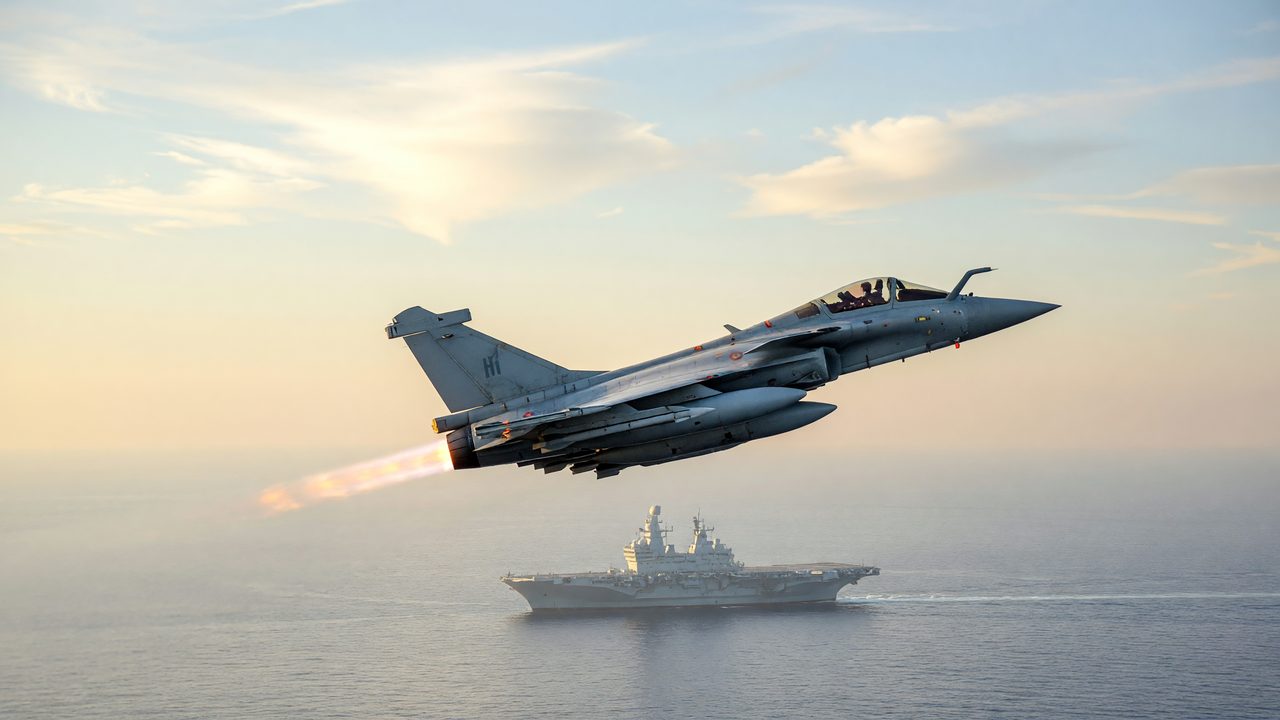
Naval aviation is where abstract “common airframe” promises usually die. The Rafale M shares maximum structure and equipment with the land-based Rafale B and C, yet must trap on a moving deck, tolerate salt corrosion, and respect approach speeds that leave little room for ego. Dassault’s specifications credit the type with a 450-meter landing roll without drag chute—numbers that matter when the runway is 300 feet wide and pitching in a seaway.
The interoperability claim is equally concrete. During combined French and American carrier qualifications in July 2008, a French F-2 Rafale M made arrested approaches to the USS Theodore Roosevelt—an event U.S. Navy imagery described as the first integrated U.S.–French carrier qualifications on an American deck. Dassault now states plainly that the Rafale M is the only non-U.S. fighter cleared to operate from U.S. carrier decks. That clearance did not happen because the catapult and wire matched Charles de Gaulle; it happened because approach speeds, hook geometry, holdback procedures, and maintenance interfaces were engineered to NATO-compatible standards from the outset, then validated trap by trap.
Eight Decades on One Wing
What ties the story together is restraint in the airframe and ambition in the mission software. The Rafale’s fourteen store stations and 9.5-ton external load capacity were laid out early to minimize interference drag, letting one jet carry MICA air-to-air missiles, AASM guided bombs, Damoclès reconnaissance pods, and tanker baskets in combinations that once demanded separate squadrons. In French operations—from Harmattan over North Africa to nuclear deterrence patrols—the type has been judged against that omnirole brief rather than against a single-scenario leaderboard.
For pilots training in simpler cockpits, the Rafale is a case study in lifecycle economics: buy a platform once, improve it by standard increments, and keep the human interface familiar enough that experience compounds instead of resetting with every procurement cycle.
Why it matters to you
You will never trap a Rafale on a supercarrier, but you will spend a flying career inside systems that age in software layers while the wings stay the same. The F1-to-F4 path shows why type ratings and platform knowledge still pay dividends when avionics refresh every few years: the airplane’s energy management, approach sight picture, and failure-mode habits remain constant even as radar modes and weapons envelopes expand. The U.S.-deck qualification of a French carrier jet is a reminder that interoperability is not a briefing-slide virtue—it is approach speed held below 120 knots, hook points that clear the wires, and procedures rigid enough that a foreign LSO can grade your pass. Whether you fly a trainer, a regional jet, or a glass-cockpit piston ship, that is the lesson worth carrying: master the machine’s physical grammar early, because the tactics layered on top will change long before the registration does.