One Jet, Three Wars: How the F-35 Rewrote Allied Air Power
"000 feet"
One Jet, Three Wars: How the F-35 Rewrote Allied Air Power
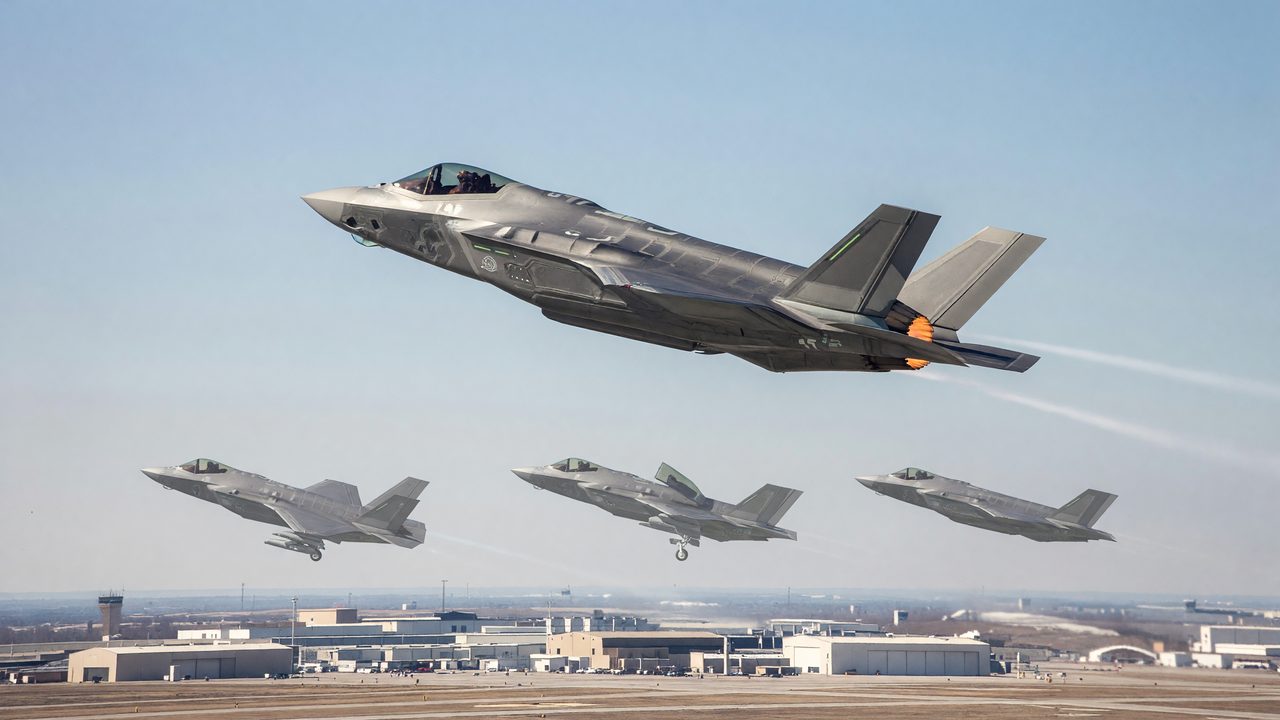
On a December afternoon over Texas, a single angular airframe proved that one design could fight from runways, carriers, and postage-stamp landing zones alike—and changed what pilots would fly for a generation.
The Joint Strike Fighter program did not begin with a thunderclap. It began with a spreadsheet and a wager. When the Pentagon launched the JSF effort in 1996, the ambition was blunt: replace a constellation of aging types—the Air Force’s F-16 and A-10, the Marine Corps’ AV-8B Harrier, the Navy’s F/A-18—with one family of aircraft that could be built in volume, flown by allies, and sustained across decades. The economics were as audacious as the engineering. A single production line in Fort Worth, Texas, would feed three American services and dozens of partner nations. One airframe. Three battlefields.
Before there was an F-35, there was the X-35. Lockheed Martin’s demonstrator program was the audition, and the company knew the stakes. On 24 October 2000, the X-35A lifted from Palmdale, California, on the first flight of what the manufacturer then called the Joint Strike Fighter. The event was measured in the language of test programs—controls checked, handling assessed, data recorded—but it established that the basic aerodynamic and propulsion package could fly conventionally, the prerequisite for everything that followed.
The harder problem was vertical landing. The Marine Corps had built its expeditionary doctrine around the Harrier’s ability to operate from short strips and amphibious ships. Replacing that capability inside a stealthy fuselage required an invention, not an iteration. On 23 June 2001, the X-35B performed the first shaft-driven lift-fan vertical landing, a milestone documented in the F-35 Joint Program Office’s program history. A lift fan mounted behind the cockpit, fed by a driveshaft from the main engine, produced the cold-air column that balanced the hot thrust from the engine’s swiveling nozzle. It was the breakthrough that kept the STOVL variant alive—and kept the “one airframe” promise from collapsing into three separate airplanes.
Six years of wind-tunnel work, simulator hours, and component testing separated those demonstrator flights from the real thing. Air Force engineers at Arnold Engineering Development Center contributed to the propulsion and integration effort that would support initial flight, as the service reported in 2006. By then, the Pratt & Whitney F135—the most powerful fighter engine ever built—was mated to a fuselage shaped for low observability and packed with sensor fusion architecture the demonstrators had only hinted at.
At 12:44 p.m. Central Standard Time on 15 December 2006, that fuselage left the ground. An angular grey shape rose from Lockheed Martin’s Fort Worth plant and climbed to 15,000 feet over Texas. Chief test pilot Jon Beesley, who years earlier had chased the F-22’s maiden flight from the cockpit of an F-16, was at the controls of the F-35 Lightning II. Lockheed Martin’s news release from that day recorded a one-hour sortie: takeoff, basic handling, and landing. The flight was short. The implication was not. The production Lightning II had flown.
What followed was a flight-test campaign the program billed as the most comprehensive in military aviation history—roughly 12,000 hours aimed at certifying three distinct operational personalities. The F-35A would fly from long runways as a conventional strike fighter. The F-35B would use short takeoffs and vertical landings to support Marines ashore. The F-35C would endure catapult launches and arrested recoveries from carrier decks. Same core structure. Same avionics philosophy. Same data links. Different outer wings, different landing gear, different approach speeds—each variant tuned to its theater, but maintained, trained, and upgraded as one system.
By the time the first operational squadron stood up, the Lightning II had already altered the arithmetic of allied air power. Partners who once operated separate logistics chains for F-16s, Harriers, or legacy Hornets could converge on common parts, common simulators, and common tactics built around a cockpit that fuses radar, infrared, and offboard tracks into a single picture. Stealth was the headline. Integration was the revolution.
Why it matters to you
You may never strap into an F-35, but you already fly in the world it built. The engineering principles validated on 15 December 2006—careful systems integration, disciplined test discipline, and the insistence that cockpit displays translate complex aircraft state into actionable information—are embedded in the trainers and glass cockpits you use today. Modern primary instruction stresses energy management and stabilized approaches; the Lightning II’s development demanded the same rigor at supersonic speed and on a carrier glide slope. Sensor fusion and datalinked traffic pictures, once exotic, now appear in GA avionics and airline fleets. When you brief a flight, cross-check instruments against outside references, and treat every first flight of a new configuration as a calculated experiment rather than a gamble, you are practicing the habits that took a grey shape over Texas and turned it into a global standard. One airframe, three battlefields—and a reminder that the best flying still begins on the ground, with engineers, checklists, and the patience to prove a bold idea one hour at a time.