One Eye, One Engine, One Week
"July 22, 1933"
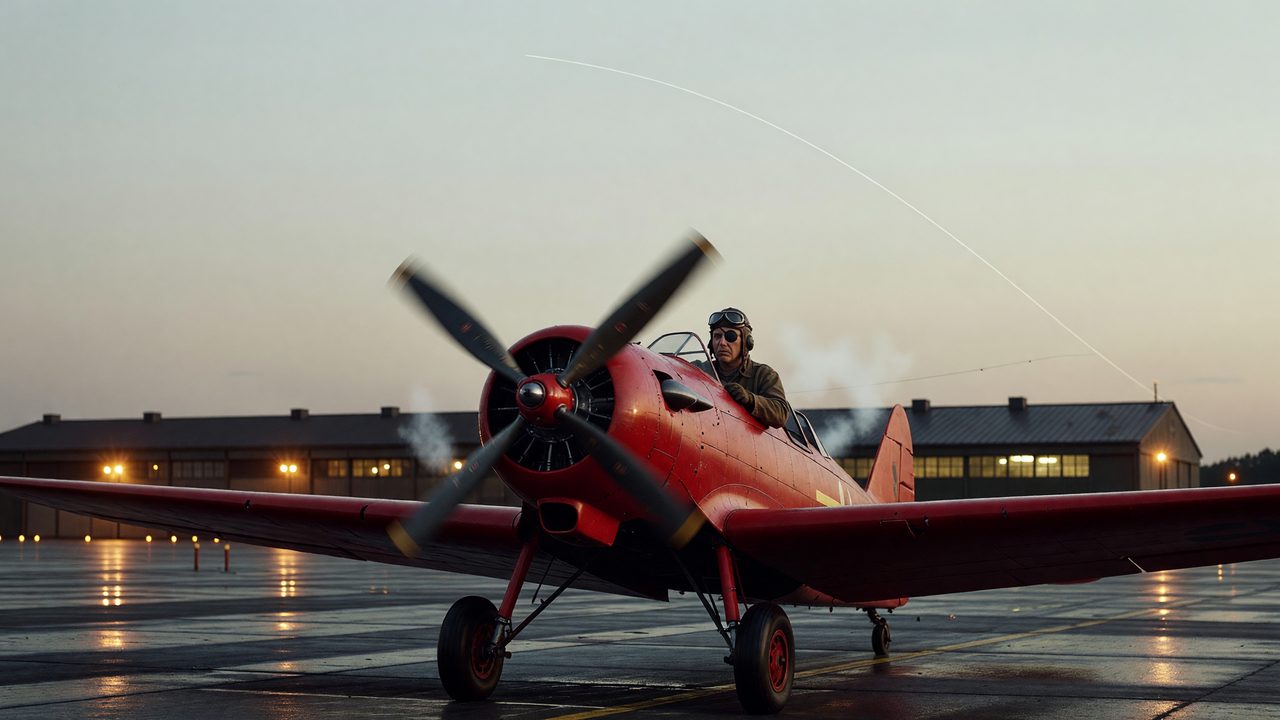
One Eye, One Engine, One Week
On July 22, 1933, Wiley Post proved that a lone pilot with a gyroscope and a radio could girdle the Northern Hemisphere faster than any crew before him—and changed what solo flight meant forever.
When Wiley Post throttled back the engine of his Lockheed Vega Winnie Mae and rolled to a stop at Floyd Bennett Field, Long Island, at 11:50 p.m. on July 22, 1933, the runway lights found a man who had just done what no aviator had ever done alone. He had departed the same Brooklyn airfield seven days, eighteen hours, and forty-nine minutes earlier. In that span he had traced a 15,596-mile arc around the Northern Hemisphere with no one in the right seat—only instruments, habit, and nerve. Contemporary scientific reporting in Nature recorded the elapsed time and distance with the precision of a laboratory measurement; the Smithsonian’s National Air and Space Museum preserves the aircraft’s log and flight records for NR105W, the registration that made Winnie Mae a household name. An Associated Press photograph of Post on the ramp that night, preserved in aviation chronicles, shows a roughneck grinning through exhaustion: the flight was over, and the record books were already obsolete.
The Man and the Machine
Post was not a polished airline captain. He was a one-eyed Oklahoma oil-field roughneck who had taught himself to fly, lost his left eye in a rig accident, and compensated with a depth of concentration that fellow pilots still discuss in hangar lore. Two years earlier, in 1931, he and navigator Harold Gatty had circled the globe in eight days—a triumph that made Post famous and left him restless. He wanted to go again, and he wanted to go alone. For the 1933 attempt he stripped the Vega to essentials and leaned on two technologies that were still novel in general aviation: a Sperry autopilot to hold heading while he slept in brief snatches, and a radio direction finder to confirm position across featureless terrain and open ocean. The museum’s biography of Post and the surviving route-map section he later returned to U.S. Navy Hydrographic Office Lieutenant J. F. Gillon—catalogued as NASM.XXXX.1006—document a path that hugged the practical latitudes of the age: New York to Berlin, then Moscow, Novosibirsk, and across the Bering Strait into Alaska before the final leg home.
Rhythm, Repairs, and Resolve
Eleven fuel stops punctuated the journey, yet the interruptions that mattered were mechanical, not diplomatic. At Flat, Alaska, Post damaged a propeller—likely from striking rough ground or debris during a hurried landing—and did what a solo transcontinental pilot does when there is no FBO and no mechanic: he pulled a spare prop from the cabin and changed it himself. A gyroscope repair somewhere along the route added another layer of self-reliance. These were not dramatic diversions that filled newspaper columns for weeks; they were the bent propeller and the failing gyro that briefly threatened rhythm, then yielded to methodical work on a dark ramp. Post’s own log, held with the Winnie Mae artifacts at the Smithsonian, is the ledger of a man treating the globe as a single, continuous cross-country—fuel, sleep, fix, fly.
The Record That Stood in Spirit
The 1933 flight shattered every existing global speed record for an around-the-world journey. More enduring than the stopwatch, though, was the demonstration itself: one pilot, one engine, and emerging radio and autopilot equipment could command a world-girdling trip that had required a navigator and a crew only months before in the public imagination. When Howard Hughes circled the globe in 1938 with a multi-person crew and the most advanced equipment money could buy, he still declared that “Wiley Post’s flight remains the most remarkable flight in history. It can never be duplicated. He did it alone!” Hughes was measuring more than hours. He was acknowledging that Post had collapsed the support structure of long-range flight into a single cockpit—and that the cultural boundary between “possible for an airline” and “possible for one person” had moved.
Why it matters to you
Every time you brief a long cross-country, manage fatigue, troubleshoot a squawk without a mechanic on the field, or trust your autopilot while you scan for traffic, you are training in the same discipline Post made visible on July 22, 1933. Solo flight is not merely legal minimums; it is the obligation to be your own navigator, engineer, and decision-maker when the nearest help is a fuel stop and a radio frequency. Post’s one-week orbit of the Northern Hemisphere remains a cornerstone of aviation culture because it showed rated pilots—and the students who study their lore—that technology extends human reach only when a pilot can still fly the airplane when the gyro drifts and the prop is bent. The Winnie Mae is in a museum. The lesson is in every cockpit: command the journey, or the journey commands you.