One Engine, Every Runway
"One engine, one planet, ten million hours."
One Engine, Every Runway
How a Swiss turboprop turned a single PT6 and a cargo door into the world’s most versatile workhorse—and why ten million hours haven’t worn it out.
On the last day of May 1991, a new shape lifted off the runway at Buochs, Switzerland: a high-wing monoplane with a single Pratt & Whitney Canada PT6A-67 turboprop on the nose and a cabin designed less like a corporate jet than a flying pickup truck. Pilatus Aircraft Ltd had not set out to build the prettiest airplane in the hangar. The company had studied what operators actually needed—short strips, rough surfaces, long legs, and the ability to swap passengers for pallets without reconfiguring the entire airframe—and folded those requirements into one airframe. Nearly three years later, on 30 March 1994, Swiss regulators granted type certification. The PC-12 was now a real aircraft, not a Swiss experiment.
What made the design coherent was restraint. One engine meant one fuel system, one propeller governor, and one line item on the maintenance sheet—yet the PT6A-67’s thermodynamic rating gave the airplane turbine smoothness and climb performance that piston twins could not match at the same gross weight. Pilatus paired that powerplant with a straight-tapered wing, sturdy trailing-link landing gear, and a flat cabin floor. According to the manufacturer’s published technical data, the aft cargo door measures 53 inches across—wide enough for stretchers, engines in crates, and the odd piece of mining equipment that would never fit through a clamshell air-stair. Cabin layouts published by Pilatus show configurations from executive seating to commuter arrangements carrying up to nine passengers, or an empty floor ready for outsized freight. The airplane did not pretend to be a jet. It promised to go where jets would not go, and to come home with revenue in the hold.
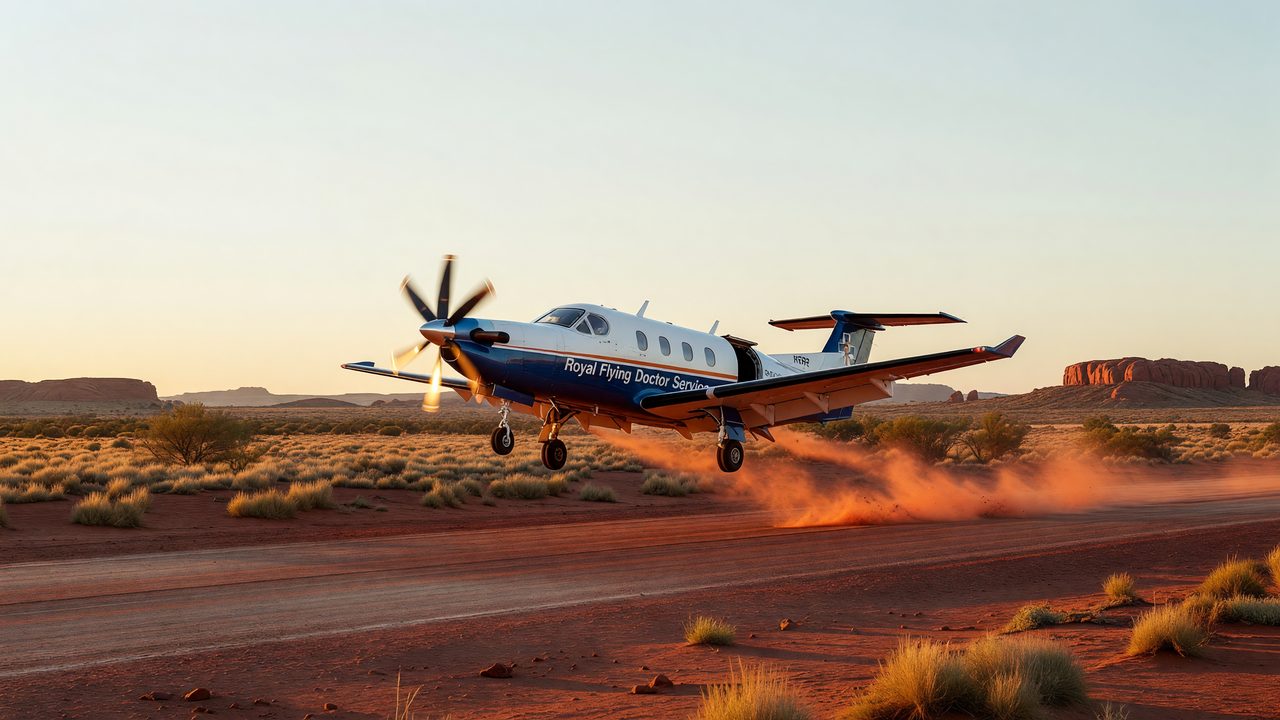
Operators tested that promise immediately. In Australia’s red heart, the Royal Flying Doctor Service (RFDS) adopted the PC-12 as a flying clinic: doctors, nurses, and medical kits rode outbound over dirt strips and graded gravel, often at night, to patients who lived farther from a paved runway than most Americans live from a grocery store. The RFDS did not make the type famous through marketing; it made it famous through repetition—thousands of landings where a twin would demand twice the fuel and a jet would demand twice the pavement. Special-mission users noticed. The U.S. Air Force acquired a militarized variant designated the U-28A Draco, configured for intra-theater transport, liaison, and special-operations support in places where runways are assumptions, not guarantees. Draco aircrews fly the same fundamental wing and the same PT6 lineage as the banker’s PC-12 NGX, but their manuals emphasize threat environments instead of passenger comfort. The through-line is capability per pound of airframe.
Pilatus kept refining what worked. Avionics suites evolved from steam-gauge eras into integrated glass cockpits; the current PC-12 NGX brochure, which Pilatus titled “THE WORLD’S GREATEST SINGLE JUST THE FACTS” (2024), stresses an Advanced Cockpit Environment built around integrated Garmin avionics and autothrottle, with Autoland and Electronic Stability & Protection reserved for the PC-12 PRO—tools that shrink crew workload on single-pilot IFR legs. Yet the company’s marketing language still leads with payload, door size, and field performance, not cabin silk. That ordering is instructive. The PC-12 sells because it solves logistical problems first and luxury second.
The numbers now speak for a mature fleet, not a novelty. In May 2023, Pilatus delivered the 2,000th PC-12—a production total few turbine singles ever approach, and one that exceeds many light-twin programs when measured by airframes, not headlines. Collectively, the global fleet has logged more than ten million flight hours. Ten million hours is not a brochure rounding error; it is the empirical record of a powerplant and maintenance culture that keeps returning airplanes to service. The PT6 family’s time-between-overhaul intervals and decades-long field history mean that a well-run operator can schedule engine work instead of fearing it—a economic fact that matters as much as cruise speed when you are financing a single-engine turbine on charter margins.
Why it matters to you
If you are training toward turbine time, the PC-12 is a case study in how single-engine risk is managed through engineering and discipline rather than through a second throttle. The PT6’s free-turbine architecture, conservative operating limits, and mature overhaul network are why owners accept one engine where they once demanded two—and why gravel strips do not automatically trigger a go-around to the nearest twin. Study the airplane’s weight-and-balance and performance charts the way an RFDS pilot would: know your landing distance on a dry, level runway, then mentally add the surface you actually have. Practice single-engine (in this case, your only engine) decision-making on every takeoff briefing: identify the abort point, the continue point, and the nearest suitable strip at your current weight. The PC-12 outsells most twins because it trades redundant metal for redundant procedures—reliable power, a forgiving gear, a door that turns the cabin into a tool, and a fleet that has already proved the concept ten million times over. That is the lesson you can carry into any cockpit: capability is not the number of engines on the cowling; it is whether the airplane, and the pilot, can complete the mission and do it again tomorrow.