Nine Days on One Tank: Voyager’s Impossible Orbit
"000 miles"
Nine Days on One Tank: Voyager’s Impossible Orbit
On a December morning in 1986, a gossamer aircraft with roughly 3.2 metric tons of fuel and no place to land rewrote what pilots thought possible—and proved that endurance, not speed, was the final frontier.
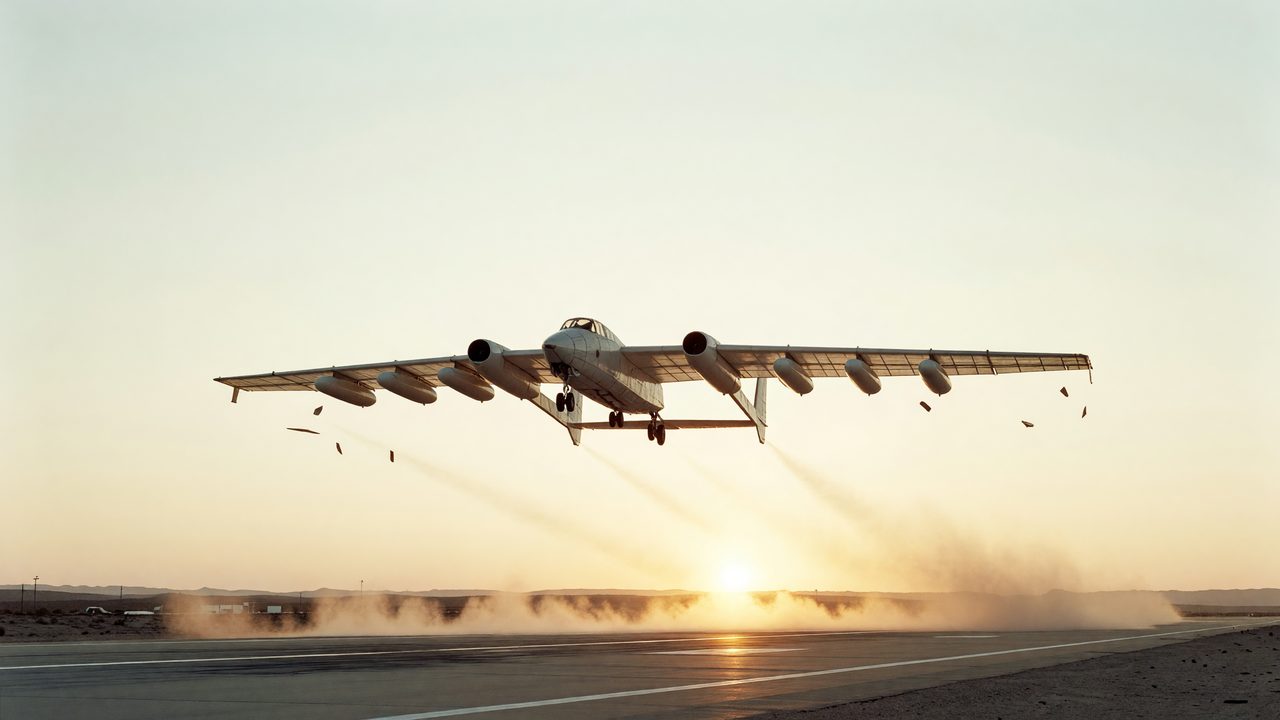
At 8:01 a.m. on December 14, 1986, the strangest-looking aircraft ever to chase a world record wobbled down the runway at Edwards Air Force Base and lifted into the Mojave sky. The Rutan Voyager looked less like an airplane than a flying sculpture: twin booms stretched aft from a forward canard, all of it skinned in graphite, paper, and epoxy resin. Inside those booms and the slender fuselage, seventeen fuel tanks held 7,011 pounds of avgas—enough to keep two Continental engines burning for more than nine days. Dick Rutan, a Vietnam combat fighter pilot who flew 325 missions, including 105 as a MISTY FastFAC, earned the Silver Star and five Distinguished Flying Crosses but is not recorded as an ace, and Jeana Yeager, an experimental pilot from Texas, had climbed into a cockpit barely larger than a phone booth. Their mission was brutally simple: circle the Earth without stopping or refueling. Many experts considered it impossible.
The aircraft was the product of five years of volunteer labor born from a napkin sketch Burt Rutan drew in 1981. His team at the Mojave desert shop had built something extraordinary: a structure roughly half the weight of aluminum yet, pound for pound, as strong as steel. Burt Rutan later described the program in his essay “Voyager: Small Team, Giant Challenge” as a triumph of weight discipline—fuel accounted for nearly three-quarters of takeoff weight, while the composite airframe itself weighed only a fraction of the whole. Engine staging added another layer of efficiency: after the first days aloft, one powerplant would shut down so the remaining engine could cruise at a higher, more economical power setting. The design was audacious. The margins were razor-thin.
Disaster nearly struck before the flight had truly begun. As Voyager accelerated down Edwards’ long runway—heavier than it had ever flown—the heavily loaded wingtips flexed downward and scraped the pavement. Both winglets tore away. The wingspan shrank, carbon-fiber skin peeled back to expose blue foam core, and the crew faced an immediate go/no-go decision. Burt Rutan, tracking the flight from a chase aircraft, judged that performance remained within limits. Dick Rutan and Jeana Yeager pressed on, sideslipping the damaged craft until the dangling winglets tore free entirely. The Smithsonian’s Milestones of Flight narrative preserves this moment as emblematic of the entire endeavor: a fragile machine, already compromised, committed to an oceanic voyage from which there would be no divert.
What followed was 9 days, 3 minutes, and 44 seconds of sustained aerial hardship, a duration the Christian Science Monitor confirmed in its December 24, 1986 report as nearly double the previous nonstop, unrefueled distance record set by a U.S. Air Force B-52. Voyager crossed the Pacific through equatorial storms, punched through a thunderstorm with wings banked ninety degrees, and at one point limped along with fuel starvation afflicting one engine. Navigation happened in a pre-GPS era; weather planning and world-spanning communications demanded constant attention from a ground team in Mojave. In the air, Rutan and Yeager ate cold food, stole short naps, and managed an aircraft whose handling changed hour by hour as fuel burned away. Sam Moses, filing contemporaneously from Edwards for Sports Illustrated’s January 5, 1987 issue, captured the tension on the ground as sightings and status reports trickled in from across three oceans and six continents.
At 8:05 a.m. on December 23, Voyager returned to Edwards. The aircraft had flown roughly 26,000 miles. Its tanks were nearly dry. Dick Rutan stepped from the cockpit and called it “the last first in aviation”—a declaration that the great unsolved distance problems of powered flight had finally yielded. The achievement brought the Collier Trophy to Rutan, Yeager, designer Burt Rutan, and crew chief Bruce Evans. In 1987, the aircraft itself entered the Smithsonian National Air and Space Museum’s Milestones of Flight gallery, where it still hangs as proof that a small team with unconventional rules can accomplish what institutional programs deem too risky to attempt.
Why it matters to you
The operational principles demonstrated on December 14, 1986, still shape how pilots operate today. Voyager’s crew did not survive on heroics alone; they managed changing aircraft performance as weight shifted, made disciplined go/no-go calls under pressure, and coordinated with a ground team for weather, fuel, and navigation when diversion was not an option. Every rated pilot trains versions of that same discipline: knowing your aircraft’s limits at current weight and configuration, briefing contingencies before they become emergencies, and respecting endurance as a finite resource whether you are crossing an ocean or holding over a fogged-in field. The Voyager flight was extreme, but its lesson is universal. Precision, patience, and the willingness to say no when the data says no are not relics of a record flight—they are the foundation of safe, professional flying in any cockpit you will ever occupy.