Mud, Malaria, and the Mongrel Squadron That Held Guadalcanal
"They called the island "Cactus." The pilots who defended it called themselves lucky to be alive."
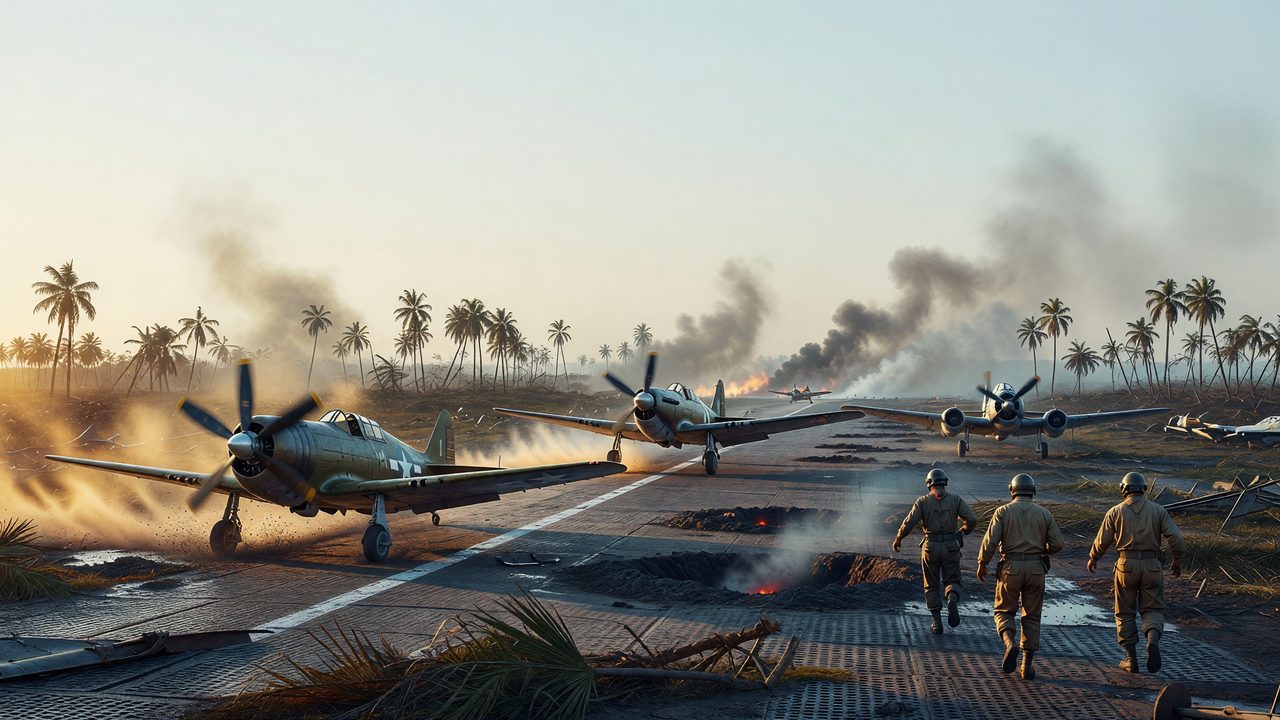
Mud, Malaria, and the Mongrel Squadron That Held Guadalcanal
At Henderson Field in the autumn of 1942, Marines, soldiers, and sailors flew whatever still had wings—and denied Japan the sky above the most miserable fighter base in the Pacific.
The Marines who seized Guadalcanal on 7 August 1942 knew the airstrip they captured was the prize. Without it, Japan could not project airpower over the southern Solomons or threaten the sea lanes to Australia. What they could not know was how wretched the field would become once the fighting settled into a siege. Henderson Field—named for Major Lofton Henderson, the dive-bomber pilot killed at Midway—sat in a coastal plain of red mud and kunai grass. Rain turned the runway into glue. Malaria and dengue fever worked through the garrison. After dark, Japanese cruisers and destroyers shelled the perimeter from Ironbottom Sound; by daylight, bombers and fighters staged from Rabaul, four hundred miles to the northwest. The base that American planners had imagined as a forward operating location became, in the words of those who endured it, the most miserable fighter station in the world.
Yet into that misery came the first American airpower of the campaign. On 20 August, nineteen F4F Wildcats of VMF-223 and twelve SBD Dauntlesses of VMSB-232 launched from the escort carrier Long Island and staggered ashore. Navy personnel of CUB One—an advanced base unit rushed from Espiritu Santo—had spent days tipping aviation gasoline from fifty-five-gallon drums into wing tanks because no pumps existed. They belted .50-caliber ammunition by hand. Within hours of arrival, Captain John L. Smith’s Wildcats were in combat. The USMC monograph on the Guadalcanal campaign records that the mixed Marine, Navy, and Army Air Forces organization at Henderson was already being called the Cactus Air Force, after the island’s codename.
The force grew stranger by the week. VMF-224 and VMSB-231 arrived on 30 August during an enemy raid that sank the destroyer Colhoun. The first Army aircraft—five P-400 Airacobras of the 67th Fighter Squadron, led by Captain Dale D. Brannan, hopping north from Nouméa—had arrived on 22 August; nine more followed on 27 August. The export-model Bell fighters were fast and heavily armed but struggled above fifteen thousand feet—exactly where Japanese Mitsubishi Zeros and Betty bombers preferred to fight. Carrier squadrons whose flattops had been damaged or sunk at Eastern Solomons and Santa Cruz diverted to Henderson as well, adding Navy fighters and dive bombers to an already crowded ramp. Marine Wildcats bore the brunt of interception work; SBDs and TBFs hunted shipping by day; Army P-400s found their niche strafing Japanese positions when the high-altitude fight was beyond their reach. It was a logistical nightmare of incompatible parts, fuels, oxygen gear, and maintenance doctrine. It was also a tactical necessity: no single service could have sustained the sortie rate the island demanded.
Between 20 August and 16 October, MAG-23 and attached squadrons claimed 244 Japanese aircraft destroyed. The cost was written in wreckage along the runway and in the faces of the pilots. Smith became the Marine Corps’ first ace of the war and earned the Medal of Honor; Major Robert E. Galer, commanding VMF-224, received the Medal of Honor for eleven aerial victories in the cited period. Captain Joe Foss, who would finish the campaign with twenty-six confirmed kills, was still building his score, but the names were already filtering home through censored dispatches. Foss, Smith, and Galer became the public face of a war the Navy and Marines were fighting yard by yard on the ground.
The human ledger kept by the group medical officer told a grimmer story. After five weeks of operations, only three pilots in his squadron remained physically unscathed. Seven had been killed. Three were wounded. The rest, he reported, were physically and mentally shattered—sleep-deprived, malnourished, and flying patched-up aircraft against an enemy who replaced losses from Rabaul around the clock. Henderson’s defenders lived on captured Japanese rice and whatever supply ships could run the gauntlet from Espiritu Santo. When a Wildcat’s propeller blades came back bullet-pierced, ground crews passed parts down a bucket brigade in the mud.
Still, the Cactus Air Force held. It covered the convoys that kept the 1st Marine Division alive. It spotted night landings of Japanese reinforcements along the coast. It struck enemy shipping during the battles of Eastern Solomons and Santa Cruz. Above all, it denied Imperial Japan the air superiority without which General Harukichi Hyakutake’s infantry could not recapture the airfield. By mid-October, when the ridge-line fighting reached its climax, Japan had poured reinforcements onto the island—but could not own the sky above them. That failure turned Guadalcanal from a toehold into the pivot of the Pacific War.
Why it matters to you
Modern training still assumes tidy squadrons with matching aircraft, common radios, and a single chain of command. The Cactus Air Force had none of those luxuries, yet the mission profile would look familiar: defensive counter-air, armed reconnaissance, close support of troops in contact, and escort of logistics under threat. The mixed-service, mixed-aircraft composition forced commanders to assign roles by capability rather than tradition—Wildcats high, Airacobras low, Dauntlesses on the water—and to build procedures across services in real time. That is the skill you practice when you brief joint operations, fly with non-standard equipment, or adapt a fragmentary order: identify what each element can contribute, accept the friction of incompatible systems, and keep the airfield open anyway. Henderson’s pilots did not win because conditions were favorable. They won because they understood that air superiority is less about perfection than about presence—and they refused to leave.