Mercury 13: The Right Stuff, the Wrong Era
"They passed the same tests as Glenn. NASA said no anyway."
Mercury 13: The Right Stuff, the Wrong Era
In 1960, thirteen women pilots passed the same brutal medical screening NASA gave its Mercury astronauts—then the Navy canceled their program before a single one could fly.
The doctor who asked the forbidden question
When NASA began selecting the men who would ride fire into orbit, the medical gatekeeper was Dr. William Randolph Lovelace II. A physician and aviation medicine pioneer, Lovelace had designed the exhaustive physical and psychological screening that winnowed military test pilots into the Mercury Seven. In 1960, with the astronaut corps still all-male and the space race accelerating, he posed a question his own agency had not: How would women perform on the same regimen?
He invited Jerrie Cobb—an accomplished long-distance pilot with thousands of hours aloft—to undergo the identical battery of tests at his private clinic in Albuquerque, New Mexico. She passed. Encouraged, Lovelace recruited twenty-four more experienced women pilots, with financial backing from record-setting aviator Jacqueline Cochran. Thirteen cleared every hurdle. They became known, though never officially by NASA, as the Mercury 13.
What “right stuff” actually meant
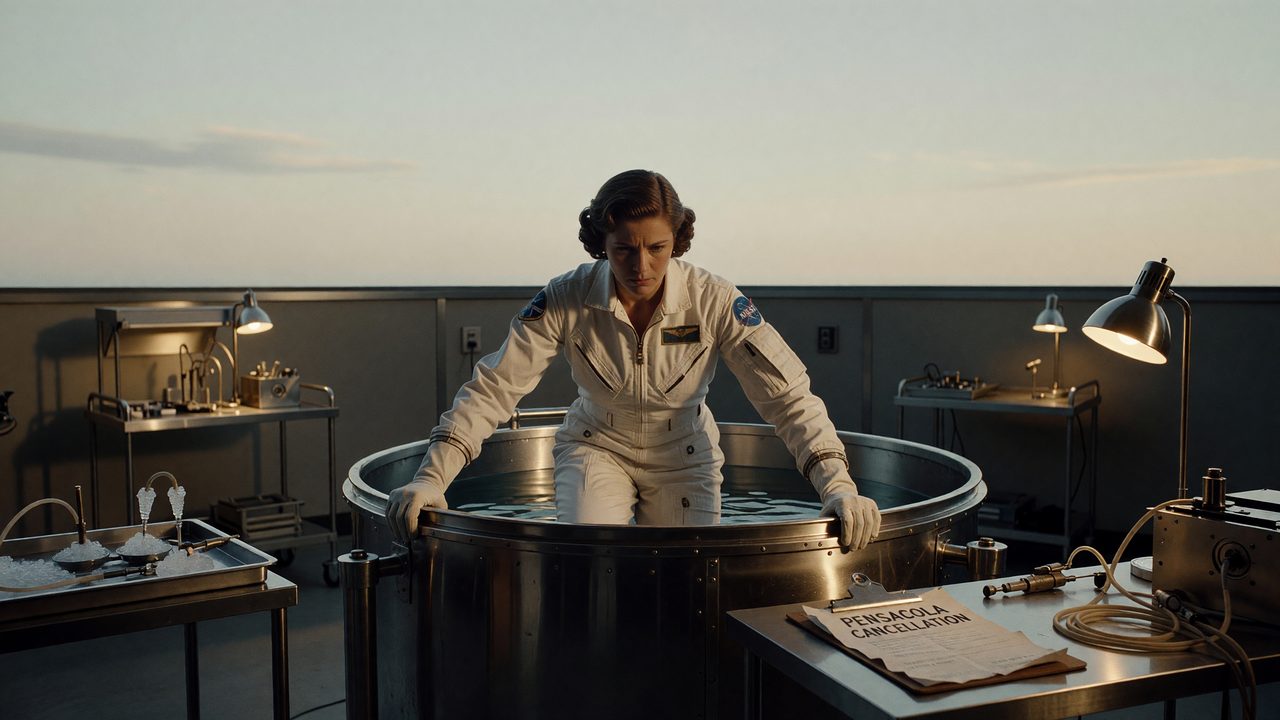
The Lovelace Woman in Space Program was not a publicity stunt. It replicated the same punishing standards NASA applied to its male candidates. Volunteers swallowed rubber tubes so technicians could measure gastric function. Ice water flooded their ear canals to trigger caloric reflexes. They endured tilt-table tests, exhaustion profiles, and hours sealed inside sensory-deprivation tanks designed to break concentration.
The youngest candidate, twenty-three-year-old Wally Funk, lasted ten hours and thirty-five minutes in the isolation tank—longer than any male candidate in the comparable screening. The women were not hobbyists hoping for a joyride. They were career pilots who had already proved themselves in cockpits when the profession barely acknowledged them. By every metric Lovelace recorded, they had the right stuff.
Pensacola—and the telegram
With preliminary screening complete, the group prepared for advanced aeromedical evaluation at the U.S. Naval School of Aviation Medicine in Pensacola, Florida—the same pipeline that fed military astronaut selection. Then the program stopped cold. The Navy canceled further testing by telegram. Lovelace’s effort had never carried official NASA sponsorship, and without it the military would not continue. The women who had passed every test were grounded not by physiology but by bureaucracy and the social assumptions wrapped inside it.
Congress, Glenn, and the long wait
In July 1962, Jerrie Cobb and Jane Hart—pilot, congressman’s wife, and mother of eight—testified before a House subcommittee on whether America should send women into space. They argued that women were lighter, needed less food and oxygen, and had already demonstrated equal tolerance for the rigors of spaceflight medicine. Astronaut John Glenn, fresh from orbital fame, told the panel that the exclusion of women from military jet cockpits was simply “a fact of our social order.” The hearing closed more doors than it opened.
NASA would not select a female astronaut until 1978, when the astronaut class of ’78—nicknamed the “Thirty-Five New Guys,” including six women—finally broke the barrier. Sally Ride flew five years later. The Mercury 13 never received a mission patch, a spacecraft call sign, or an official place in the agency’s roster.
Sixty-one years to the Kármán line
On July 20, 2021—sixty-one years after she first proved she was ready—Wally Funk rode Blue Origin’s New Shepard above the Kármán line. At eighty-two, she became the oldest person to reach space on that flight, carrying with her the unfinished business of a dozen colleagues who had passed the same tests and never got the chance. Jerrie Cobb, who had pushed hardest for recognition, died in 2019 without making the journey herself.
NASA History’s account of Lovelace’s Woman in Space Program, reporting by the BBC, and historical summaries at HISTORY.com all document the same arc: qualified pilots, rigorous data, institutional silence.
Why it matters to you
Modern flight training teaches you to treat data as perishable and documentation as part of safety culture—weight-and-balance worksheets, medical certificates, proficiency checks, maintenance logs. The Mercury 13 episode is a cautionary counterexample at institutional scale. Much of the women’s aeromedical test data was lost or scattered; researchers in the 1970s had to rebuild baselines that Lovelace’s clinic had already established, duplicating effort and delaying understanding of how sex differences affect human performance in extreme environments. Bias did not just deny thirteen pilots a fair shot at history—it erased science the whole aviation and space community could have used. For pilots today, the lesson is blunt: when qualified people are excluded for reasons that have nothing to do with skill or physiology, the profession loses more than talent. It loses the record of what was true.