Mercenaries at Dawn: The Flying Tigers Over Burma
"A hundred American pilots, a hundred old P-40s, and one retired deaf major who understood the Japanese better than the Army did."
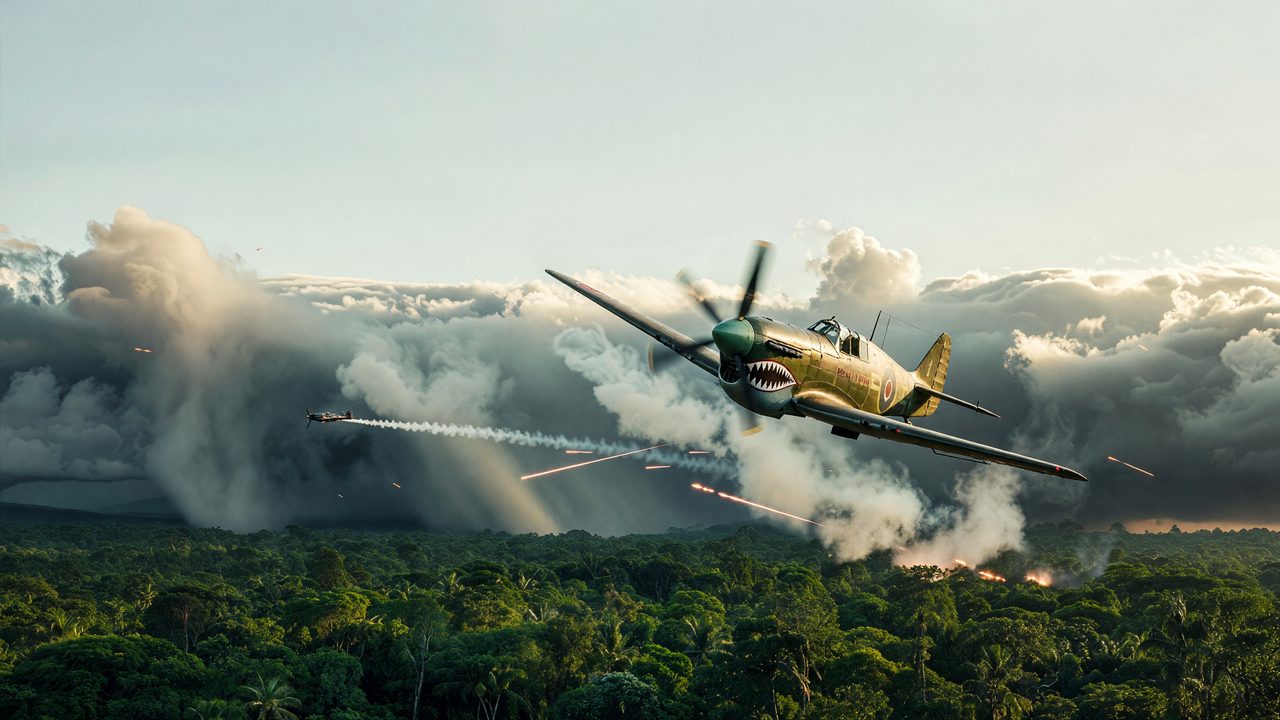
Mercenaries at Dawn: The Flying Tigers Over Burma
Before the United States entered World War II, a hundred American pilots were already shooting down Japanese aircraft over Burma and China — paid as civilians, fighting with tactics the Army had not yet embraced.
On 7 December 1941 AVG pilots were training and repositioning in Burma and China; their first combat mission occurred on 20 December over Kunming. They were not wearing U.S. uniforms. They belonged to the American Volunteer Group, a private air force recruited with Roosevelt's quiet approval to defend China's lifeline: the Burma Road. Their commander, Claire Lee Chennault, had resigned from the Army Air Corps years earlier — officially retired for deafness, unofficially because he could not abide an institution that valued paperwork over fighting skill. By late 1941, his mercenaries had become the only effective Allied fighter force standing between Japanese bombers and the warehouses at Rangoon and Kunming.
Chennault had spent the 1930s in China watching Japanese formations work. He studied how Mitsubishi A6M Zeros used their extraordinary turn rate and climb to dominate slower opponents. When he assembled the AVG in 1941, he drilled a doctrine built around the Curtiss P-40's actual strengths: weight, structural strength, and speed in a dive. His pilots learned to climb above the fight, dive through Japanese formations, fire a short burst, and zoom away. Never turn with a Zero. The instruction was blunt and repeated until it became reflex. As Chennault later wrote in Way of a Fighter, the P-40 could not win a turning contest — but it could win a diving pass.
The pay was as unconventional as the tactics. AVG pilots earned $600 a month in combat, plus a $500 bonus for each confirmed kill. TIME magazine, reporting from Rangoon in February 1942, called them "Chennault's Mercenaries" and described pilots flying outnumbered against formations that looked, to one ground observer, "like a fleet of rowboats attacking the Spanish Armada." The group's war diary, preserved at the Air Force Historical Research Agency, records the grinding rhythm of those months: alert scrambles from muddy airstrips, fuel shortages, ground strafing that destroyed aircraft on the ramp, and sorties flown in threes and sevens against dozens of Japanese attackers.
Between December 1941 and July 1942, the AVG fought over Rangoon's port approaches and Kunming's mountain-ringed airfields — the outer and inner gates of the Burma Road. Group records claim 297 Japanese aircraft destroyed at a cost of fourteen pilots killed. British and American correspondents could not name the pilots openly; they filed dispatches using pseudonyms to protect families still in neutral America. Yet the results spoke plainly. Winston Churchill, addressing Parliament, said the AVG and RAF pilots in Burma had won victories "comparable with the Battle of Britain." Air Vice Marshal D.F. Stevenson, in his Burma campaign despatch preserved at the Australian War Memorial, acknowledged the AVG's contribution to holding the line during the desperate winter of 1941–42.
When the AVG was absorbed into the U.S. Army Air Forces as the 23rd Fighter Group in July 1942, Chennault's mercenary experiment ended — but his tactical lessons did not travel easily. The Army Air Corps had spent the interwar years training fighter pilots in formation attack and turning engagements modeled on European doctrine. Chennault's hit-and-run method required pilots to abandon the instinct to stay and fight, to accept that survival meant disengaging while you still had altitude and speed. The AVG proved that properly trained American aviators could defeat the Imperial Japanese Navy's air arm. The institutional response was more complicated: a civilian contractor, paid by the Chinese government, had solved a problem the regular Air Corps was still learning in blood over the Pacific.
Why it matters to you
Chennault's two-rule doctrine — dive and zoom, never turn with a Zero — contradicted the Army Air Corps' prevailing fighter tactics because it treated the airplane as a weapons platform with specific performance limits, not as a knight on a chessboard. Interwar training emphasized formation integrity and maneuvering combat: stay with your element, turn into the attack, win the dogfight. That worked when opponents flew comparable aircraft. Against the Zero, it was lethal. Chennault's method demanded what every student pilot eventually learns in energy-management training: know your aircraft's corner of the envelope, refuse fights on the enemy's terms, and use altitude and speed as renewable weapons. Modern instructors teach the same principle when they tell you not to slow down and haul back on the yoke just because someone is on your six. The Flying Tigers did not win because they were braver. They won because they flew a disciplined plan built on physics — and because a retired major with bad hearing understood that tactics, not swagger, keeps pilots alive.