Mach 1 Has No Gender
"Yeager trained her. Then she outran him."
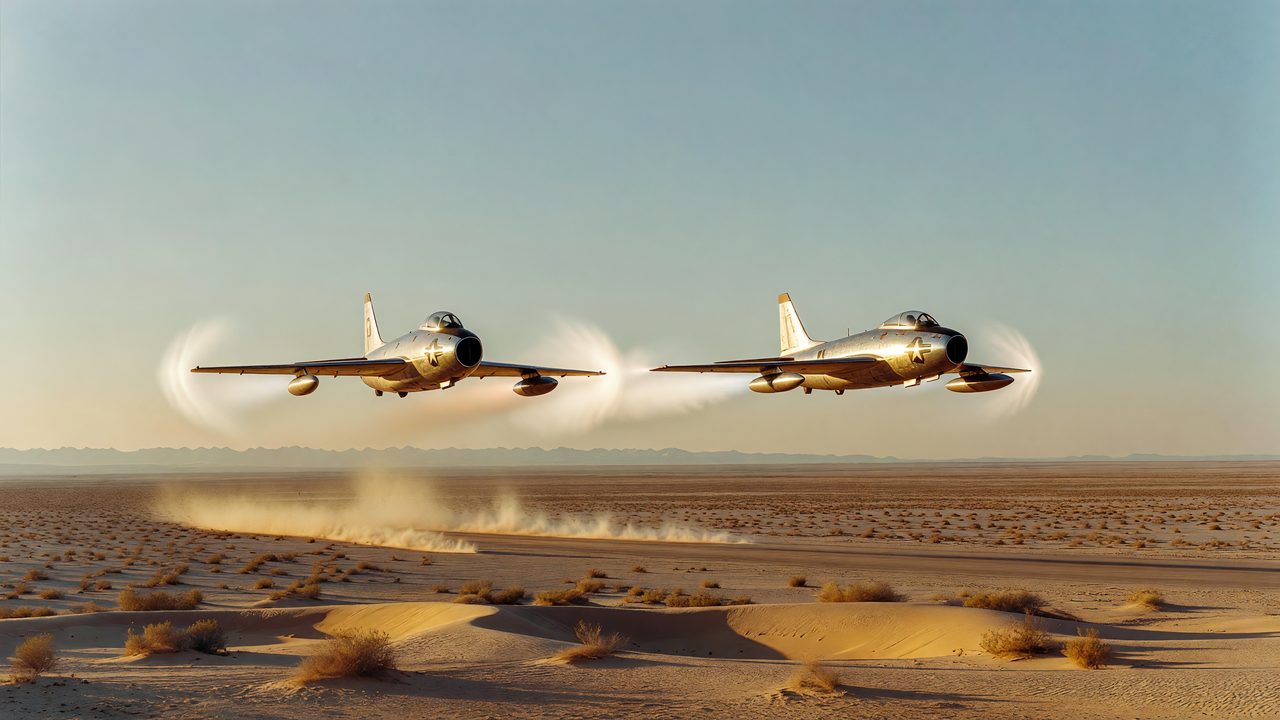
Mach 1 Has No Gender
Jacqueline Cochran did not wait for the jet age to make room for her. She climbed into an F-86, demanded the Air Force’s best instructor, and wrote her name across the sound barrier.
A Pilot Who Already Owned the Sky
By the spring of 1953, Jacqueline Cochran had little left to prove in propeller-driven aviation. She had directed the Women Airforce Service Pilots during World War II, earned the Distinguished Service Medal, and spent two decades collecting trophies, distance marks, and speed records that most pilots never approached once. The National Air and Space Museum’s archives describe a career that spanned four decades; when Cochran set her sights on the sound barrier, she was already among the most decorated women in American aviation. The jet age, however, opened a new ledger. Supersonic flight was no longer a laboratory experiment confined to rocket research aircraft. Fighter jets like the North American F-86 Sabre made Mach 1 a practical frontier—and Cochran intended to cross it.
She Did Not Ask Politely
Cochran did not stumble into the record books. According to accounts preserved by the Chuck Yeager Foundation, she approached General Hoyt Vandenberg in 1953 about flying the Sabre for speed-record attempts at Edwards Air Force Base, home of the Air Force Flight Test Center. Military jets were not ordinarily available to civilian pilots, and especially not to women; the Smithsonian Institution notes that Cochran borrowed a Canadair F-86 Sabre from the Royal Canadian Air Force for the attempt. Once the Air Force agreed to support the program, Colonel Albert Boyd’s deputy, Colonel Fred Ascani, assigned Captain Chuck Yeager—six years removed from his own Mach 1 flight in the Bell X-1—as her instructor.
Yeager’s first-hand account of the training is blunt. Cochran had no jet time. He walked her through the cockpit, the G-suit, and the essentials of Sabre handling, then laid down one rule above all others: when he gave an instruction, she obeyed immediately and asked questions later. After roughly half a dozen orientation flights, with Yeager tucked on her wing, Jimmy Doolittle sought Yeager’s honest assessment at Cochran’s California ranch: could she go supersonic without hurting herself? Yeager said yes. The responsibility, and the risk, settled on his shoulders.
Two Booms Over the Mojave
On May 18, 1953, Cochran lifted off from Rogers Dry Lake at Edwards in the Canadair Sabre. Yeager flew chase, wing-to-wing, as he had throughout the syllabus. The Air Force Flight Test Center’s historical record for the first half of 1953, preserved through the Defense Technical Information Center, documents the program alongside the base’s other test work that spring. At 45,000 feet, Yeager directed Cochran to pitch into a straight dive—throttle wide open, Mach meter climbing. She passed Mach 1.06. Two sonic booms rolled across the Mojave floor. Jacqueline Cochran became the first woman to break the sound barrier. The Fédération Aéronautique Internationale, which Cochran herself would later lead as its first female president, marked the seventieth anniversary of the flight in 2023 as a milestone in certified aviation history.
Cochran delighted in the partnership as much as the number. She liked to point out that she and Yeager were likely the first man-and-woman team to exceed Mach 1 together—a formation flight through the barrier that turned a solo feat into a shared one.
Records That Outlasted the Century
The sound barrier flight was one chapter, not the epilogue. Cochran kept flying jets for another two decades, trading speed records with France’s Jacqueline Auriol and eventually pushing past Mach 2 in a Lockheed F-104 Starfighter. When she died in August 1980, she held more speed, altitude, and distance records than any pilot then living—man or woman. Some of those marks still stand.
Why it matters to you
Cochran’s insistence on high-altitude supersonic training from the Air Force’s premier test pilot set a precedent that outlived her flight suit: women in the jet age would not accept second-tier instruction. She did not ask for a shortened syllabus or a gentler syllabus. She showed up on time, flew the same profiles Yeager flew, and earned the checkout that mattered. That standard maps directly onto how you should evaluate your own training today—whether you are a student pilot building instrument discipline or a rated aviator stepping into a faster, more complex aircraft. The credential that counts is not the endorsement in your logbook alone; it is whether your instructor pushed you to the actual operating environment you intend to fly. Cochran treated Mach 1 as a flight-training problem before it was a headline. Pilots who do the same with their next rating—demanding honest, scenario-based instruction rather than a rubber stamp—are following the same logic that carried her through the barrier on May 18, 1953.