Invisible First, Overwhelming Always
"**THE FLIGHT** On 17 January 1991, more than 1,100 USAF..."
Invisible First, Overwhelming Always
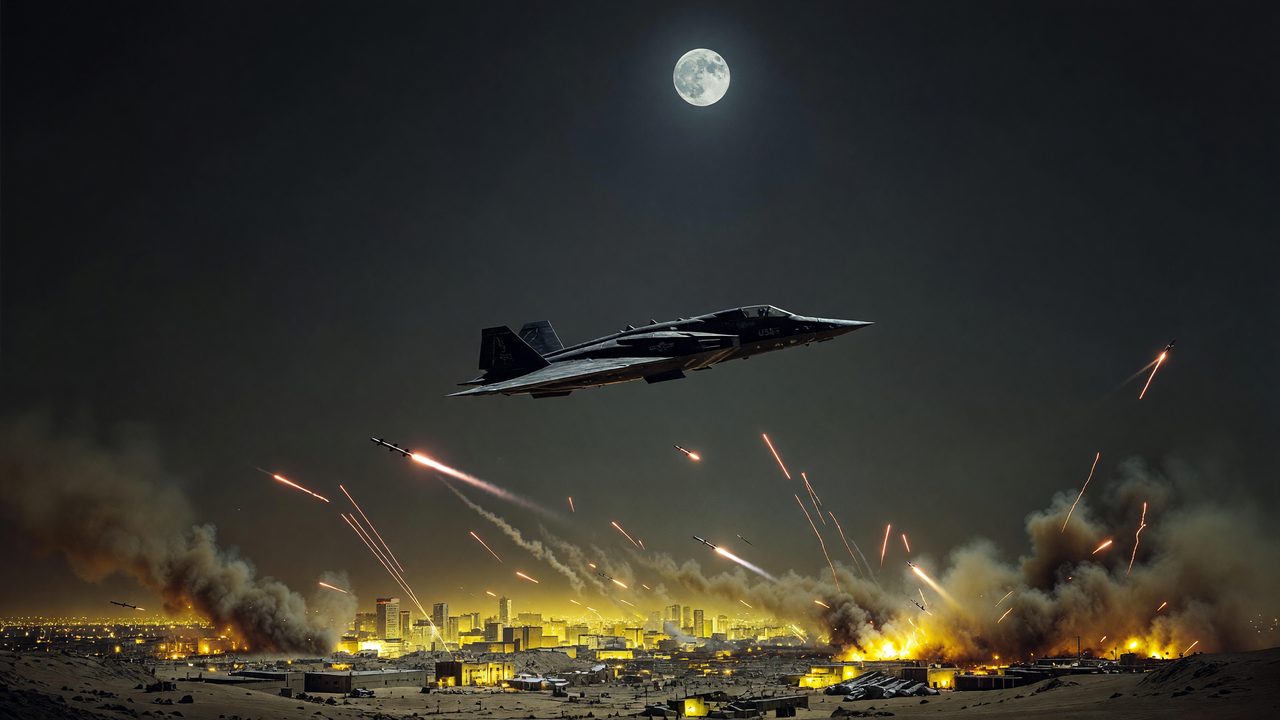
On the night of 17 January 1991, more than 1,100 coalition aircraft opened the Gulf War with a strike package designed to blind Iraq before the first tank rolled—and the numbers still define how pilots think about modern air campaigns.
The war did not begin with a ground assault. It began in the sky, over Baghdad and across Iraq and Kuwait, when coalition air forces executed a plan years in the making. According to the Department of the Air Force’s Persian Gulf War Chronology, which draws on CENTCOM situation reports and Air Staff briefings, the opening hours were not a single raid but a synchronized campaign against an integrated air defense system, command bunkers, communications nodes, and strategic targets stretching from the capital to the Kuwaiti theater.
Stealth led the way. F-117 Nighthawks—aircraft Iraqi radar could not reliably track—punched holes through defenses so follow-on strike aircraft could operate. Tomahawk cruise missiles and precision-guided munitions struck hardened command and control facilities while conventional bombers and fighters expanded the attack across the battlespace. The Gulf War Air Power Survey, commissioned by the Secretary of the Air Force and published in 1993, documents how this opening phase was built around suppression and destruction of enemy air defenses, followed by systematic attacks on leadership, infrastructure, and fielded forces. The intent was not merely to drop bombs. It was to collapse the enemy’s ability to see, decide, and fight.
The scale of what followed is difficult to grasp without numbers. Volume V of the Gulf War Air Power Survey, A Statistical Compendium and Chronology, records roughly 40,000 coalition air-to-ground sorties and about 50,000 support sorties over the campaign. That intensity was historically extraordinary. The U.S. General Accounting Office, in report NSIAD-97-134, Operation Desert Storm: Evaluation of the Air Campaign (1997), noted that average daily bomb tonnage during the air war approached 85 percent of the average daily tonnage dropped on Germany and Japan in World War II—yet concentrated into a far shorter calendar span and delivered with far greater precision. Pilots were not simply repeating Second World War mass-area bombing. They were flying a new kind of war, one in which individual aimpoints mattered as much as aggregate weight of attack.
Air superiority came fast. Iraqi fighters posed only sporadic resistance; many never left the ground or were destroyed when they did. Volume I of the Gulf War Air Power Survey, Planning and Command and Control, makes clear that the campaign’s architecture—centralized planning, decentralized execution, real-time battle management, tanker corridors, AWACS coverage, and joint targeting boards—allowed coalition commanders to adapt daily while keeping strategic coherence. Within days, coalition aircraft owned the skies. Iraqi forces below increasingly fought blind: cut from headquarters, harassed by night, and unable to mass effectively under persistent aerial surveillance and strike.
When the ground offensive began on 24 February, the air campaign had already done much of the war’s decisive work. Iraqi units were demoralized, isolated, and battered. The hundred-hour ground war that followed was not proof that armor had become irrelevant; it was proof that air power had prepared the battlefield so thoroughly that maneuver forces could advance with historically low coalition casualties. Kuwait was liberated. The coalition had demonstrated that modern air power could achieve strategic results swiftly, at scale, and with losses far below what prewar estimates had feared.
For student and rated pilots reading this history today, the lesson is not nostalgia for a single night over Baghdad. It is operational design. Desert Storm showed that success starts with objectives stated in effects, not merely sortie counts; that SEAD and command-and-control strikes are not supporting acts but opening acts; that tanker planning, package timing, and deconfliction are as decisive as weapons release; and that air superiority is a condition to be created and exploited, not assumed. The principles that shaped the flight on 17 January 1991—integration, precision, persistence, and the relentless pursuit of the enemy’s ability to command—still shape how pilots brief, fly, and debrief in every theater where the first move belongs to the air.
Why it matters to you
Whether you are building hours in a trainer or flying operational missions, you are training inside a doctrine Desert Storm made undeniable: control the air first, attack the system that lets the enemy fight, and make every sortie serve a campaign—not a calendar. Brief your threats the way the opening packages did: radar, comms, C2, then fielded forces. Respect tanker timing, package integrity, and battle management as flight-critical skills, not admin. When you study airspace deconfliction, threat reactions, or night operations, you are practicing the same operational logic that turned more than 1,100 aircraft on night one into forty thousand air-to-ground sorties and a hundred-hour ground war. The cockpit technology has changed; the requirement has not. Win the sky, blind the enemy, then make the next flight count.