Into the Flak: The Ploesti Raid That Rewrote Courage—and Cost
"Blood for oil"
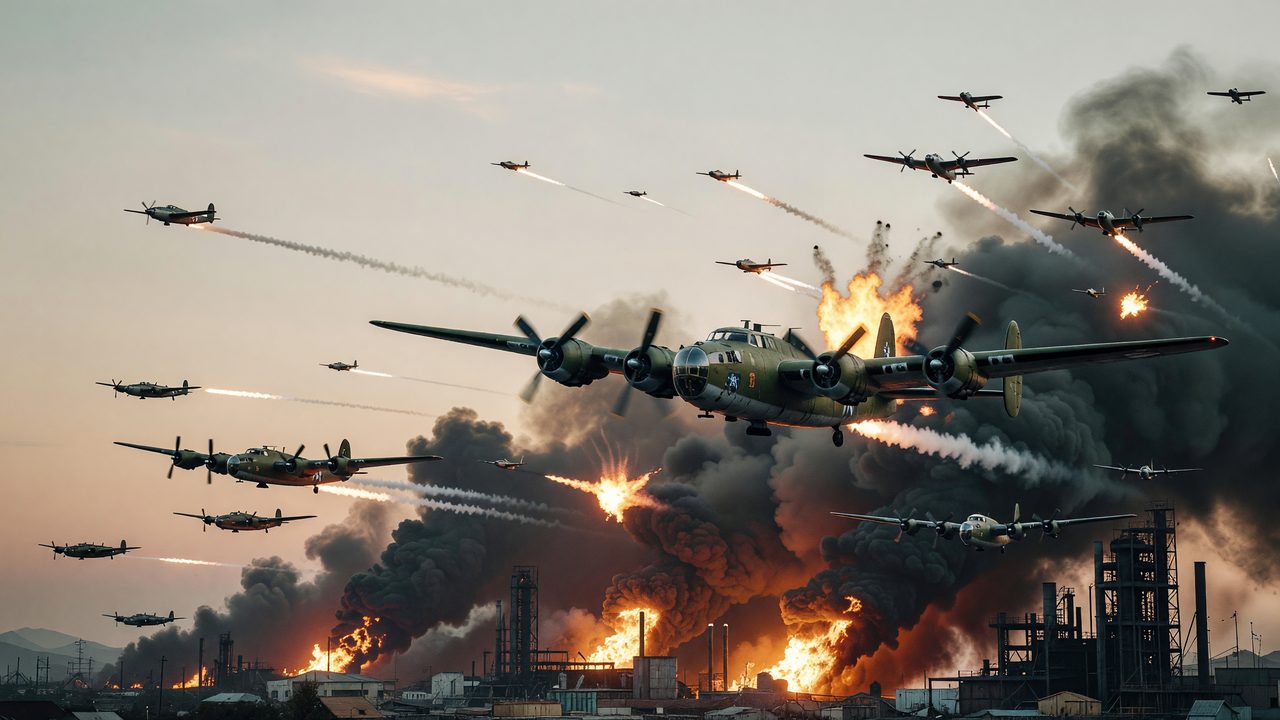
Into the Flak: The Ploesti Raid That Rewrote Courage—and Cost
On 1 August 1943, 178 B-24 Liberators left Libya on a treetop run to Romania’s oil fields. What followed was the most decorated—and most costly—single mission in U.S. Army Air Forces history.
Churchill’s Taproot
By mid-1943, Allied planners understood that petroleum was the sinew of the Third Reich. Winston Churchill had called Romania’s Ploesti refineries the “taproot of German might,” and intelligence placed roughly a third of Axis crude processing capacity within a few square miles north of Bucharest. Destroy those stacks and cracking plants, the theory ran, and tanks, aircraft, and U-boats would starve for fuel.
The U.S. Army Air Forces answered with Operation Tidal Wave—a gamble born of distance and desperation. Ninth Air Force B-24 Liberators staged from dusty fields near Benghazi, Libya, more than 1,000 miles from the target. Standard doctrine called for high-altitude daylight precision bombing: form up, climb into the cold, and drop from above the heaviest flak. Ploesti demanded something else. Planners chose a low-level approach at treetop height, hoping to slip under German radar and put bombs directly into refinery infrastructure before defenders could react. As Air University historians later noted in “Today’s Target is Ploesti: A Departure from Doctrine,” the mission was a deliberate break from the bombing philosophy the USAAF had been built to execute.
The Long Run In
Shortly after dawn on 1 August, 178 Liberators roared off the Libyan desert carrying 1,726 crewmen. For hours they stayed low over the Mediterranean and Balkan countryside, heat and dust boiling in the cockpits, terrain rushing past at altitudes where a moment’s inattention meant a wingtip in the trees.
The gamble unraveled before the first bomb fell. Clouds over the mountains broke the carefully rehearsed formations. Then the lead navigator for one strike force turned short of the IP. Aircraft that should have arrived together came piecemeal over a landscape already alert. Surprise—the entire premise of the low-level plan—was gone. According to the National Museum of the United States Air Force account of Operation Tidalwave, raiders found themselves threading smokestacks and storage tanks while ground gunners and fighters threw up a lethal curtain of fire.
Fire at Refinery Level
What followed was not precision bombing but industrial warfare at eye level. Crews flew into a maze of chimneys, pipelines, and balloon cables, dodging towers while flak burst at windshield height. Some groups pressed their runs through walls of tracer; others fought to regroup and find targets through smoke and chaos. Gunners traded shots with fighters slashing between the bombers. Liberators collided with obstacles, absorbed hits in wings and cockpits, and limped toward the Adriatic or went down in Romanian fields.
When the day ended, the arithmetic was brutal. Fifty-four bombers failed to return. Three hundred ten airmen were killed and 186 captured. Five crew members received the Medal of Honor—the largest number ever awarded for a single American air action, a measure of individual heroism on a scale the USAAF had never seen. The U.S. Air Force’s official history of Operation “Tidal Wave” records both the devastation inflicted and the price paid in blood.
Damage and Aftermath
The refineries burned. Storage tanks collapsed. For a few weeks the Axis fuel picture looked genuinely threatened. Yet the same assessment that chronicled the raid’s courage also documented its strategic limits: German engineers repaired much of the complex within weeks, and output recovered faster than planners had hoped. Tidal Wave did not cut the taproot.
It did prove something else. Ploesti showed that the Allies would strike deep into Europe to reach the enemy’s oil, and that Axis air defenses could punish even the boldest plan. The mission entered Air Force memory as a benchmark of valor—and as a warning etched in wreckage and empty bunks at Benghazi.
Why it matters to you
Modern training still circles back to the question Tidal Wave forced in 1943: when do you abandon doctrine for a single high-risk solution? The USAAF dropped its high-altitude precision model because low-level attack promised radar avoidance and accurate hits on discrete refinery targets across 1,000 miles of enemy territory. On paper it was logical; in the air, it depended on flawless navigation, intact formations, and perfect timing. Clouds, one wrong turn, and lost surprise turned a treetop ingress into the deadliest kind of flying—low, fast, and saturated with anti-aircraft fire.
That is why briefing discipline, route study, and contingency planning remain non-negotiable skills. A rated pilot today may never fly a combat ingress, but every IFR departure and every low-level transition still punishes the same failures: broken formation, confused navigation, pressing ahead when the plan’s central assumption—surprise, weather, fuel, communications—no longer holds. Ploesti is not an antique story about courage alone. It is a case study in how one doctrinal departure, executed brilliantly by individuals but undermined collectively, can convert a daring plan into a lesson written at treetop height.