Hangar Talk: The Dialect Pilots Never Put in the Manual
" a slow trainer was a "
Hangar Talk: The Dialect Pilots Never Put in the Manual
From Royal Flying Corps trainees called "Huns" to Edwards jet jockeys with "pinball machines," aviation slang is the profession's unwritten logbook—and it still shapes how pilots think, brief, and fly.
Every tribe has its tongue. Aviators forged theirs in adrenaline, oil, and altitude long before anyone wrote a formal syllabus for it. Outsiders who wandered onto a wartime aerodrome in 1917 heard what sounded like nonsense. The British Royal Flying Corps had already turned ordinary English into something sharper and stranger. A trainee was a "Hun"—not an enemy, but a novice still learning the trade. A slow, ungainly trainer might be dismissed as a "quirk" or a "rumpty." When a pilot pulled the nose up hard, he was not merely climbing; he was executing a "zoom." A heavy, flat arrival on the grass earned the blunt verdict of a "pancake." Even a crash could be dressed in bravado: a pilot might insist that a violent arrival had done nothing worse than put a "vertical gust up me." Contemporary reporting in the Daily Mail of 19 July 1917, under the headline "Airmen in the Making," captured that early RFC vocabulary at the moment it was still fresh—slang as proof that flying was already a culture, not only a craft.
Across the Atlantic, American barnstormers and airfield regulars were building a parallel dialect. By the late 1920s, the language of the ramp had its own rhythms and judgments. A pilot who had not flown in a week had not, in the local idiom, "cracked a throttle"—a phrase that measured currency in motion, not calendar dates. To "hoik 'em up" was to lift off aggressively enough to clear obstacles on takeoff, the verb carrying the whole geometry of a short field in a single syllable. A daredevil needed no lecture; he was simply "hot." An International News Service dispatch published in the Lima News on 12 October 1928, "New English is Made for Uses on Air Fields," documented that American airfield slang for readers far from any hangar. The piece treated the patter as news because it was: pilots were inventing words faster than dictionaries could follow.
Officialdom noticed. The National Advisory Committee for Aeronautics spent years trying to impose order on a field that resisted tidy labels. Between 1916 and 1934, NACA issued seven formal nomenclature reports gathered under the title Nomenclature for Aeronautics, an ambitious effort to standardize how engineers, manufacturers, and government agencies described aircraft and their parts. Historians of technical language have traced that committee work in studies of how American aeronautical vocabulary was shaped by conference and compromise. NACA's reports mattered enormously to design offices and wind tunnels. They did not, however, tame the language of the hangar. On the line, where wrenches turned and preflight briefings were half joke and half warning, pilots kept choosing words that fit the hand and the gut. Precision had its place in a drawing; on the ramp, "rumpty" told you more about an airplane's soul than any committee-approved adjective.
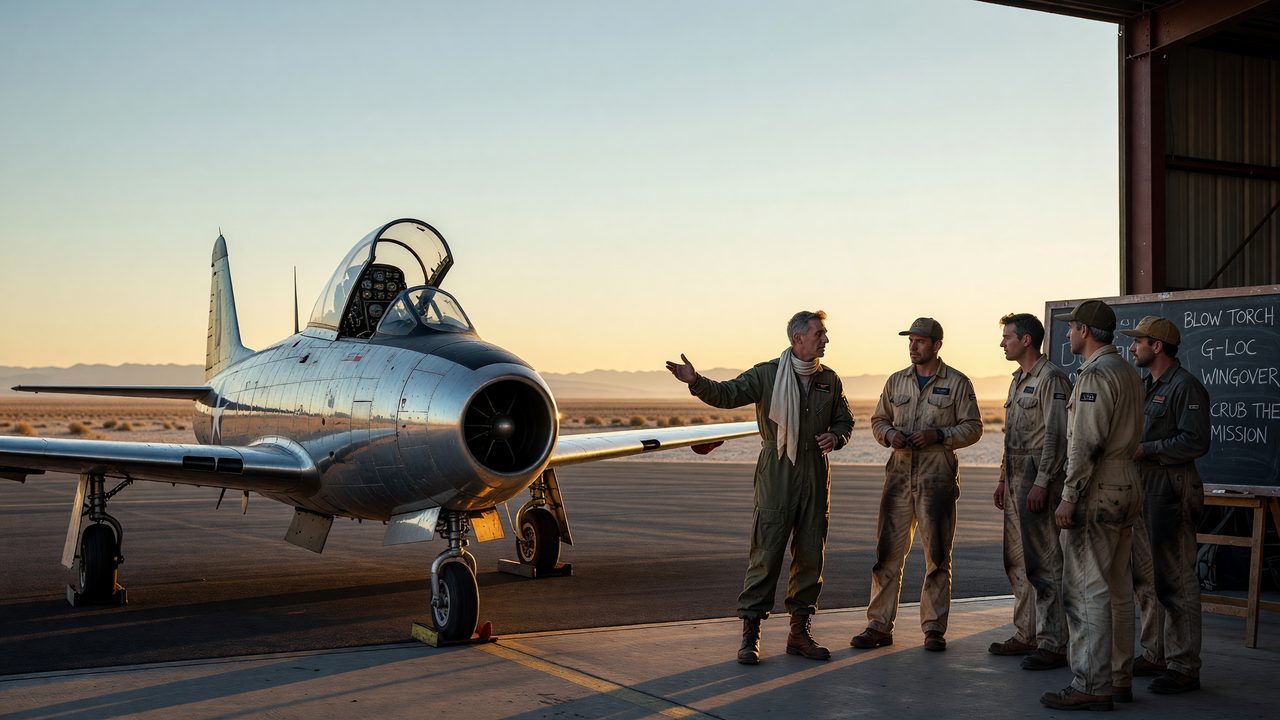
The jet age added another layer. At Edwards Air Force Base in 1950, test pilots and jet crews were already speaking a dialect tuned to speed, heat, and new kinds of risk. A jet might be a "squirt job." The instrument panel, crowded with unfamiliar gauges and annunciators, became a "pinball machine." Brakes were "binders," and when a pilot needed to stop in a hurry he "chomped" them. The base newspaper Desert Wings carried an Armed Forces Press Service dispatch on 30 June 1950 titled "Jet Jockey Slang," preserving that postwar vocabulary at the moment jets were rewriting what it meant to be a pilot. Terms like "dead stick" and phrases such as "fat and flute happy"—hangar speech that mixed fatalism, humor, and technical shorthand—showed that even as aircraft grew more complex, the human voice remained the first interface between pilot and machine.
From "pancake" to "pinball machine," from "zoom" to "squirt job," this slang is not decoration. It is memory compressed into syllables: how a community describes fear without freezing, competence without boasting, and failure without surrender. The words change with the hardware, but the impulse does not. Every generation of aviators inherits a dialect and then bends it to new realities.
Why it matters to you
When you step into a flight school briefing room or listen on the CTAF, you are hearing the latest chapter of the same story. Standard phraseology keeps the airspace safe; hangar slang keeps the culture legible. Learning both is part of becoming a rated pilot. The RFC pilot who blamed a "vertical gust," the barnstormer who had not "cracked a throttle," and the Edwards jet jockey staring at a "pinball machine" were all doing what you do today when you absorb how experienced pilots describe a gusty crosswind, a stale checkout, or an unfamiliar glass cockpit: they were translating machine behavior into language a human can act on under pressure. That habit—turning sensation and risk into shared words—is a professional skill. It builds situational awareness, sharpens judgment in debriefs, and reminds you that aviation remains a spoken craft. Every tribe has its tongue. Yours is still being written on the ramp, in the pattern, and in the hangar after the engine cools.