Hands Off the Stick: How a 21-Year-Old Rewrote Instrument Flight
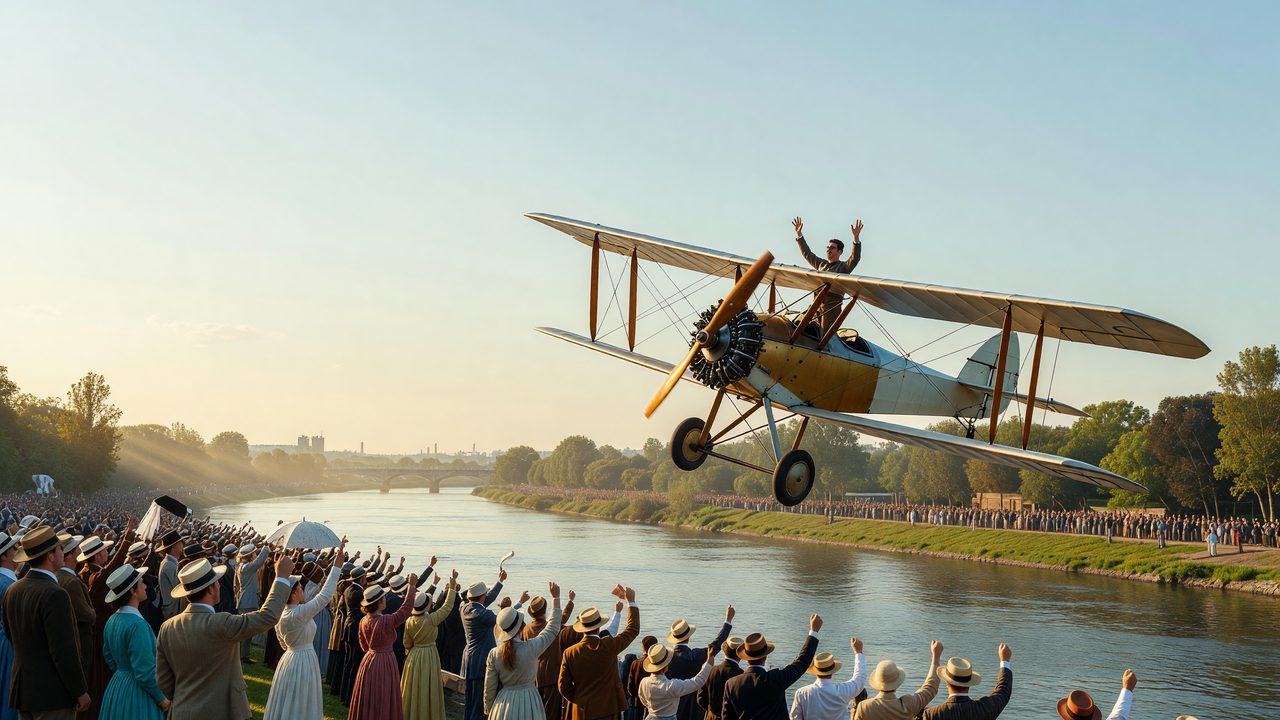
"On 18 June 1914, the banks of the Seine River near Paris ..."
Hands Off the Stick: How a 21-Year-Old Rewrote Instrument Flight
On a June afternoon along the Seine, Lawrence Sperry proved that a spinning wheel could hold an airplane steady—and changed what pilots could trust when the horizon vanished.
The summer of 1914 found European aviation obsessed with a single question: how to make flying survivable. The Concours de la Sécurité en Aéroplane—an international contest devoted to airplane safety—drew fifty-seven specially equipped machines to the Seine River corridor between Pont Bezons and Pont Argenteuil, just northwest of Paris. Judges, engineers, and a thick crowd of spectators lined the banks on 18 June, expecting demonstrations of parachutes, structural reinforcements, and other hardware meant to keep aviators alive. What they witnessed instead was something stranger and more consequential: a young American pilot who refused to touch his controls.
Lawrence Burst Sperry was slight, barely twenty-one, and already steeped in gyroscopic machinery. His father, Elmer Ambrose Sperry, had built a fortune on spinning mass—gyrocompasses for warships, stabilizers that damped a vessel’s roll in heavy seas. Lawrence had spent his adolescence in workshops and hangars, translating that maritime logic into aviation. By 1913 he held Federal Aeronautics Pilot License No. 11 from the Aero Club of America. He arrived in France with a Curtiss C-2 biplane carrying his own invention: a compact gyroscopic stabilizer, scaled for an aircraft and wired to move control surfaces when the machine departed from its commanded attitude.
The device was not magic, only disciplined physics. A rapidly spinning gyro resists displacement from its plane of rotation; link that resistance to elevators, ailerons, and rudder through servo mechanisms, and the airplane fights to recover equilibrium without constant human correction. Contemporary accounts and Sperry’s own U.S. patent filings describe a unit weighing well under fifty pounds—roughly eighteen inches on a side—mounted where it could sense pitch, roll, and yaw and answer disturbances in kind. It was, in essence, the first practical autopilot.
Sperry’s first pass before the judges was deliberate theater. He engaged the stabilizer, lifted both hands above his helmet, and flew the length of the course in level, coordinated flight. The biplane held its line as if guided by an invisible crew chief. The crowd understood the implication immediately: a pilot could be freed, even briefly, from the relentless physical labor of stick-and-rudder balancing.
Sperry was not finished. On a second run he staged a harsher test. His mechanic, Emil Cachin—a Frenchman who shared little language with his American employer but plenty of mechanical trust—climbed out of the cockpit and onto the starboard wing. The sudden shift in center of gravity should have driven the Curtiss into a bank. It did, for a heartbeat. Then the gyroscope sensed the upset, commanded corrective deflection, and the airplane steadied itself while Cachin stood exposed above the water. Spectators erupted. A safety competition had become a ballet of controlled instability.
The demonstration records from the Concours, together with Sperry’s patent documentation, mark that afternoon as the public birth of automatic flight control. Sperry took first place and a prize of fifty thousand francs—roughly ten thousand U.S. dollars—cementing his reputation across two continents. William Scheck’s later historical account in Aviation History, drawing on archival material, frames the event as the hinge between stunt flying and instrument-era discipline. Air Force Times echoed that judgment a century on: the teenager on the Seine had shown that attitude could be delegated to machinery governed by law, not luck.
Sperry’s life ended violently in 1923, when he disappeared on a flight across the English Channel, yet the lineage he launched did not. He refined gyrostabilizers through World War I, pushed toward bombing autopilots, and helped seed the instrument suite—artificial horizon, turn coordinator, airspeed and drift indicators—that would later define blind flying. The Sperry name migrated through corporate mergers into the supply chains of modern avionics manufacturers. The hardware changed; the principle did not.
Why it matters to you
Every time you engage an autopilot, flight director, or stability augmentation system, you are exercising engineering logic first demonstrated when Lawrence Sperry raised his hands over the Seine. Your training in attitude instrument flying, partial-panel recovery, and automation management assumes that gyroscopic reference can be trusted to hold pitch, bank, and heading when visual cues fail or workload spikes. That trust did not arrive with glass cockpits. It began with a spinning mass on a Curtiss biplane, correcting for a mechanic’s weight on the wing. Know the history, and you fly the automation as Sperry intended—not as a substitute for airmanship, but as a disciplined extension of it.