Hands-Off Across America: How the L-1011 Taught Jets to Land Themselves
"November 16, 1970"
Hands-Off Across America: How the L-1011 Taught Jets to Land Themselves
Before GPS-guided approaches and digital flight decks became routine, one wide-body trijet from Palmdale proved that a commercial airliner could fly itself from rotation to rollout—and changed what “autopilot” meant forever.
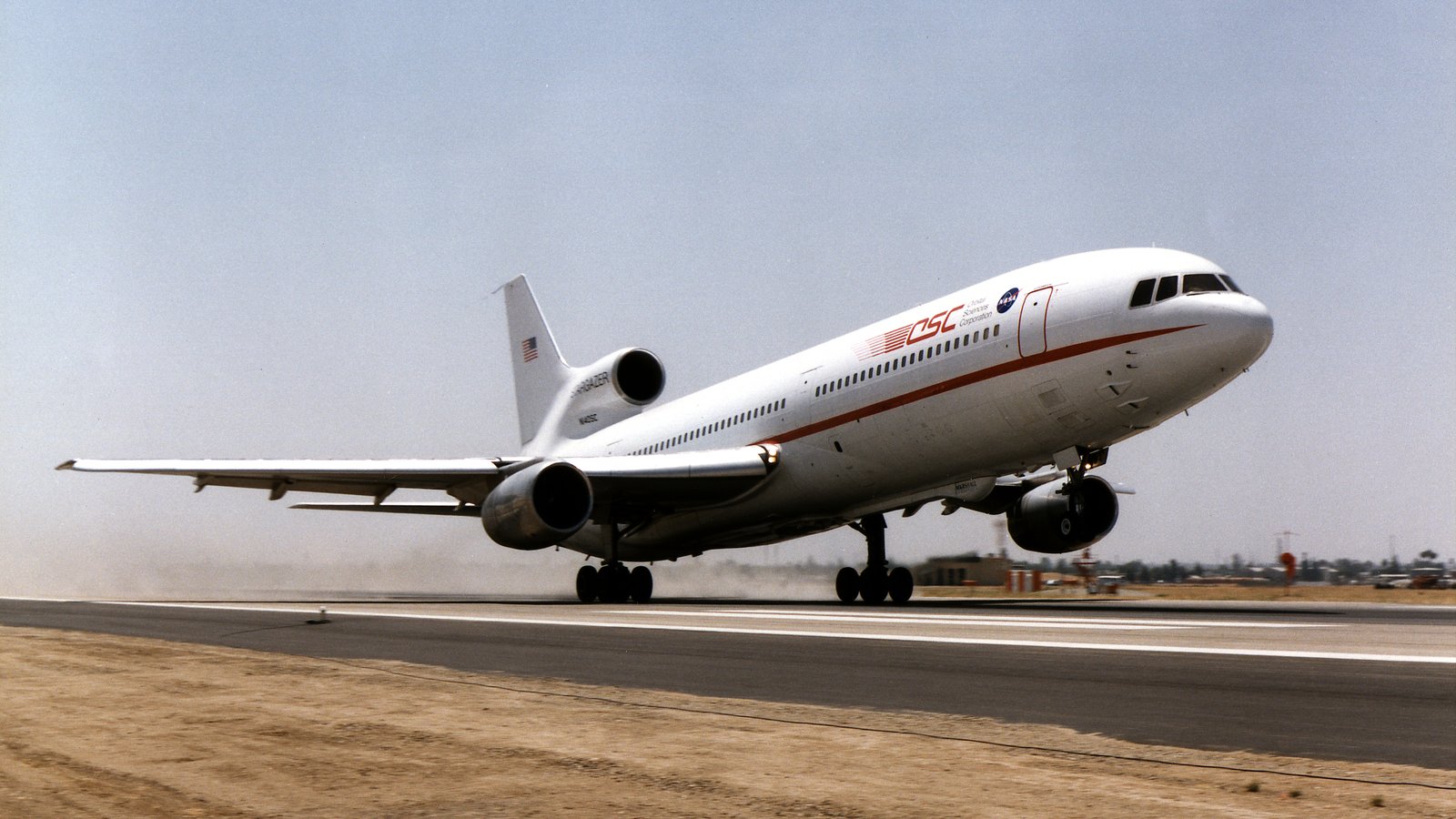
On the morning of November 16, 1970, the high desert north of Palmdale offered the kind of clear, hard light that flight test crews prize. Test pilot Henry Baird “Hank” Dees advanced the throttles on a prototype that bore little resemblance to the angular jets of the previous decade. The Lockheed L-1011 TriStar arched upward with a curved nose, low-set wings, and a tail engine fed through an S-duct—lines that contemporaries compared to a dolphin carved from aluminum. Co-pilot Ralph C. Cokely rode the right seat while flight test engineers Glenn E. Fisher and Rod Bray watched over the instrument panels that would define the aircraft’s legacy. For two and a half hours the ship climbed to 20,000 feet and cruised at 288 miles per hour, marking Lockheed’s return to commercial airliner production after the turboprop Electra had ended that chapter nearly a decade earlier.
Lockheed had conceived the TriStar in the mid-1960s as a technologically ambitious answer to American Airlines’ call for a wide-body jet suited to dense domestic routes and transcontinental service. Where rival Douglas leveraged existing DC-8 architecture to field the DC-10 quickly, Lockheed pursued a more advanced path: a fly-by-wire Automatic Flight Control System that could command the aircraft through altitude changes, course intercepts, and—most radically—an automatic landing locked onto ground-based radio beacons. Pilots dialed in targets and monitored performance while the AFCS translated electrical signals into control-surface movement. The cabin offered luxuries of its era—glare-resistant windows, coat closets, even a below-deck galley with elevators—but the feature that mattered most to crews sat behind the glare shield.
The promise became public proof on May 25, 1972. Veteran Lockheed test pilots Anthony LeVier and Charles Hall lifted off from Palmdale with 115 employees, crew members, and reporters aboard and flew east to Washington Dulles International Airport. For four hours and thirteen minutes the TriStar’s AFCS remained engaged from takeoff roll through touchdown—what Lockheed Martin’s historical record describes as the first cross-country flight of a commercial airliner flown without human hands on the controls. The demonstration was not a laboratory stunt divorced from airline operations. Eastern Airlines had already placed the type into scheduled service on April 30, 1972, flying passengers between Miami and New York. Eastern would later dub the jet the “Whisperliner” for its quiet cabin, but pilots knew it for something else: an airliner the Federal Aviation Administration cleared to complete Category III autoland approaches when weather closed other wide-bodies to their destinations.
Market history, however, refused to reward engineering elegance on its own timetable. Rolls-Royce’s financial collapse and entry into receivership in 1971 choked RB211 engine deliveries and stalled TriStar production while Douglas’s DC-10 reached operators first. A British government rescue and U.S. loan guarantees kept the program alive, but the delay cost orders and margin. Lockheed built 250 L-1011s before ending TriStar production in the early 1980s and withdrawing from the commercial passenger market—its final act in a line that had begun with the Electra. The California Wunderplane, as enthusiasts at the Flight Path Museum LAX have called it, mastered the atmosphere more convincingly than the ledger.
Why it matters to you
Every time you brief a coupled ILS, watch the flight director capture glideslope, or trust the autopilot/flight-director system through minimums on a Category I—or, in appropriate aircraft, a lower-visibility—approach, you are exercising concepts the L-1011 helped normalize: precise radio-navigation tracking, flight-control automation with human monitoring, and the disciplined division of authority between pilot and machine. Modern avionics have replaced much of the TriStar’s analog hardware, but the operational logic endures. You remain the final authority; the automation executes what you command and verify. Studying how the L-1011 earned autoland certification sharpens the habit that keeps automation an asset rather than a distraction: know what the system is doing, why it is doing it, and exactly when you will take over. That discipline, born in the Palmdale sky in 1970, remains one of the most valuable skills in your training.