Grand Central Stations of the Sky
"Berlin's Tempelhof Airport opened on October 8, 1923, on a former Prussian parade ground."
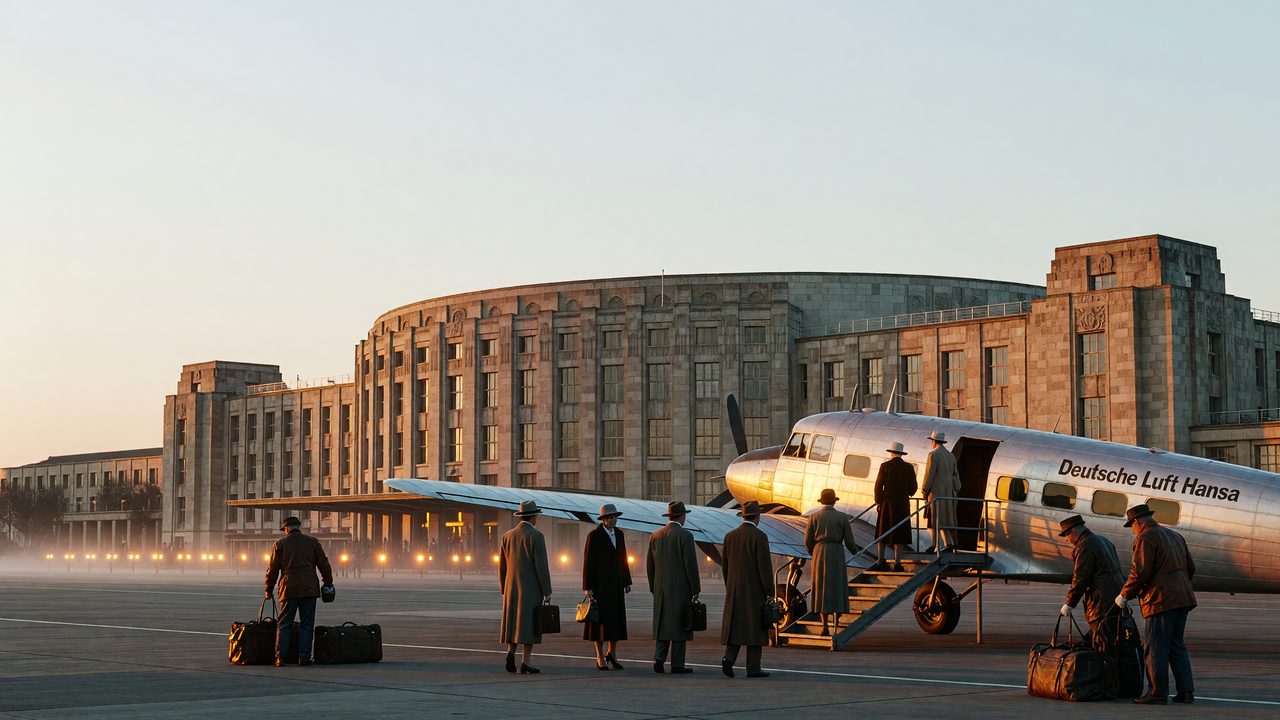
Grand Central Stations of the Sky
Before jets and jumbo terminals, three European airfields taught the world how to board an airplane, cross a border, and believe the continents had grown close enough to touch.
London’s First Real Airport
When Hounslow Heath closed in March 1920, commercial aviation needed a permanent home nearer the capital. Croydon answered. London Terminal Aerodrome opened on 29 March 1920 on a former First World War airfield, and within a decade it had become something the world had never seen before: a working airport designed as a single, coherent machine.
The Historic Croydon Airport Trust records that Britain’s 1925 Airport Expansion Act funded a wholesale rebuild. When the Administration Building opened in 1928, it became the world’s first purpose-built airport terminal — not a converted hangar or military shack, but a structure organized around departure and arrival as sequential processes. Customs, ticketing, waiting rooms, and ramp access flowed in zones, a layout that still shapes how you move through terminals today.
Croydon was also where Britain learned to manage air traffic as a public responsibility. Radio officer F. S. “Stanley” Mockford coined the international distress call “Mayday” there in 1923, adapting the French m’aider into a word that could cut through static. From this field rose Imperial Airways, the airline that would eventually become British Airways. Amy Johnson, Jean Batten, and a generation of record-seekers departed from its grass runways into global celebrity. For a pilot studying the Golden Age, Croydon is the proof that infrastructure — not just aircraft — creates aviation.
Berlin’s Beating Heart
South of the city center, Tempelhof Field had been parade ground, balloon launch site, and spectacle stage long before scheduled service arrived. On 8 October 1923, the first airline operation began; the magistrate soon committed to developing Berlin’s central airport on the site. Architects Paul and Klaus Engler completed the main terminal complex by 1928, giving Deutsche Luft Hansa — formed in January 1926 from the merger of Aero Lloyd and Junkers Luftverkehr — a headquarters beside the runways.
By 1930, according to Tempelhof Airport’s historical archives, the field ranked as Europe’s largest airport by passenger volume. Luft Hansa’s network reached 71 cities, 25 of them outside Germany, with Tempelhof at the center of a continent-spanning web. Pilots trained there in instrument flying from 1930 onward, a professionalization that mirrored the field’s growing complexity. Transatlantic fever followed close behind: in June 1927, Clarence Chamberlin and Charles Levine brought their aircraft Columbia to Tempelhof after a marathon flight from New York, and Berlin turned out as if the ocean had narrowed overnight.
A darker chapter followed. The vast terminal Ernst Sagebiel designed between 1936 and 1941 — integrating hangars, check-in, and administration into one colossal curve — became a monument to National Socialist architectural ambition and, during the war, a factory floor. Yet Tempelhof earned a second life. When Soviet forces blockaded West Berlin in June 1948, Allied aircraft landed around the clock on the same field, delivering coal, food, and medicine until the siege lifted in May 1949. The airlift turned a symbol of authoritarian scale into one of logistical courage — and gave every pilot who studies fuel planning, load limits, and relentless scheduling a case study written in flour and coal dust.
Paris and the Public Imagination
French aviation did not wait for concrete terminals to capture the public. In 1908 the Société d’Encouragement à l’Aviation chose a park at Viry-Châtillon, south of Paris, for Port-Aviation — described in contemporary records compiled by The First Air Races as the world’s first purpose-built airfield, complete with hangars, marked courses, and grandstands. Officially inaugurated in May 1909, it hosted the Grande Quinzaine meeting that October, when Parisians streamed in by train from nearby Juvisy station to watch machines they had previously known only from newspapers.
Northwest of the city, Paris–Le Bourget entered commercial service in 1919 and remained the capital’s sole airline airport until Orly opened in 1932. Its defining hour came on the night of 21 May 1927, when Charles Lindbergh’s Spirit of St. Louis emerged from the Atlantic darkness and a waiting crowd surged across the field. Radio, telephone, and newsreel cameras spread the moment worldwide — aviation’s first truly global media event, and one that fixed Le Bourget in the pilot’s imagination forever.
The field’s exhibition heritage proved equally durable. After postwar revival, the Paris Air Show found a permanent home at Le Bourget in 1953, carrying forward a tradition that began when aircraft shared floor space with automobiles at the Grand Palais in 1909. Today Le Bourget serves business aviation and hosts France’s Air and Space Museum, but its name still means arrival at the edge of the possible.
Gateways to Empire
Croydon, Tempelhof, and Le Bourget were never interchangeable. Britain routed empire mail and long-range flying boats through its suburban terminal; Germany built a continental hub with night routes and instrument training at its core; France supplied both the world’s earliest purpose-built flying ground and the airfield where a solitary Atlantic crossing became folklore. Together they formed the Grand Central Stations of the Golden Age — places where passengers learned to trust scheduled flight, where governments learned that airports required law and architecture, and where the twentieth century discovered that distance was negotiable.
Why it matters to you
Every preflight briefing you give or receive rests on infrastructure decisions made at fields like these. Croydon’s terminal zoning still echoes in how FBOs and airline concourses separate landside from airside; Mockford’s Mayday remains the standard you hope never to need, but must pronounce clearly if you do. Tempelhof’s 1930 hub status reminds you that a runway is only one node in a network — weather, alternates, fuel, and ATC coordination turn a piece of pavement into a system. The Berlin Airlift, meanwhile, is the ultimate lesson in disciplined operations under pressure: repetitive approaches, strict loading, and crews who flew because a city depended on it. Study these airfields not as nostalgia, but as the origin story of the professional culture you inherit every time you taxi for departure.