Gemini: The Workshop Between Worlds
"970 hours"
Gemini: The Workshop Between Worlds
If Mercury proved that a human being could endure the vacuum, Gemini proved that a crew could work there—and the skills it forged still echo in every cockpit where precision is not optional.
On January 3, 1962, NASA formally conceived Project Gemini as the indispensable engineering bridge between Mercury’s single-seat capsules and Apollo’s three-man lunar voyages. The question had shifted. Mercury had asked whether a man could survive in space. Gemini would ask whether he could work there—changing orbits, meeting another vehicle in the void, stepping outside his spacecraft, and returning to Earth on command rather than by luck. NASA’s own program documentation, laid out in Gemini Program Working Paper No. 5019, Gemini Program Objectives and Mission Guidelines, framed those demands with bureaucratic clarity and operational ruthlessness: demonstrate long-duration flight of up to two weeks; perfect rendezvous and docking with another orbiting vehicle; execute extravehicular activity; master controlled reentry to a precise landing point; and build the proficiency of flight and ground crews until orbital flight resembled a practiced profession rather than a dare.
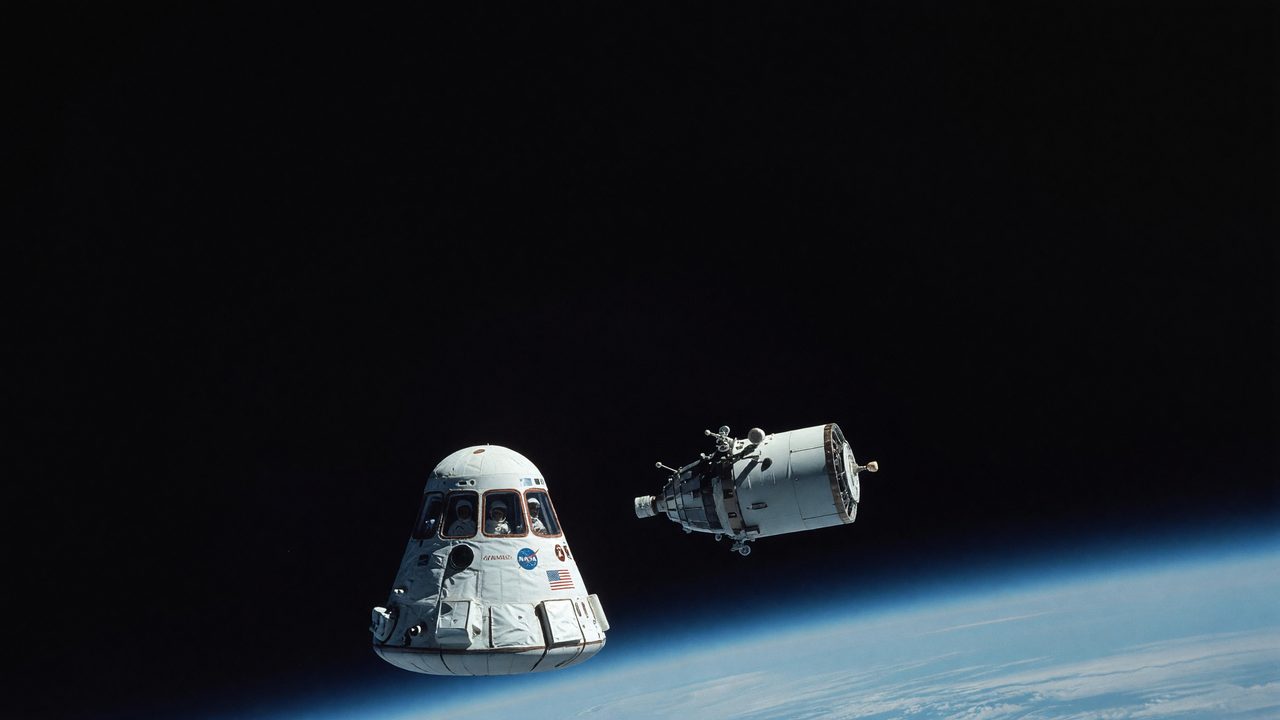
The spacecraft itself was a study in compressed ambition. Built by McDonnell Aircraft, it weighed 8,490 pounds and carried two astronauts in a cabin often compared to the front seats of a Volkswagen Beetle—close quarters where every switch, gauge, and restraint mattered. What distinguished Gemini from its Mercury predecessor was maneuverability. The Orbital Attitude and Maneuvering System, or OAMS, gave crews the ability to change orbits deliberately. That capability was not a laboratory curiosity. Rendezvous in space required a chasing spacecraft to adjust altitude, phase, and closure rate with mathematical discipline. So would the lunar mission architecture still being drawn on drafting tables: a lunar module lifting from the Moon’s surface would need to climb into an orbit where a command module could find it. Gemini would rehearse that logic in Earth orbit, again and again, until the choreography became reflex.
Between March 1965 and November 1966—a span of barely twenty months—NASA launched two uncrewed and ten crewed Gemini missions, supported by seven Agena target vehicles. The pace was relentless. Gemini IV kept Edward White outside his spacecraft on America’s first planned extravehicular activity, tethered to a machine moving at five miles per second. Gemini VI-A and VII achieved the first rendezvous of two crewed spacecraft, a feat that turned abstract orbital mechanics into something a pilot could feel through hand controller and thruster pulse. Later missions closed the distance further: docking with an Agena, conducting station-keeping, practicing reentry profiles that aimed not merely at an ocean but at a defined recovery zone. By the program’s end, Gemini had logged 970 hours of spaceflight. The raw courage of Mercury had been transformed into practiced skill—the kind of skill a lunar landing would demand.
The program’s legacy, as NASA has noted in its retrospective accounts of the era, extended far beyond the race to the Moon. Gemini pioneered technologies and procedures that continue to shape human spaceflight: long-duration life support, orbital maneuvering, precision recovery, and the integrated teamwork of crew and mission control under sustained stress. It was, in the agency’s own framing, the workshop where Americans learned to live and labor in the void.
Why it matters to you
The legacy of this moment—if Mercury asked whether man could survive in space, Gemini asked whether he could work there—continues to influence modern aviation practice in ways that should feel familiar to anyone training for a rating today. Rendezvous is not only an orbital problem; it is a problem of closure rate, energy management, and situational awareness. Gemini crews learned to fly toward a target they could not touch, adjusting trajectory in small, timely corrections rather than heroic last-second saves—the same discipline that governs merging, intercepting a final approach course, or managing a stabilized descent when the margin for error is thin. Controlled reentry to a precise point demanded mastery of energy, attitude, and predictable outcomes rather than approximate survival. That is the pilot’s contract with every landing: not merely arriving, but arriving where intended, with reserves intact. And the cramped, unforgiving Gemini cabin trained two people to divide labor, cross-check one another, and execute under fatigue—crew resource management before the phrase existed. When you brief a flight, monitor an instrument scan, or call out a deviation before it becomes an emergency, you are practicing the inheritance of a program that turned spaceflight from a stunt into a profession. Gemini built the bridge. Every precise approach you fly walks across it.