Gates at Sea Level: How Red Bull Reinvented Pylon Racing for Television
"The series expanded rapidly, gaining World Championship s..."
Gates at Sea Level: How Red Bull Reinvented Pylon Racing for Television
For sixteen years, the world's fastest pilots threaded inflatable pylons above harbors and city skylines—turning a forgotten interwar spectacle into a global motorsport, then proving how hard that dream is to sustain.
A Hungarian Blueprint Takes Flight
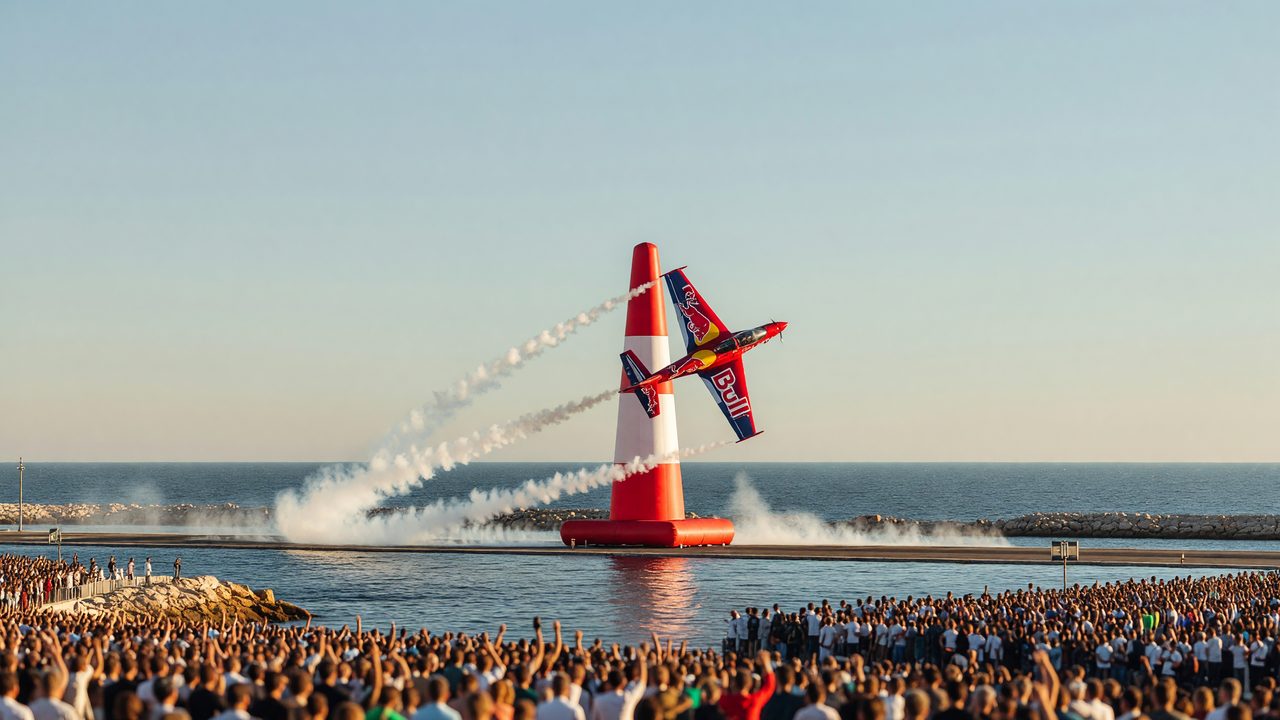
Long before a million spectators lined the Barcelona waterfront, the Red Bull Air Race existed as an idea in a hangar. Hungarian aerobatic champion Péter Besenyei—one of the architects behind the concept—made the first test flight through the prototype Air Gates in 2003, validating a course format that had vanished with the closed-circuit age of Thompson and Bendix. The inaugural World Series opened at Zeltweg, Austria, on June 28 of that year; Besenyei fittingly claimed the first title after victories in Austria and his native Budapest. Red Bull's own historical record and Content Pool archives document those earliest seasons as equal parts engineering trial and flying circus: fabric pylons anchored on water, raceplanes screaming between them at altitudes that would make any flight instructor wince.
World Championship, World Calendar
The experiment hardened quickly into institution. The Fédération Aéronautique Internationale granted official World Championship status in 2005, and American Mike Mangold seized the first sanctioned crown with a dominant run—five wins across seven races—while a deepening pilot roster stretched the map. By 2007 the calendar reached ten events, carrying the championship to five continents and settings from Rio de Janeiro beneath Christ the Redeemer to the Hudson River with the Statue of Liberty as backdrop. Crowds followed. Red Bull's highlight chronicle records the 2009 Barcelona finale as the series' attendance apex, with an estimated one million spectators packing the Catalonian coast. That afternoon also delivered a long-deferred coronation: Britain's Paul Bonhomme, runner-up on a tiebreaker in 2007 and again in 2008, finally wore the world title after a season-long duel with Austria's Hannes Arch.
Technology at the Threshold
If Reno Air Races preserved the piston thunder of an earlier century, Red Bull Air Race addressed a different problem—how to make solo time-trial flying feel like wheel-to-wheel combat in the jet age. The answer layered broadcast engineering onto aerodynamic craft. Standardized Lycoming engines and Hartzell propellers arrived with the 2014 relaunch, shifting advantage toward pilot skill, while teams experimented openly with winglets that traded drag for grip in knife-edge turns. GPS-fed race simulators let crews rehearse gate sequences before wheels touched foreign soil. From 2015 onward, the "Ghost Plane" overlaid a leader's flight path onto live video, giving television audiences the head-to-head drama the format's safety rules forbade in the sky. Later seasons pushed into virtual reality, piping cockpit data into immersive views that won industry recognition. The pylons themselves—tall, tear-resistant inflatables designed to collapse on impact—embodied the same philosophy: contain risk without draining spectacle.
Glory, Grounding, and a Final Pass
Beneath the glamour, the business of air racing proved brittle. After incidents that underscored how tight courses and rising speeds strained an outgrown structure, Red Bull cancelled the entire 2011 season to rework safety and operations; 2012 and 2013 followed the same fate. When the championship returned in 2014, it brought the Challenger Cup feeder class and tighter technical parity—yet the interruption marked a turning point. Bonhomme added one more title before retiring in 2015; German Matthias Dolderer, Japan's Yoshihide Muroya, and Czech Martin Šonka each claimed the crown in the revived era's compressed dramas. In May 2019 the FAI announced what pilots already feared: the series would not continue beyond that season. Three months later, along the Chiba shoreline in Japan, roughly 100,000 fans watched the last race unfold over the Pacific. Australia's Matt Hall clinched the final world championship as the gates were deflated for good—more than ninety races after the first, and the most successful modern attempt to marry pylon racing to mass media.
Why it matters to you
You will never fly through an Air Gate at 230 knots, but the disciplines the Red Bull era sharpened are the same ones your examiner watches for on a checkride. Race crews learned to manage energy through sequenced turns without bleeding airspeed—precisely the habit that keeps a student from overshooting final or chasing altitude with pitch alone. Their simulators and course briefings made gate geometry as familiar as a traffic pattern; your GPS track logs and chair-flying sessions serve the same purpose when you rehearse a crosswind landing or an instrument approach. The winglets they debated are now commonplace on production airframes, a reminder that every modification trades lift, drag, and controllability. And the series' hard lesson after 2010—that speed without structural margin invites catastrophe—echoes in every stall-awareness drill and every g-load limit you respect in aerobatic practice. The gates may be packed away, but the hunger for precision flying they exposed is still the standard your training is building toward.