From Hobby Shop to Gunnery Range: The Radioplane OQ-2
"The OQ-2 was a simple, low-wing monoplane powered by a sm..."
From Hobby Shop to Gunnery Range: The Radioplane OQ-2
Before stealth bombers and satellite-guided missiles, one of the most numerous American aircraft of World War II was a plywood target drone launched from a catapult—and its creator had once shared the screen with Alfred Hitchcock.
A Movie Star Builds a Flying Target
The story of the Radioplane OQ-2 begins not in a Pentagon briefing room but on Hollywood Boulevard. Reginald Denny, a British-born actor who had flown with the Royal Flying Corps during World War I, opened a model-aircraft shop in 1934 and soon turned his hobby into a company. By 1935 he was demonstrating radio-controlled prototypes to the U.S. Army, convinced that inexpensive unmanned aircraft could solve a problem that had vexed anti-aircraft gunners for years: how to practice against a moving target without burning through fuel, airframes, and pilots.
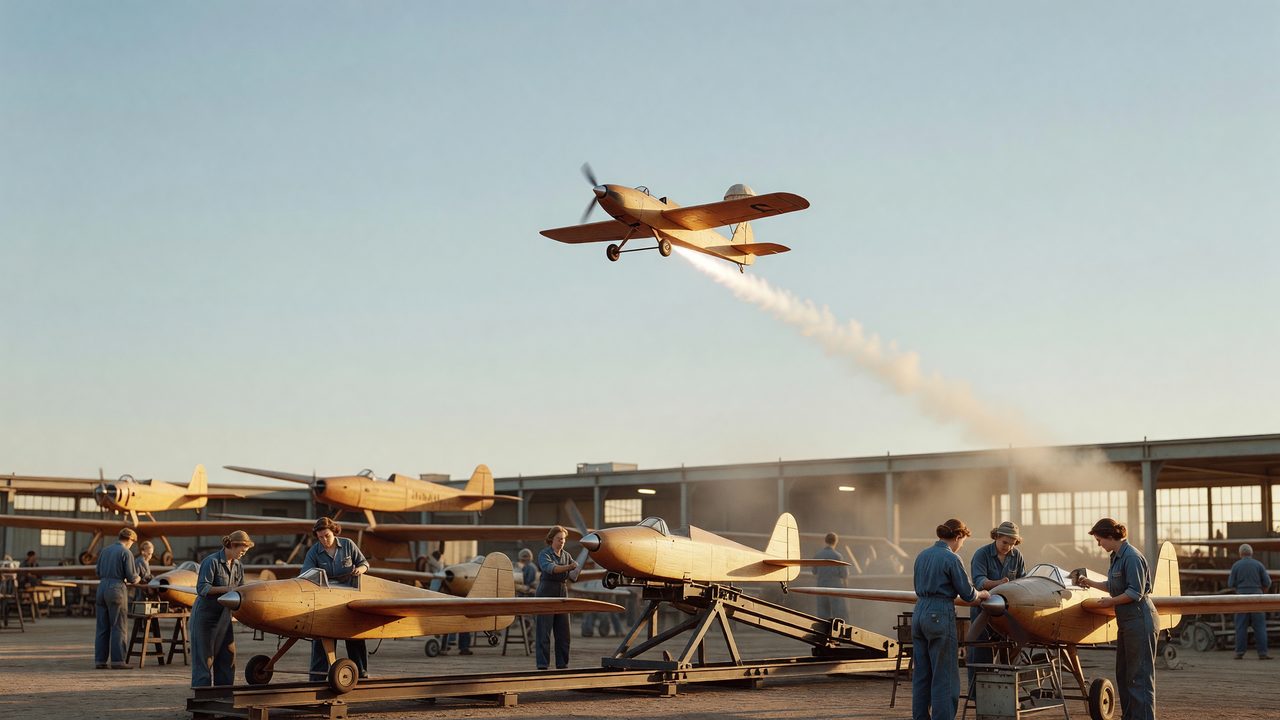
The Army agreed. In 1940 it placed its first production order, and by 1939 the design that would become the OQ-2 had already taken flight. Denny’s Radioplane Company, operating from a plant at Van Nuys Airport in the Los Angeles basin, delivered a simple low-wing monoplane powered by a small two-stroke engine—typically a Righter O-15-1 producing roughly seven horsepower—and controlled in flight by a Bendix radio system. Gunners tracked it across the sky; when the shooting stopped, a parachute brought the wreckage—or the lucky survivor—back to earth. Launch was by catapult only. There was no pilot aboard, and no pretense of glamour in the mission. The drone existed to be chased, fired upon, and replaced.
As curator Roger D. Connor of the National Air and Space Museum has noted, it was the demand for anti-aircraft training—not battlefield strike missions—that established unmanned aircraft as a viable industrial niche during the 1930s. The British de Havilland Queen Bee had proved the concept for naval gunnery; Denny gave the U.S. Army the smaller, cheaper answer it wanted.
Fifteen Thousand Targets
The OQ-2 entered service in 1941 as the Army’s OQ-2 and the Navy’s TDD-1, with improved variants following as the OQ-3 and beyond. Radioplane and its licensed contractors manufactured nearly 15,000 OQ-2 and OQ-3 drones during the war, a figure that places them among the most numerous American aircraft of the conflict—outproduced only by a handful of famous fighters and trainers. The OQ-3 alone accounted for more than 9,400 airframes. They were expendable by design, and that expendability was the point. Every drone shredded by .50-caliber fire or proximity-fused flak meant a gun crew somewhere had faced something closer to combat than a towed sleeve or a balloon on a cable.
The aircraft itself was modest in every dimension that mattered to a trainee looking through iron sights. It spanned a little over twelve feet, weighed roughly 100 pounds loaded, and cruised at speeds an instructor could describe without exaggeration. Endurance ran about an hour—long enough for a gunnery exercise, short enough to keep operations economical. Contra-rotating propellers driven by that buzzing two-stroke engine gave the little monoplane a distinctive silhouette against the California haze or the coastal sky above a Pacific fleet exercise. Smithsonian’s survey of unmanned-aircraft history records the OQ-2 as the first mass-produced unmanned aerial vehicle in the United States, a distinction that sounds modern until you remember that American factories were already building them by the thousand while many citizens still associated “drone” with a bagpipe’s low note.
The Photograph That Outlasted the Target
War work at Radioplane attracted more than ordnance officers. In June 1945, Army Air Forces Captain Ronald Reagan, then assigned to the First Motion Picture Unit, dispatched photographer David Conover to the Van Nuys assembly line on assignment for Yank, the Army Weekly. His brief was straightforward: document the women keeping production moving. Conover moved down the line until he noticed a young assembler named Norma Jeane Dougherty, her face smudged with factory grime, fitting propellers to an airframe. He asked her to pose. The photographs from that visit led to a modeling contract, a film career, and eventually a new name the world would recognize: Marilyn Monroe.
The irony is durable. One of history’s most famous faces entered public life beside an aircraft few people outside the gunnery community had ever heard of—an unmanned trainer destined for the weapons of the men who would never know its designation. The OQ-2’s combat contribution was indirect, but it was not trivial. Gunners who learned their lead angles on Radioplane targets helped protect convoys, airfields, and cities from aircraft that carried bombs rather than parachutes.
Why it matters to you
When you sit behind the controls of a training aircraft today—feeling the vibration of a small piston engine, managing power on climb, tracking an imaginary opponent’s flight path—you are practicing skills that the OQ-2 was built to sharpen in others. The engineering logic that made Denny’s drone workable is the same logic embedded in the light aircraft most pilots learn in: modest horsepower, simple systems, predictable handling, and a design honest enough to forgive mistakes. The OQ-2 could not teach you to fly, but it taught thousands of gunners to see airspeed, angle, and closure rate in a way that still underpins how we train: isolate the skill, repeat it at manageable cost, and only then raise the stakes. Hollywood gave the Arsenal of Democracy a factory legend. The drone itself gave it gunners who could shoot straight when the targets started shooting back.