Four Pontoons, One Planet
"175 days"
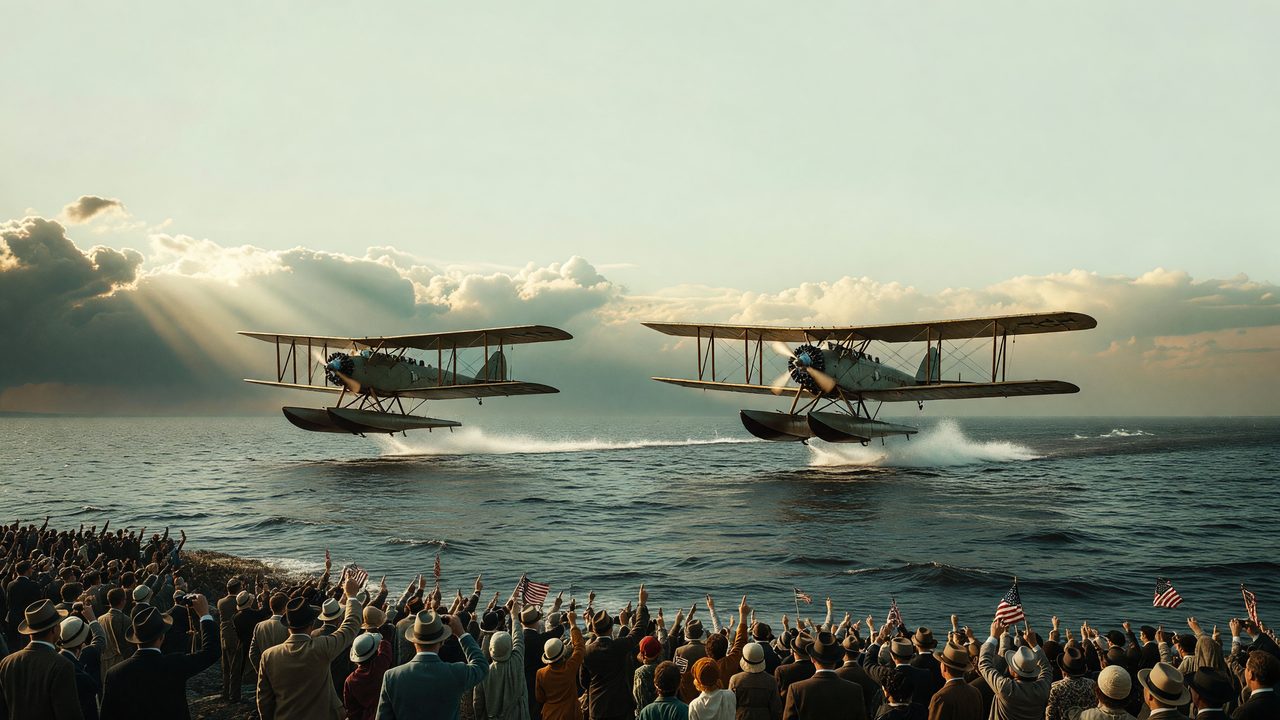
Four Pontoons, One Planet
In 1924, eight U.S. Army Air Service aviators set out to prove that the world could be girdled by air—not as a dare, but as a test of logistics, diplomacy, and nerve.
On the morning of April 6, 1924, four Douglas World Cruiser biplanes rose from the waters of Lake Washington at Sand Point Aerodrome, Seattle. Each aircraft bore the name of an American city: Seattle, Chicago, Boston, and New Orleans. Behind the sticks and wrenches sat eight men handpicked from the Air Service ranks—pilots and mechanics who had already pushed machines to the edge of what seemed possible. Major Frederick Martin commanded the expedition from the lead ship Seattle. Beside him flew a team that included Lieutenants Lowell Smith, Leigh Wade, Erik Nelson, Leslie Arnold, and John Harding Jr., with Staff Sergeants Alva Harvey and Henry Ogden keeping the engines alive.
The airplanes themselves were purpose-built answers to an impossible question. Working from Air Service Lieutenant Erik Nelson’s specifications, Donald Douglas had reshaped the DT-2 torpedo bomber into a globe-trotting machine: tubular steel fuselage, enlarged fuel tanks, strengthened structure, and—critically—landing gear that could be swapped between wheels and pontoons as terrain demanded. Oak propellers served the sea; lightweight walnut carried them over land. An earth inductor compass offered navigation beyond ordinary magnetic limits. Radios did not make the weight budget. According to Air Service planning records summarized by the National Museum of the United States Air Force, the expedition relied on seventy-four pre-arranged landing sites, supply ships positioned worldwide, and crates of spare engines staged where aviation had scarcely existed. Each two-seat biplane carried roughly three hundred pounds of gear. Parachutes and life preservers were left behind.
Ice, Fog, and the First Casualty
The opening leg punished the crews immediately. Across Alaska, freezing fog swallowed horizons, storms arrived without warning, and mountain terrain offered no forgiveness. On April 30, near Point Moller, the flagship Seattle struck a mountainside in zero visibility. Martin and Harvey survived the crash but found themselves alone on an Alaskan slope with winter still in command. They walked for ten days before reaching help—a story later gathered into Lowell Thomas’s 1925 chronicle The First World Flight, compiled from the airmen’s own accounts. Three aircraft continued. When the remaining cruisers hopped from the Aleutians toward the Komandorski Islands on May 15, they recorded what Air Service logs describe as the first airplane flight across the Pacific Ocean—yet only after threading a diplomatic labyrinth that barred convenient overflight of Soviet territory and forced a cautious island-hopping route eastward.
Monsoons, Suspicion, and Sheer Heat
Asia tested endurance as thoroughly as Alaska had tested survival. Typhoons hammered the Pacific rim. Monsoon humidity turned cockpits into ovens. In Shanghai, countless small boats crowded the harbor until every water landing felt like threading a needle. Japan, wary of military overflights, dictated serpentine paths to shield sensitive installations. Through French Indochina’s jungles the crews raced schedule and weather alike, pausing in Vietnam to patch the Chicago before pushing into the furnace of the Middle East, where British airmen famously traded their heavy wool for short trousers and pith helmets. The Seattle World Cruiser Project’s “1924 World Flight Chronicle,” drawn from primary Air Service reports and the papers of Major General Leigh Wade, captures the rhythm of those weeks: dawn departures, improvised repairs, refueling from ships that had sailed weeks ahead, and crowds swelling at every European stop—even as Italy mounted its own competing round-the-world attempt.
Two Ships Lost, Two Press On
Losses were not finished with Alaska. On August 3, while flying toward Iceland, the Boston was forced down at sea. Pilot Wade and mechanic Ogden lived; the cruiser did not. A Navy vessel attempted recovery, but the airplane sank beneath the Atlantic. Only Chicago and New Orleans remained of the original quartet. Their final ocean crossings proved the flight’s most harrowing hours: fog so dense the pilots flew within feet of North Atlantic swells, icebergs materializing from gray nothingness. Navy ships lined the route as floating rescue stations. In Nova Scotia the Boston crew rejoined the mission aboard a replacement prototype rechristened Boston II, but the original four-ship formation was gone forever.
Home to Sand Point
What returned to Seattle on September 28, 1924, was not the fleet that had departed—but a proof. Chicago and New Orleans settled onto Lake Washington before an estimated crowd of fifty thousand spectators. The expedition had consumed one hundred seventy-five days, covered 27,553 miles, and logged 363 hours aloft. The National Air and Space Museum, in its account adapted from the Smithsonian’s Barron Hilton Pioneers of Flight exhibition, frames the achievement as more than spectacle: it demonstrated that global air reach was achievable when meticulous planning met interchangeable floats, pre-positioned support, and crews willing to maintain aircraft with hand tools on distant beaches. Douglas Aircraft adopted a motto that still echoes in company lore: “First Around the World – First the World Around.”
Why it matters to you
The operational principles on display that April morning at Sand Point still sit at the center of pilot training. Martin’s expedition did not succeed because four biplanes were fast or glamorous; it succeeded because planners mapped fuel, alternates, and maintenance before anyone spun a propeller, because crews understood weight-and-balance tradeoffs down to the pound, and because every pilot treated weather, terrain, and diplomatic constraints as active participants in the flight plan—not background noise. When you brief a cross-country today, file an international routing, or decide whether a marginal forecast warrants a delay, you are practicing the same discipline those World Cruisers demanded: know your limits, stage your resources, never confuse optimism for fuel, and treat the airplane as one link in a chain that includes people on the ground oceans away. The globe is smaller now. The standard of preparation is not.