Four Engines Against the Ledger
"Fortress in the clouds"
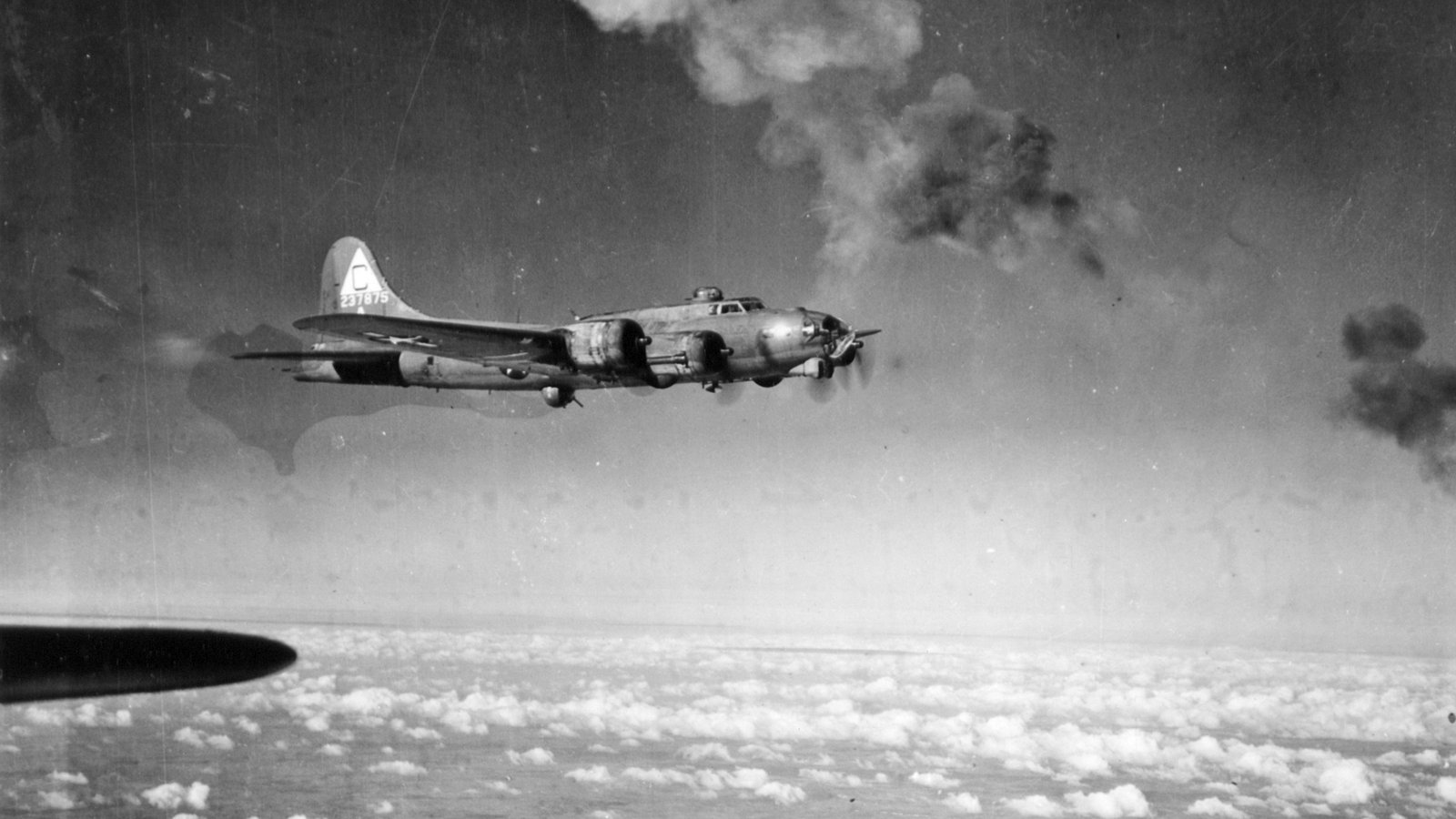
Four Engines Against the Ledger
Before the Flying Fortress became a symbol of American air power, the Army had to be convinced that range and redundancy were worth the price of a fourth engine.
A Bomber Too Ambitious for Its Time
In the summer of 1935, Boeing rolled out the Model 299—a four-engine, all-metal mid-wing monoplane built to carry a heavy bomb load fast, high, and far. Reporters and Air Corps observers soon nicknamed it the Flying Fortress, and the name stuck when the design entered service as the B-17. On paper, the airplane answered a brutal set of requirements: high speed at altitude, long endurance, and the ability to keep flying meaningful missions even with one engine out. The U.S. Army Air Forces Boeing B-17F and G Flight Manual describes the production Fortress as a 74-foot-9-inch-long aircraft with a 103-foot-9-inch span, turbosupercharged Wright R-1820 radials, and a crew of ten operating from a cockpit built for coordinated division of labor rather than single-pilot simplicity.
The prototype’s promise was nearly undone before the type ever won a contract. On 30 October 1935, the Model 299 crashed at Wright Field, Ohio, when elevator controls were found locked after takeoff. A board of officers concluded the airplane itself had not failed structurally or mechanically; the loss traced to a control lock left engaged. The accident became a watershed in cockpit discipline—one of the first great lessons that big, complex aircraft demand systematic checks, not memory alone.
Buying Bolos Instead of Fortresses
For all its performance, the B-17 initially struck Army leadership as an expensive luxury. As the National Museum of the United States Air Force recounts in its “Four-Engine Bomber” exhibit narrative, the General Staff directed most bomber procurement funds toward the cheaper twin-engine Douglas B-18 Bolo. By mid-1937, the contrast was stark: only 13 YB-17s and one YB-17A had been ordered, against 133 B-18s and 177 B-18As. The Air Corps kept faith with the four-engine concept anyway, flying its small YB-17 fleet across the United States and dispatching goodwill missions to South America to demonstrate range the twin-engine types could not match. The demonstrations worked. Contracts for 39 B-17Bs followed by the end of 1938, and on 30 March 1939 the Army ordered Consolidated’s new XB-24—acknowledging that strategic bombardment would rest on four engines, not two. When war began in Europe that September, the first B-17Bs were leaving the production line.
Over Europe, Formation by Formation
B-17s eventually served in every World War II combat zone, but their defining work was the daylight strategic campaign over Europe. Alongside the B-24 Liberator, the Fortress formed the backbone of the USAAF effort to wreck German industry through massed, high-altitude raids flown in disciplined formations. Museum records on the B-17F Memphis Belle note that the type’s design emphasized speed, altitude, and defensive firepower: turbosupercharged engines for operations near 30,000 feet, powered turrets, and flexible gun stations to cover the entire airframe. Late-war B-17Gs added a chin turret for frontal defense and accounted for roughly two-thirds of more than 12,700 Fortresses built before production ended in May 1945. Armament reached up to thirteen .50-caliber machine guns; the Memphis Belle display fact sheet lists a maximum bomb load of 8,000 pounds.
Crews paid dearly for those specifications. Flak and fighters tore into aluminum skin and control cables; yet Fortresses routinely returned with mangled tails, shattered canopies, and engines feathered to silence. That reputation for absorbing punishment turned the airplane into something larger than hardware—a visible expression of American industrial will.
The Belle and the Bond Tour
No single airframe embodied that symbolism more vividly than the B-17F Memphis Belle. In May 1943, the airplane and its crew completed 25 combat missions over Europe—the threshold then considered a full tour—and became the first USAAF heavy bomber to complete 25 missions over Europe and return successfully to the United States. The Army selected the Memphis Belle for a high-profile war bond tour from June through August 1943, parading crew and aircraft before a nation that needed heroes as much as it needed bombers. Today the restored Fortress anchors the National Museum’s World War II Gallery in Dayton, a few miles from the Wright Field crash site where the type’s story nearly ended before it began.
Why it matters to you
The Army did not reject the B-17 because it was a bad airplane. It favored the B-18 because procurement arithmetic favored cheaper twins that could fill hangars faster on a peacetime budget. The Air Corps had to prove that range, ceiling, and engine-out capability were operational necessities—not luxuries—before the Fortress won the ledger. That is the same judgment you make every time you evaluate aircraft for a mission: not which airplane looks best in the brochure, but which combination of payload, fuel, altitude, and redundancy actually closes the gap between departure and arrival.
The B-17’s flight manual still speaks directly to that mindset. It prescribes oxygen use above 10,000 feet, documents automatic engine-control behavior if control cables are damaged, and spells out feathering, fuel transfer, and emergency procedures for a crew managing four engines as one system. Whether you fly a piston single or a turbine twin, the Fortress lesson endures: performance you cannot afford on the ground becomes survival at altitude—and the checklist exists because someone once forgot to unlock the elevator.