Forty Kills and One Last Flight: Richard Bong, America's Ace of Aces
"He came home on one engine five times—and called that second propeller a "million-dollar life insurance policy."
Forty Kills and One Last Flight: Richard Bong, America's Ace of Aces
From a Wisconsin hayfield to the Pacific sky, Dick Bong rewrote the American air-combat record — then died testing the jet that would define the next war.
Richard Ira Bong grew up on a farm near Superior, Wisconsin, where the sound of passing mailplanes became the soundtrack of his childhood. He was eight years old when he decided he would fly. That decision was not a daydream; it was a compass heading he never altered. On his twentieth birthday he soloed. In January 1942 he earned his wings and shipped out toward the war that would make his name immortal.
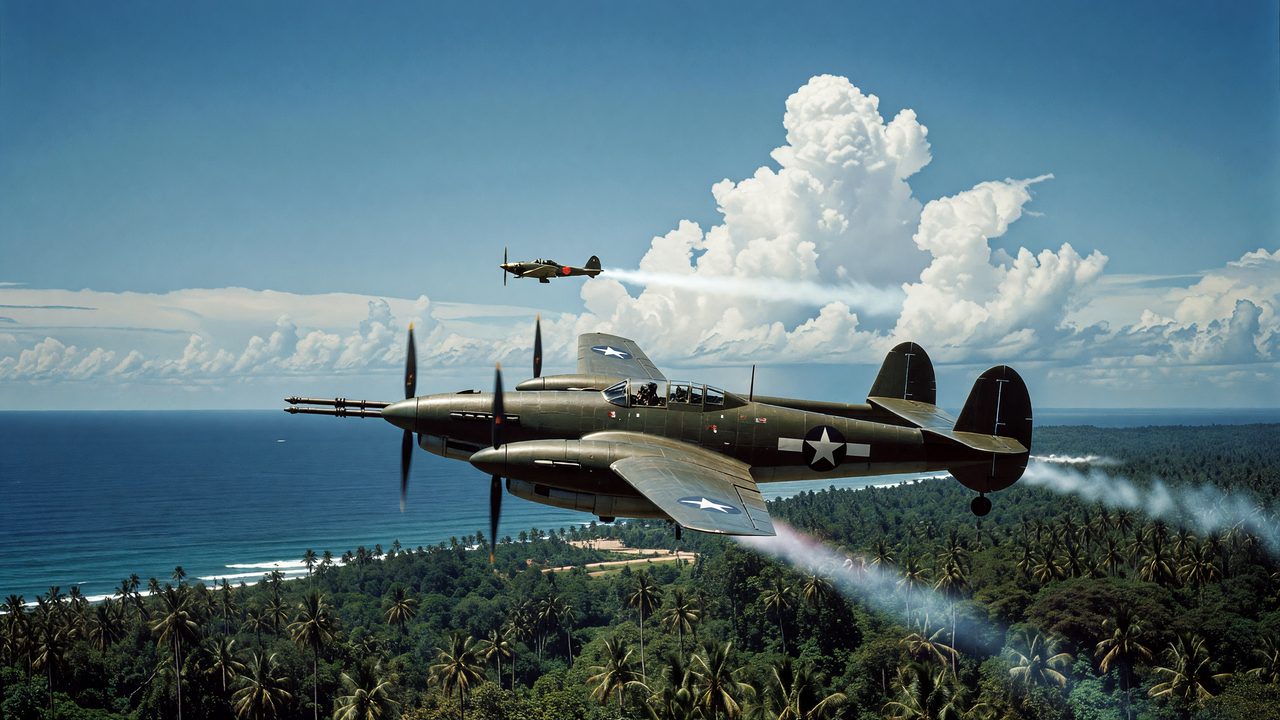
In the Southwest Pacific, Bong flew the Lockheed P-38 Lightning with the 49th Fighter Group. The twin-boom fighter was a demanding machine — fast, long-legged, and heavy on the controls — but in skilled hands it was a predator. On 27 December 1942, over Buna, he claimed his first two aerial victories. From that day forward, the scoreboard moved in only one direction.
Bong fought the way he spoke: directly. He favored head-on attacks and closed to distances that made instructors wince. "Put the gun muzzles in the Jap's cockpit," he told fellow pilots — not bravado, but a description of his method. The P-38 carried four .50-caliber machine guns clustered in the central nacelle, and Bong used that concentration of firepower ruthlessly. A head-on pass gave him a brief, violent window: one burst, one decision, one result. He was not interested in prolonged turning fights against lighter, more maneuverable opponents. He wanted the encounter over before luck could intervene.
The numbers accumulated through 1943 and into 1944. On 12 April 1944, Bong surpassed Captain Eddie Rickenbacker's long-standing American record of 26 confirmed kills — a milestone that placed him alone at the summit of U.S. fighter aviation. By December 1944, General George Kenney, commander of Fifth Air Force, presented him with the Medal of Honor. Kenney then did something harder than decoration: he grounded Bong for his own safety at 40 victories. The war still raged, but the commanding general had decided that America's ace of aces had given enough.
Six months later, on 6 August 1945 — the same day the atomic bomb fell on Hiroshima — Bong climbed into a Lockheed P-80 Shooting Star at Burbank, California, on a routine test flight. The jet failed shortly after takeoff. Bong ejected, but too low; his parachute did not fully deploy. He was 24 years old. The man who had survived hundreds of combat sorties over New Guinea and the Philippines died in peacetime, testing the aircraft that pointed toward aviation's future.
The Richard I. Bong Veterans Historical Center in Superior preserves his story for a new generation — farm boy, fighter pilot, national hero, and cautionary reminder that risk does not respect résumés.
Why it matters to you
Bong's preference for head-on attacks was not recklessness dressed up as courage; it was a tactical match between pilot and airframe. Japanese fighters of the period typically carried lighter armament in the wings, where converging fire required careful gunnery at varying ranges. The P-38's nose-mounted .50-caliber battery fired straight ahead through a single point — ideal for a closing pass where you have seconds, not minutes, to solve the problem. A head-on engagement also denied the enemy the turning fight that favored more agile single-engine opponents.
The Lightning's twin-engine layout added a margin that single-engine fighters could not offer. Pacific combat meant long over-water transits, tropical weather, and battle damage far from friendly fields. Lose one Allison on the way home and you still had another. The broad twin-boom structure placed the pilot between two powerplants, and the aircraft's size and power allowed Bong to dictate the geometry of the fight — closing fast, firing decisively, and exiting before a damaged adversary could re-enter the contest. Modern pilots train a different vocabulary — energy management, see-and-avoid, stabilized approaches — but the underlying lesson from Bong's record remains sharp: know what your aircraft does better than the other airplane, then insist the fight happen on those terms.