First Contact at Coral Sea
"For the first time in naval history, two fleets fought a battle without ever seeing each other's ships."
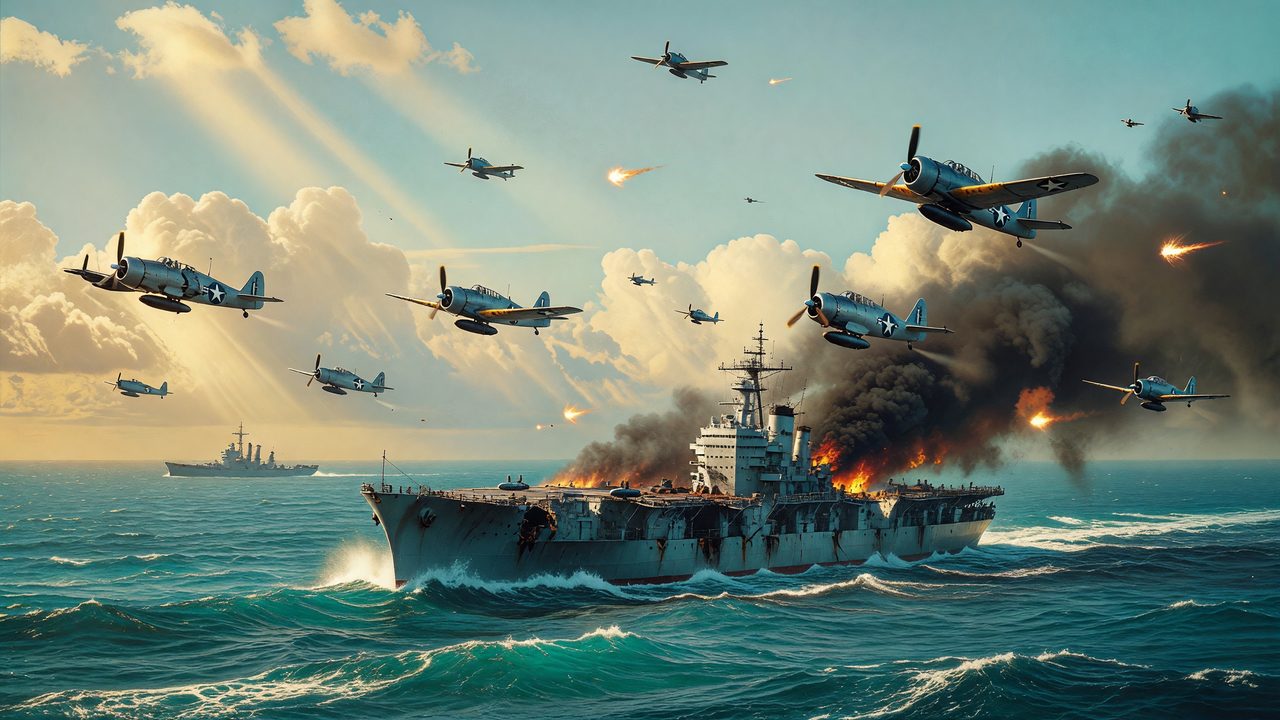
First Contact at Coral Sea
In May 1942, two fleets fought a battle no navy had ever fought before—entirely beyond the horizon, with aircraft as the decisive weapon.
The Opening Gambit
By early May 1942, American carrier doctrine was still being written in combat. Rear Admiral Frank Jack Fletcher’s Task Force 17, built around USS Lexington and USS Yorktown, had spent weeks in the Coral Sea waiting for intelligence that a Japanese amphibious thrust toward Port Moresby was imminent. When coastwatchers reported enemy shipping at Tulagi on May 3, Fletcher detached Yorktown to strike at dawn on May 4. Torpedo planes and dive bombers hammered the anchorage while combat air patrol circled overhead—a preview of how the coming week would unfold.
The two carrier task forces merged on May 5 with Rear Admiral Aubrey Fitch aboard Lexington as Commander Air. Intelligence placed three Japanese carriers somewhere in the waters between New Guinea and the Solomon Islands. Fletcher’s force needed to be within striking distance by May 7, when the enemy was expected to push through Jomard Passage toward Port Moresby and Australia’s northern approaches.
The Kill on May 7
The first carrier-on-carrier exchange began with confusion. A scout bomber’s contact report, later corrected after the attack group was already airborne, misidentified enemy cruisers as carriers. Yet Army aircraft soon confirmed a carrier group near Misima Island, and the strike diverted to intercept. Lexington’s air group found the light carrier Shoho and overwhelmed her. Squadron after-action accounts describe bomb hits walking across the flight deck and torpedo after torpedo slamming into the hull. The Lexington action report, filed May 15, 1942, records the carrier sinking within roughly five minutes, “a mass of flames” consumed by splashes and fire. American pilots radioed the famous signal: “Scratch one flattop.”
That evening brought a sharper warning. Lost Japanese aircraft circled the American formation with running lights on, mistaking Fletcher’s ships for their own. Radar and radio intercepts placed Carrier Division Five—Shokaku and Zuikaku—roughly a hundred nautical miles away. Fletcher kept his force concentrated rather than risk a night surface action that might expose his carriers to dawn air attack. The USN Combat Narrative later judged this the wiser course.
The Exchange on May 8
At 0828 on May 8, a Lexington scout sighted two fleet carriers, four heavy cruisers, and destroyers roughly 175 miles northeast of the American force. Both sides had been found. Fletcher launched his attack groups at 0900 while the circular screen tightened around the carriers.
American bombers reached the Japanese first. Yorktown’s dive bombers and torpedo planes coordinated an attack on Shokaku, reporting multiple 1,000-pound bomb hits and several torpedo strikes; the carrier was ablaze and circling when the last pilots departed. Lexington’s group concentrated its attack on Shokaku; Zuikaku slipped into a rain squall and escaped largely undamaged. Commander Task Force 17’s report of May 27 concluded that the two American strike groups had attacked separate enemy carriers and “severely damaged both.”
In fact only Shokaku was badly hit; Zuikaku escaped serious hull damage, though she lost much of her air group. Then the Japanese wave arrived. High-altitude dive bombers pushed over from 17,000 feet while torpedo planes split across both bows. Lexington’s fighter director noted that Wildcats could not gain enough altitude to intercept the bombers before they reached their release points—a lesson written in the ship’s action report. Two torpedoes struck Lexington’s port side; bombs tore through the port gun gallery and gig pocket. Damage control had fires contained and the ship making 25 knots when, at 1247, accumulated gasoline vapor ignited deep in the hull. The explosion severed communications and doomed the ship. After orderly abandonment, destroyer USS Phelps scuttled Lexington with torpedoes. Of 2,951 aboard, 216 were lost.
Yorktown absorbed a bomb hit through the flight deck but retained 30 knots. Fletcher retired southward. The Japanese invasion force turned back. Port Moresby would not fall by sea—not then.
What the Losses Meant
Losing Lexington—at 36,000 tons, the Navy’s largest carrier—was a shock. Yet the battle’s strategic arithmetic favored the Allies. Shoho was gone. Shokaku required months of repair. Zuikaku survived but absorbed Shokaku’s surviving aircraft and suffered her own air-group depletion; Carrier Division Five could not sortie at full strength when the Pacific Fleet next met the Combined Fleet.
One month later, at Midway, Japan brought four carriers. Two that fought at Coral Sea sat in Japanese shipyards or lacked the trained aircrews to deploy. In a war decided by narrow margins, Coral Sea had already tilted the table.
Why it matters to you
Modern pilots train resource management and contingency planning because battles are won or lost before the first bomb falls—and lost again when damaged assets cannot be replaced in time. Coral Sea is the textbook case. American strikes sank Shoho on May 7 and heavily damaged Shokaku on May 8 (while Zuikaku escaped serious hull damage), directly shrinking the Japanese carrier force available for Midway. Shokaku’s battle damage kept her in repair; Zuikaku’s depleted air group—many pilots and planes already spent—left Carrier Division Five unable to field a third and fourth flattop at the decisive engagement. Fletcher’s pilots did not know they were fighting Midway’s preliminary round, but their May 8 attacks on Shokaku and Zuikaku are why Admiral Nagumo faced four carriers instead of six. When you brief a cross-country alternate or calculate whether your aircraft can launch again after maintenance, you are practicing the same arithmetic Fletcher’s air groups applied in the Coral Sea: every sortie spends an asset that may not be available when the next fight begins. Timing, in the Pacific, was everything—and Coral Sea bought America time.