Fifty Feet of Hose
"Two sticks of gum and a rubber hose changed global reach forever."
Fifty Feet of Hose
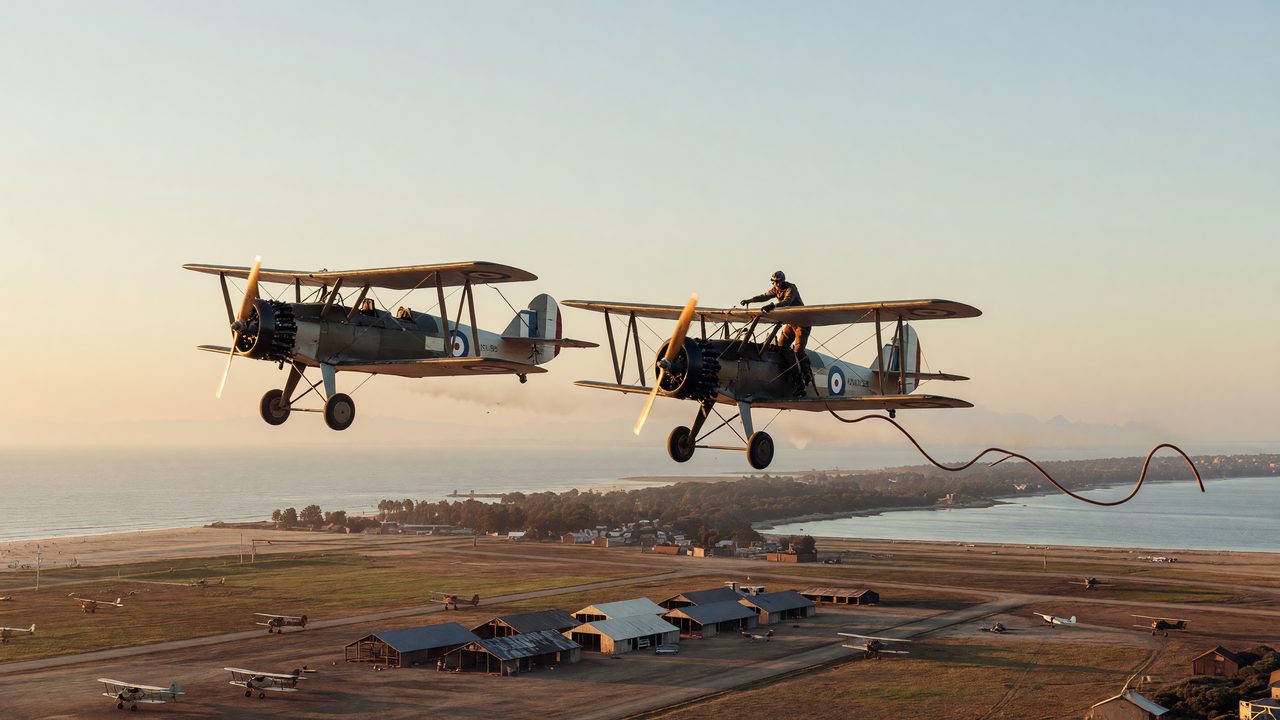
On a summer morning over San Diego, two Army biplanes proved that range is a choice—not a factory specification.
The oldest problem in aviation
Every pilot learns the same arithmetic early: fuel is finite, tanks are fixed, and the map does not care how badly you wish otherwise. By 1923, military aviation was barely finding its footing after the chaotic demobilization of 1919 and chronically thin budgets. Long-range bombing and global reach remained ambitions on paper. The DH-4B, a sturdy single-engine de Havilland biplane weighing roughly 4,600 pounds, offered a practical range of about 275 miles—enough for local work, not for the distances strategists were beginning to imagine.
What the airplane could not carry, perhaps another airplane could deliver. That idea was not new in theory. Making it work in a slipstream was another matter entirely.
You dangle it; I'll grab it
On 27 June 1923, at an altitude of about 500 feet above Rockwell Field on San Diego’s North Island, the U.S. Army Air Service tried the crudest possible answer. Two DH-4Bs closed formation: one as tanker, one as receiver. In the tanker, 1st Lt. Virgil Hine flew from the front cockpit while 1st Lt. Frank W. Seifert worked from the rear, feeding out a fifty-foot length of rubber hose fitted with manually operated quick-closing valves at each end. In the receiver, Capt. Lowell H. Smith flew up front while 1st Lt. John P. Richter reached from the rear cockpit to seize what Seifert trailed.
The technique, preserved in Air Force historical accounts, amounted to plain nerve: you dangle it; I'll grab it. Seventy-five gallons moved through the hose. In roughly an hour, aviation had its first successful air-to-air refueling. The transfer was modest. The implication was not.
From stunt to proof
Recognizing that a single tanker offered limited margin, the team added a third DH-4B for the next attempt. On 27–28 August, with fourteen midair contacts, tankers flown by Hine and Seifert and by Capt. Robert G. Erwin and 1st Lt. Oliver R. McNeel kept Smith and Richter aloft for 37 hours and 25 minutes along a prescribed track of 3,293 miles—roughly the distance from Goose Bay, Labrador, to Leningrad in the Soviet Union. Army records later credited the flight with breaking multiple world marks for endurance, speed over defined distances, and total distance flown.
Two months later, on 25 October, Smith and Richter demonstrated why that endurance mattered. They departed Suma, Washington, near the Canadian border and headed south. Near Eugene, Oregon, they took fuel from Seifert and Hine; hours later, over Sacramento, California, Erwin and McNeel topped them off again. A little more than twelve hours after takeoff, they circled the customs house at Tijuana, Mexico, then landed back at Rockwell Field. A border-to-border nonstop flight of 1,280 miles showed how an airplane built for 275 miles could be stretched nearly fivefold. For a moment, the fuel gauge looked less like a sentence and more like a negotiation.
A solution in search of a problem
Then the Army moved on. The Rockwell experiments were widely dismissed as stunts—spectacular, certainly, but disconnected from everyday service needs. The dismissal hardened on 18 November 1923, when an airplane was wrecked and a pilot killed during an airshow demonstration of aerial refueling at Kelly Field, Texas. That crash became refueling’s first fatal accident. In the absence of a clear operational requirement, it would remain its only fatality for more than a quarter-century.
British and French air services ran brief experiments of their own and reached the same conclusion. Aerial refueling was ingenious. It was also, for the moment, unnecessary. The arrival of the modern all-metal monoplane in the 1930s—retractable gear, efficient engines, sharply improved range—made inflight topping-off look like a workaround for yesterday’s limitations. When the B-17 and B-24 offered ranges exceeding 2,500 miles in World War II, the question seemed settled. Refueling could extend endurance for publicity flights like the 1929 Question Mark operation, but the War Department’s practical answer, after a failed 1929 bomber-tanker demonstration over storm-battered Washington, was essentially: forget it.
Doctrine changed only when strategy demanded it. As the Cold War matured and the Air Force needed true intercontinental reach for bombers and, later, fighters, aerial refueling ceased to be a circus trick and became infrastructure. By the late 1940s and early 1950s, dedicated tanker aircraft and standardized boom-and-receptacle procedures turned a 1923 hose grab into an everyday military capability—one that would later underpin global mobility from round-the-world bomber flights to fighter deployments halfway across the planet.
Why it matters to you
The Army did not abandon aerial refueling because the June 1923 hookup failed—it succeeded. It walked away because the technique solved a problem the service did not yet have, and because a fatal crash at Kelly Field made the risk feel disproportionate to the reward. That gap between possible and operational is worth studying in the cockpit today. When you plan fuel, brief formation standards, or coordinate crew duties in a two-ship training flight, you are practicing the same fundamentals those DH-4B crews improvised at 500 feet: stable platform, disciplined separation, clear roles, and the humility to know that a clever maneuver is not doctrine until your mission truly needs it. Modern tanker operations are incomparably safer and more precise, but the piloting lesson from North Island endures. Range is not only what the POH prints. It is what careful planning, crew coordination, and the right support at the right time can still add—once the mission makes the effort worth the risk.