Fifteen Minutes That Put America in Orbit
"302 miles"
Fifteen Minutes That Put America in Orbit
On May 5, 1961, Alan Shepard’s suborbital hop did not match Gagarin’s orbit—but it proved an American pilot could command a spacecraft through launch, weightlessness, and a brutal reentry.
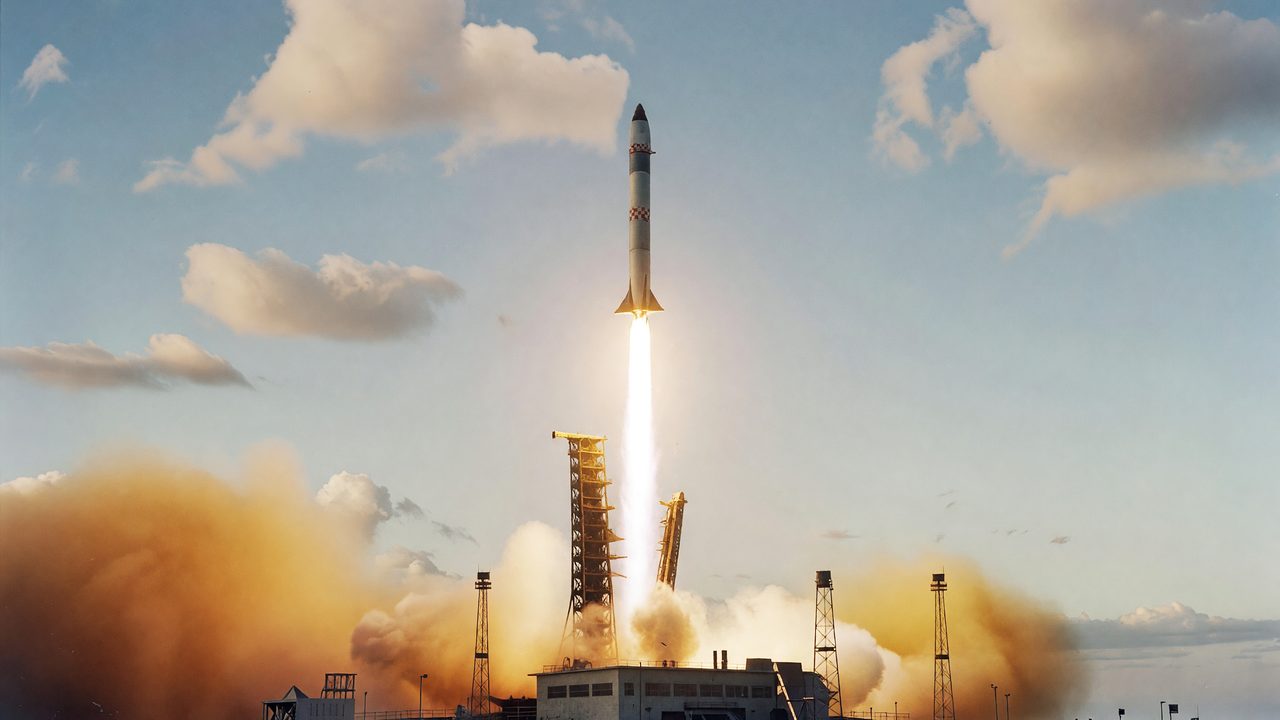
The morning of May 5, 1961, carried more weight than the slender Redstone booster strapped to Launch Complex 5 at Cape Canaveral. Three weeks earlier, Soviet cosmonaut Yuri Gagarin had completed a full orbit of Earth, and the American space program still had not placed a human above the atmosphere. The gap felt existential. At 9:34 a.m. Eastern Standard Time, a modified Army ballistic missile ignited and lifted astronaut Alan B. Shepard, Jr., inside the spacecraft he had named Freedom 7, toward a sky that had suddenly become a measure of national competence.
Shepard’s mission, officially Mercury-Redstone 3, was ballistic by design. The Redstone could not reach orbital velocity; it was a stepping stone, not a moon rocket. What followed was a compressed master class in the hazards of high-performance flight. The booster burned for roughly two minutes, accelerating the capsule along a steep arc. Shepard climbed to 116.5 statute miles—well above the sensible atmosphere—before gravity reclaimed the trajectory. For approximately five minutes he floated in weightlessness, a condition no American had ever experienced in a operational vehicle. Then reentry delivered the mission’s harshest demand: deceleration approaching 12 g’s, a load that would pin an untrained body helpless against the couch and threaten consciousness itself.
Through that arc, Shepard was not a passenger. NASA’s post-flight report on MR-3, issued June 6, 1961, documented his active use of the Mercury attitude-control system. He exercised fly-by-wire commands and manual proportional control, confirming that a trained pilot could manage spacecraft orientation during the most dynamic phases of flight. That finding mattered to Mercury’s architects, who had argued from the program’s inception that astronauts should retain authority over their machines rather than ride as automated cargo. Shepard’s hands on the controls turned philosophy into data.
The flight lasted fifteen minutes and twenty-two seconds—brief by any aviation standard, shorter still beside Gagarin’s 108-minute orbit. Yet the mission’s engineering objectives were distinct. Freedom 7 had to validate the Mercury spacecraft as a complete system: environmental control, communications, instrumentation, and the recovery apparatus that would one day support orbital missions. Shepard splashed down 302 miles downrange in the Atlantic Ocean. Recovery forces reached him within minutes by helicopter, demonstrating that the new global tracking and recovery network could locate and retrieve a crewed capsule with the urgency flight operations demanded.
President John F. Kennedy would later award Shepard NASA’s Distinguished Service Medal at the White House, but the medal measured only part of the outcome. The deeper consequence was psychological. Since Sputnik’s beep in 1957 and Gagarin’s triumph in April 1961, Americans had watched Soviet firsts accumulate while their own efforts stalled on the pad. MR-3 did not win the Space Race; it refused to concede it. An American had launched, survived the unknowns of microgravity, endured crushing reentry loads, and returned alive under manual command. The nation was, at last, in the game.
Project Mercury’s official chronology records May 5, 1961, as the day the United States joined human spaceflight as a participant rather than a spectator. The arc was suborbital; the implication was orbital. Every Mercury flight that followed—each longer, each more complex—rested on the confidence Freedom 7 purchased in a quarter-hour above the Florida coast.
Why it matters to you
Shepard’s quarter-hour flight established a principle every rated pilot still trains toward: active aircraft command under escalating stress. He did not merely endure 12 g’s and weightlessness; he switched control modes, assessed spacecraft behavior, and made real-time inputs when the margin for error was measured in seconds. Modern upset-recovery training, crew resource management, and the discipline of maintaining manual proficiency alongside automation all echo that Mercury lesson. Systems can fly the routine; the pilot must own the non-routine. When you practice hand-flying through an unexpected attitude or rehearse a go-around while the autopilot disengages, you are extending a lineage that began when a naval aviator named his capsule Freedom 7 and proved that a human being belonged at the controls—not as cargo, but as commander.