Eleven Nights Over Hanoi
"000 miles"
Eleven Nights Over Hanoi
In December 1972, the B-52 Stratofortress flew the longest sustained heavy-bomber campaign of the Vietnam War—and paid a price that forced SAC to rewrite the book on massed attack.
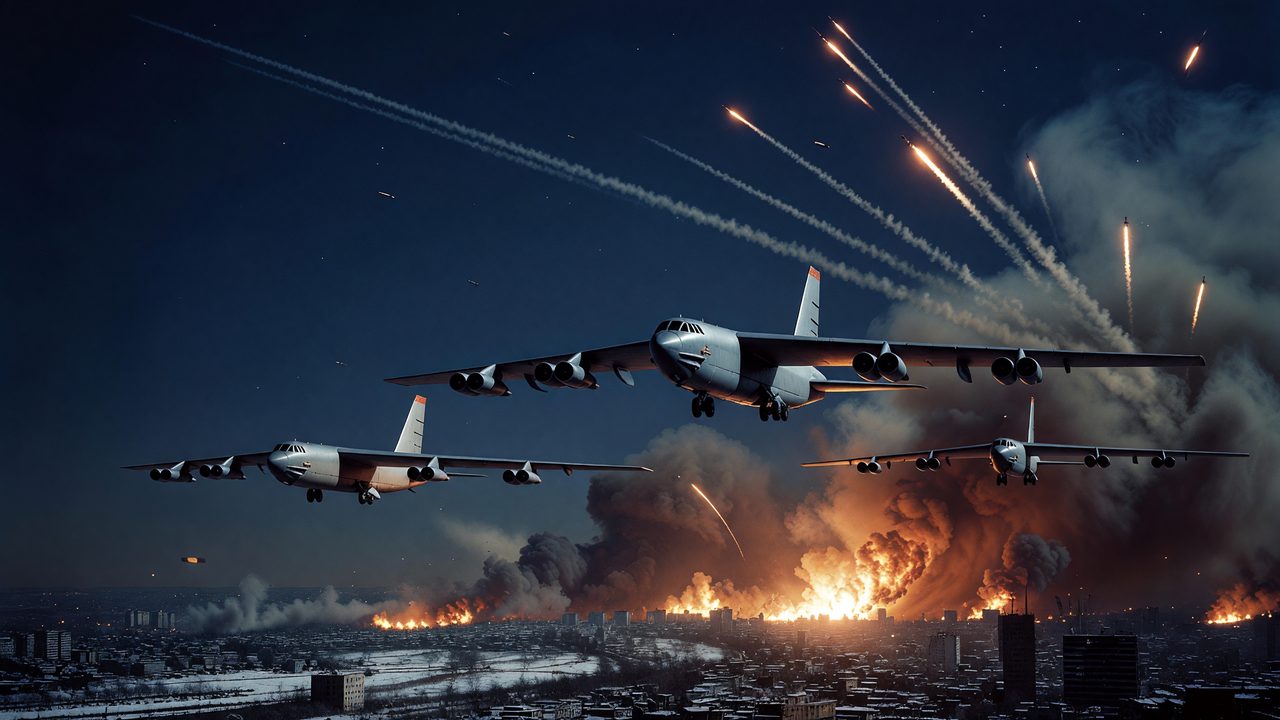
On the night of 18 December 1972, the air over North Vietnam changed character. Waves of Boeing B-52 Stratofortresses lifted from Andersen Air Force Base on Guam and turned west across more than 3,000 miles of open Pacific, each crew facing a one-way transit longer than many commercial routes of the era. Strategic Air Command had committed its signature bomber to a mission unlike any it had flown in Southeast Asia: not isolated Arc Light strikes in the south, but sustained, round-the-clock pressure against the heartland around Hanoi and Haiphong.
The opening night set the scale. One hundred twenty-nine B-52s struck seven targets in three timed waves, flying in three-ship cells that would become the campaign’s defining tactical unit. Over the eleven days that followed, those cells would deliver roughly 15,000 tons of ordnance—an industrial weight of destruction measured not in single sorties but in cumulative saturation. North Vietnam answered with the SA-2 Guideline, a Soviet-designed surface-to-air missile whose radar-guided reach turned the final approach into the most dangerous minutes of every mission.
The cost arrived quickly. On the night of 20 December, six B-52s fell to SAM fire in a single strike—a loss rate that shocked planners who had expected the bomber’s altitude and electronic defenses to hold. By the end of the fourth night, eleven Stratofortresses were gone. SAC commander General John C. Meyer faced a blunt choice: persist with tactics the enemy had learned to exploit, or redesign the entire approach before the campaign consumed its force. Brigadier General James R. McCarthy and Lieutenant Colonel George B. Allison, writing in Linebacker II: A View from the Rock, document how Meyer’s decision on 26 December became the pivot on which the air campaign—and, in the judgment of senior leaders, the American position in Vietnam—turned.
That night, 120 B-52s struck ten targets simultaneously from four different axes, compressing what had been staggered waves into roughly fifteen minutes of overlapping attack. The geometry was deliberate. Sequential arrivals had given North Vietnamese fire-control crews time to shift aim from one bomber stream to the next; simultaneous ingress from multiple headings overwhelmed the limited channels of command, control, and radar tracking. Admiral Thomas H. Moorer, Chairman of the Joint Chiefs, recorded the mounting stakes in his diary during the week of 22–27 December 1972, as Washington watched whether airpower alone could break a diplomatic deadlock that ground operations had not resolved.
The revised tactics worked. By 29 December, North Vietnam’s SAM inventory was effectively spent, its airfields battered into limited usefulness, and the integrated air-defense network that had bloodied SAC in the opening nights largely dismantled. The United States paid dearly for the reversal: fifteen B-52s lost across the campaign, plus eleven tactical aircraft supporting the strikes. Yet the cumulative effect achieved what months of negotiation had not. Hanoi agreed to resume talks; on 27 January 1973, one month after Linebacker II ended, representatives signed the Paris Peace Accords.
Lieutenant Colonel Peter M. Burlingame’s Air War College study of the campaign emphasizes that Linebacker II was not simply a bombing offensive but a live experiment in systems under fire—radar warning receivers, chaff corridors, cell spacing, tanker rendezvous, and the human limits of crews cycling through Guam’s long runways again and again. The Air Force Historical Support Division’s official fact sheet frames the operation as the decisive air component of a war whose endgame was negotiated, not conquered.
For pilots studying the period, the campaign offers a rare clear lesson: technology and tonnage do not substitute for tactics. The B-52 was not a failure; the initial plan was. Meyer’s 26 December restructuring—documented across SAC records, Moorer’s archived diary, and the McCarthy-Allison operational history—demonstrates how mass, timing, and geometry can matter as much as any single airframe capability.
Why it matters to you
The engineering and operational principles that carried those B-52 cells from Guam to Hanoi still sit inside the aircraft you fly today, even if the mission looks nothing like strategic bombing. Long-range fuel planning, tanker scheduling, and precise time-on-target coordination are not historical curiosities; they are the same disciplines you exercise on a cross-country or an IFR arrival compressed into a busy sector. Electronic self-protection—whether a B-52’s defensive suite or a modern transponder and traffic advisory stack—assumes an adversary who learns your pattern and punishes repetition. Meyer’s shift to simultaneous, multi-axis attack is a blunt ancestor of the crew-resource and traffic-management logic you practice when breaking a predictable flow: vary the approach, distribute the workload, and deny any single point of failure the time to organize a response. Linebacker II ended before most current pilots were born, but its central aviation truth endures: the airplane is only as effective as the plan that flies it.