Dawn Over the Delta
"The Israel Defense Forces Air Force of 1967 was a predomi..."
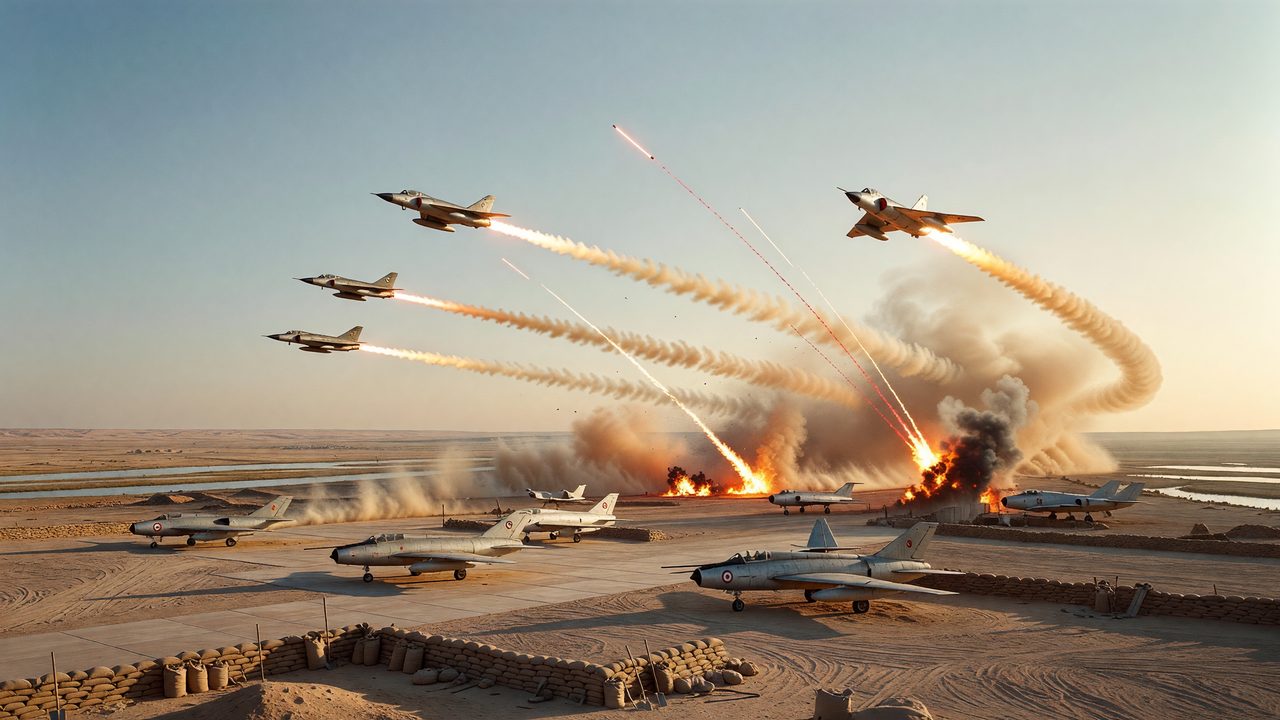
Dawn Over the Delta
On the morning of 5 June 1967, Israel's French-built fighters did not wait for permission to fight on equal terms—they erased the enemy's air force before breakfast.
In late May 1967, the Israel Defense Forces Air Force faced arithmetic that no squadron commander could ignore. Egypt, Syria, and Jordan together fielded more than 600 combat aircraft. The IAF, by contrast, was a compact force built around French hardware: delta-wing Mirage IIICJ interceptors, Super Mystère B.2 fighter-bombers, Vautour IIN light bombers, and Mystère IVAs. Numbers favored the coalition. Israeli planners therefore rejected the conventional choice—trading losses in the sky—and committed instead to a single, rehearsed objective: destroy hostile air power where it was most vulnerable, on the ground.
That decision crystallized as Operation Moked, Hebrew for "Focus." Contemporary Israeli records, including Foreign Affairs and Defense Committee Protocol No. 62 of 26 May 1967, preserved in the Wilson Center Digital Archive, capture a military establishment already reasoning in terms of preemption rather than prolonged attrition. Air Force Commander Mordechay Hod later testified before the Israeli Ministry of Defense Archives that the campaign's success depended on concentration, timing, and the ruthless exploitation of surprise—principles the IAF had drilled for years in anticipation of one specific morning.
That morning arrived at 0745 local time on 5 June. The first wave—roughly 170 aircraft—hit ten Egyptian airfields at once. Pilots drove in below effective radar coverage, hugging the desert floor and the Nile Delta's agricultural mosaic until air defenses had seconds, not minutes, to react. Mirage IIICJs of the 101st, 117th, and 119th Squadrons bore the brunt of the hardest targets in the Delta and Sinai, where Egyptian defenses were densest. On the ground, the Egyptian Air Force was caught in the worst posture for war: aircraft parked in the open or in revetments still ringed with half-built sandbag walls. Runways, fuel lines, and maintenance parks became kill zones. By nightfall on the first day, Egypt had lost 286 aircraft—about ninety percent of its operational strength, according to campaign analyses compiled by ACIG.org from Israeli air-power historians including Eliezer Cohen and Shlomo Aloni, with additional operational detail from Salvador Huertas.
Moked did not end with Egypt. Once the IAF had torn the largest enemy air arm from the order of battle, it pivoted against Jordan and Syria with the same method: strike first, strike simultaneously, and deny recovery. A declassified CIA assessment of the Israeli air campaign from 5–10 June 1967 noted the operational tempo and the near-total collapse of Arab air readiness within hours of the opening strikes—confirmation, from an adversary's intelligence service, that the outcome was not accidental but the product of doctrine executed at scale.
By the war's close on 10 June, Arab air forces had lost 452 aircraft. The IAF lost 46—nineteen in air-to-air combat and the remainder to ground fire. The Six-Day War would be remembered for tank columns in the Sinai and paratroopers at the Western Wall, but its strategic hinge turned in the first hours. Without air superiority, Egyptian armor could not be shielded, Jordanian reinforcements could not move safely, and Syrian positions could not be sustained. The war was not won by tanks alone. It was won by an air force that had spent years training for one specific morning, and used it.
Why it matters to you
Operation Moked endures in professional military education not as ancient history but as a case study in mission design. The IAF of 1967 was predominantly French-equipped, yet hardware was secondary to how it was employed: a clearly defined center of gravity (enemy aircraft on the ground), synchronized timing across multiple axes, ingress altitudes chosen to defeat sensors rather than honor them, and relentless follow-through once advantage appeared. Modern pilot training still circles those ideas—threat analysis before commitment, briefing discipline that aligns every crew to the same "go" time, low-level navigation under radar, and the habit of asking where an opponent is weakest before asking where you are strongest. You may never fly a preemptive campaign across a border, but every checkout ride and every instrument approach inherits the same operational logic Moked made visible at 0745: define the decisive effect, rehearse it until it is boring, then execute it before the other side can bring its numbers to bear.