Dawn Over Pad 39B
"563 miles"
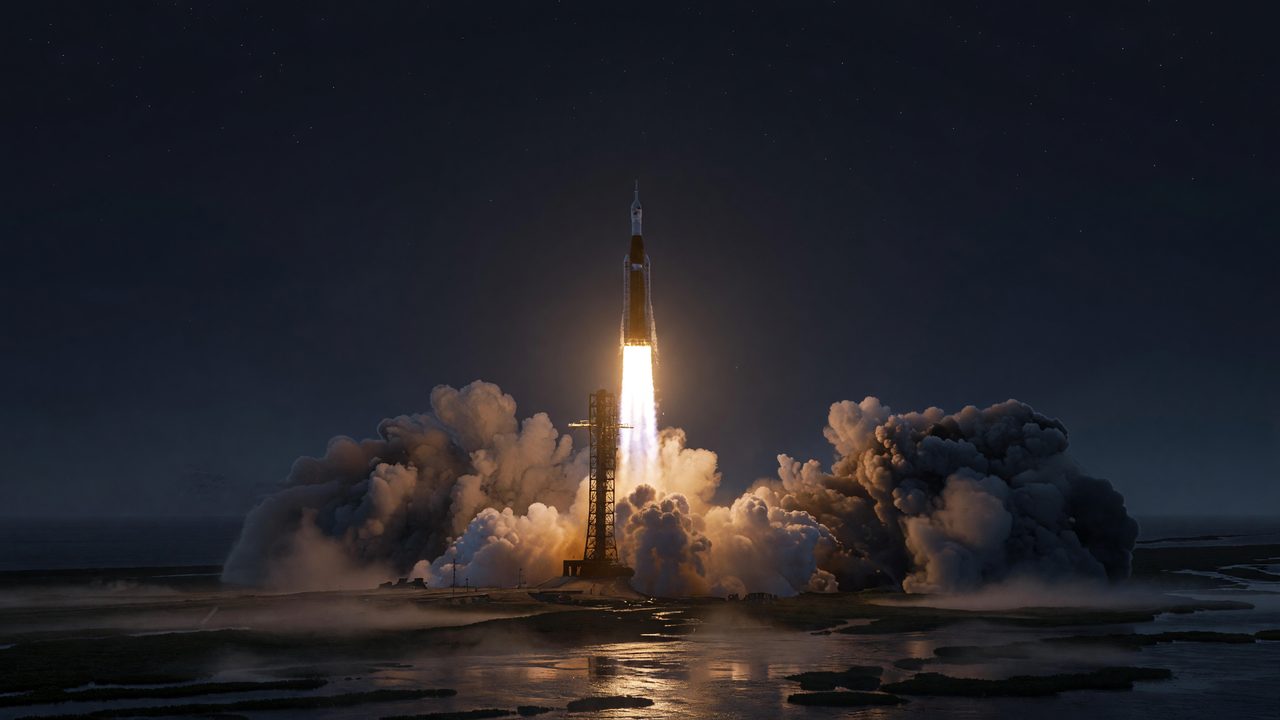
Dawn Over Pad 39B
On 16 November 2022, an uncrewed spacecraft left Florida bound for lunar distances no human-rated vehicle had ever reached—and proved that the hardest part of returning to deep space is not the destination, but the discipline of getting there.
The Hour Before Sunrise
In the dark hours before dawn, the most powerful rocket NASA had ever built roused the ancient launch grounds of Kennedy Space Center. At 1:47 a.m. EST, the Space Launch System Block 1 rose from Pad 39B, its twin solid rocket boosters and four RS-25 engines pouring thrust across ground that had witnessed Apollo and the space shuttle. Riding atop the stack was Orion, the crew capsule at the heart of the Artemis program. No astronauts occupied the seats on this flight. Artemis I was a shakedown cruise—the first integrated test of the deep-space exploration system NASA intends to carry humans back to the Moon and, eventually, toward Mars.
The launch itself answered questions that no ground test could settle. Would the Exploration Ground Systems at Kennedy coordinate fueling, countdown, and range safety under real pressure? Would SLS deliver Orion to the correct translunar injection trajectory on its maiden voyage? NASA’s 16 November 2022 news release confirmed what controllers in Firing Room 1 already knew: the vehicle had cleared the tower and begun the long arc toward cislunar space.
Into the Distant Retrograde Orbit
Over the next 25.5 days, Orion traced a path through a distant retrograde orbit around the Moon—a wide, stable loop that kept the spacecraft far from the lunar surface while exercising the systems future crews will depend on. Propulsion came from the European Service Module, built by ESA as NASA’s international partner on Orion. Firing its main engine and auxiliary thrusters, the module adjusted Orion’s trajectory, maintained attitude, and supplied power and life-support architecture that, on this flight, supported instrument racks and a suited manikin rather than living passengers.
On flight day 13, Orion reached the mission’s apogee: 268,563 miles from Earth, and 43,471 miles beyond the far side of the Moon. NASA’s Artemis I reference data records that distance as farther than any spacecraft designed and built for humans had ever traveled—surpassing the record set by Apollo 13’s emergency loop half a century earlier. From that remote vantage, Earth appeared small enough to cover with a thumb, yet every telemetry stream, every solar array deployment, and every thermal cycle was being logged for the flights that will follow.
Fire and Water
The return leg demanded the most violent maneuver of the mission. Orion slammed into Earth’s atmosphere at nearly 25,000 miles per hour—speeds that only a capsule rated for lunar reentry can survive. The heat shield, a critical item on NASA’s validation checklist, faced temperatures hot enough to ionize air around the spacecraft. After shedding velocity through atmospheric drag, Orion descended under parachutes and splashed down in the Pacific Ocean on 11 December 2022, where recovery teams closed the loop on a flight that had begun in a Florida night.
Artemis I validated hardware, but it also validated a program architecture. SLS proved it could launch. Orion proved it could navigate, endure, and come home. Exploration Ground Systems proved Kennedy could stage a lunar-class mission again. The mission timeline published by NASA maps each milestone—from launch through outbound powered flyby, DRO insertion, return powered flyby, and splashdown—into the procedural spine future crewed missions will follow.
The Next Chapter
Though no pilot flew this voyage, Artemis I reopened a corridor human exploration had left dormant since the Apollo era. NASA’s Artemis program aims to land the first woman and the first person of color on the lunar surface, establish a sustainable presence near the Moon’s south pole, and mature the technologies required for the long voyage to Mars. A century after the Wright brothers’ first powered flight at Kitty Hawk, the same instinct—that controlled flight can extend human reach—now points toward another world.
Why it matters to you
The legacy of that pre-dawn liftoff continues to shape how pilots train today. Artemis I was, at its core, a systems flight test: every phase depended on disciplined checklist execution, cross-checked telemetry, and go/no-go decisions made with incomplete information—skills every certificated pilot practices in the cockpit, whether flying a Cessna on a short cross-country or monitoring an FMS on an oceanic leg. Orion’s distant retrograde profile is an exercise in energy management writ large, the orbital equivalent of planning fuel reserves and alternates before you leave the ground. Its high-speed reentry reminds us that aerodynamic heating and structural limits do not forgive approximation, a lesson that echoes in our own steep approaches, gusty landings, and recovery from unusual attitudes. NASA published the Artemis I timeline and mission data so the next generation of aviators could study how a complex vehicle is proven—not in a simulator alone, but in the real night sky over Florida. That is the aviator’s oldest contract: master the machine, respect the environment, and fly the plan you briefed.