Christmas Eve Behind the Moon
"December 24, 1968"
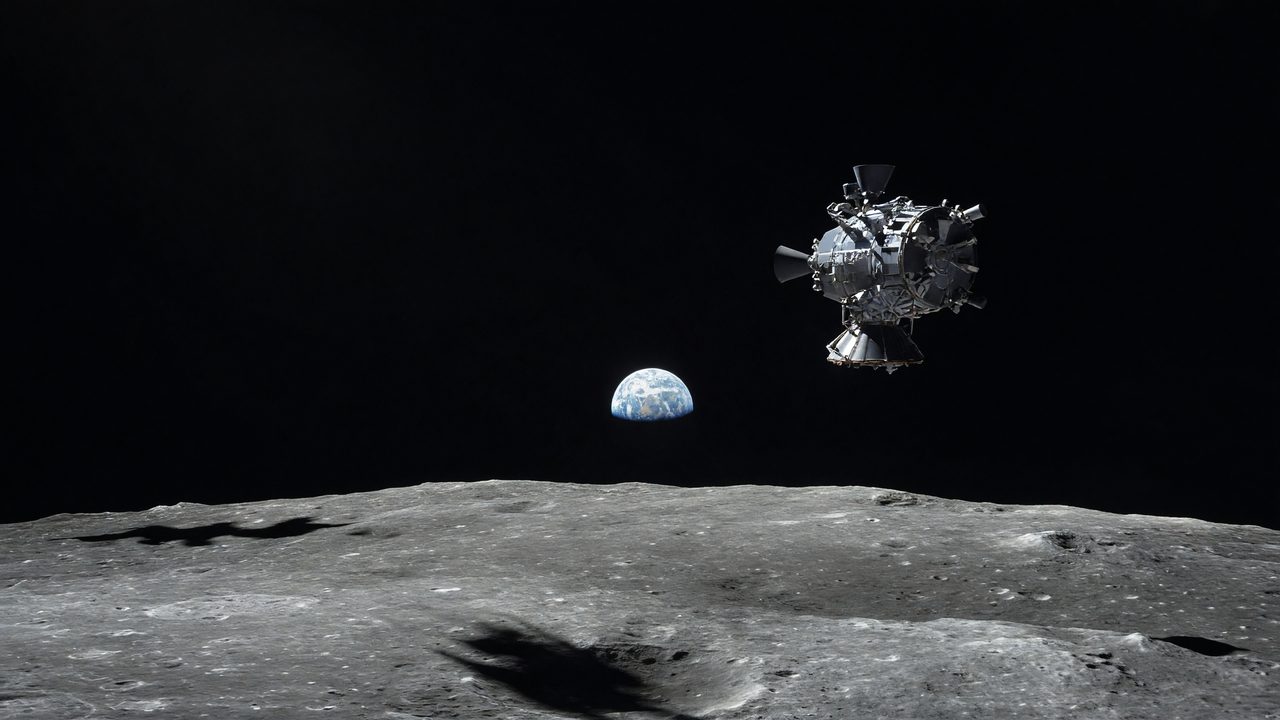
Christmas Eve Behind the Moon
Apollo 8 turned a schedule crisis into humanity’s first crewed voyage to another world—and gave pilots a lesson in improvisation under pressure that still echoes in every cockpit.
When the Plan Changed
By late 1968, NASA’s race to land astronauts on the Moon before the decade ended had run into a stubborn bottleneck. The Lunar Module—the spider-legged spacecraft that would carry crews to the surface—was not ready. Rather than idle the Saturn V, the agency’s most powerful rocket, program managers made a gamble that would reshape spaceflight history.
They reassigned the Apollo 8 crew—commander Frank Borman, command module pilot James A. Lovell Jr., and lunar module pilot William A. Anders—to a mission no human had ever attempted. Apollo 8 would become the first crewed flight of the Saturn V and the first mission to orbit another celestial body. It was bold improvisation born of schedule pressure, and it carried enormous risk.
On December 21, 1968, the 363-foot rocket rose from Kennedy Space Center’s Pad 39A. The Saturn V placed the Command and Service Module into a parking orbit roughly 114 by 118 miles above Earth. A second burn then sent the crew onto a trans-lunar trajectory, committing them to a quarter-million-mile journey.
Ten Orbits in the Void
For three days the spacecraft coasted outward. On Christmas Eve—December 24, 1968—Apollo 8 reached the Moon. To enter lunar orbit, the crew fired the Service Propulsion System engine for just over four minutes while the spacecraft passed behind the far side, beyond radio contact with Mission Control. Until the engine burn completed and the spacecraft reappeared, controllers on Earth could only wait.
The maneuver worked. Apollo 8 became the first crewed spacecraft to orbit another world. Over ten circuits of the Moon, the astronauts worked, observed, and photographed a landscape no human eyes had seen from such proximity. During one pass, William Anders captured an image that would outlive the mission itself: Earth rising above the lunar horizon—a small, cloud-swirled sphere suspended in the black of space. NASA and the National Air and Space Museum have since treated that photograph as a turning point in how humanity sees its home planet.
A Billion People Listening
That evening, during a live television broadcast estimated to have reached roughly a billion viewers across 64 countries, the crew did something no flight plan had scripted in quite the same way. Against the stark lunar backdrop, Borman, Lovell, and Anders read aloud the first ten verses of the Book of Genesis, describing the creation of Earth, sea, and sky. Borman closed with a simple wish: “a Merry Christmas and God bless all of you—all of you on the good Earth.”
NASA’s History Office has noted that the broadcast arrived at a moment when 1968 had strained the nation—war abroad, unrest at home—and the sight of fellow humans circling another world offered a rare shared pause. The mission was engineering first, but that Christmas Eve transmission gave it a human voice heard around the globe.
Proving the Machine, Coming Home
Apollo 8 was not only a voyage of perspective; it was a demanding flight test. The mission had to prove that the Saturn V could safely launch a crew to the Moon and that the Command and Service Module could navigate, endure, and return from deep space—tasks essential to a later lunar landing.
On Christmas morning, the crew fired the Service Propulsion System again for the Trans-Earth Injection burn, leaving lunar orbit and setting course for home. Six days after launch, on December 27, 1968, the command module splashed down in the Pacific Ocean. The astronauts had demonstrated that the Saturn V and the CSM were capable of the lunar voyage. The Lunar Module could follow when it was ready.
Why it matters to you
Apollo 8’s legacy is not confined to museums or history books. It is a case study in operational adaptation—the same discipline modern pilots train when plans change, equipment fails, or weather closes a destination. Borman, Lovell, and Anders did not simply execute a checklist; they accepted a rewritten mission under tight timelines and flew it with precision: parking orbit, translunar injection, a critical engine burn out of communications range, ten precise lunar orbits, and a return trajectory that had to work the first time. In instrument training, contingency planning, and crew resource management, aviation still rewards the ability to improvise without abandoning procedure—to recognize when the original plan is no longer viable and commit fully to the one that is. Apollo 8 did that at the scale of deep space. The Christmas Eve broadcast reminded the world that exploration is human work performed by people who must fly well, even when the Moon is waiting behind the radio silence.