Charms Against the Void
"When the altimeter reads forty thousand and the flak is r..."
Charms Against the Void
When skill meets statistics it cannot beat, pilots have always reached for something older than the checklist — ritual, talisman, and the thin hope that fate can be negotiated.
The arithmetic of survival
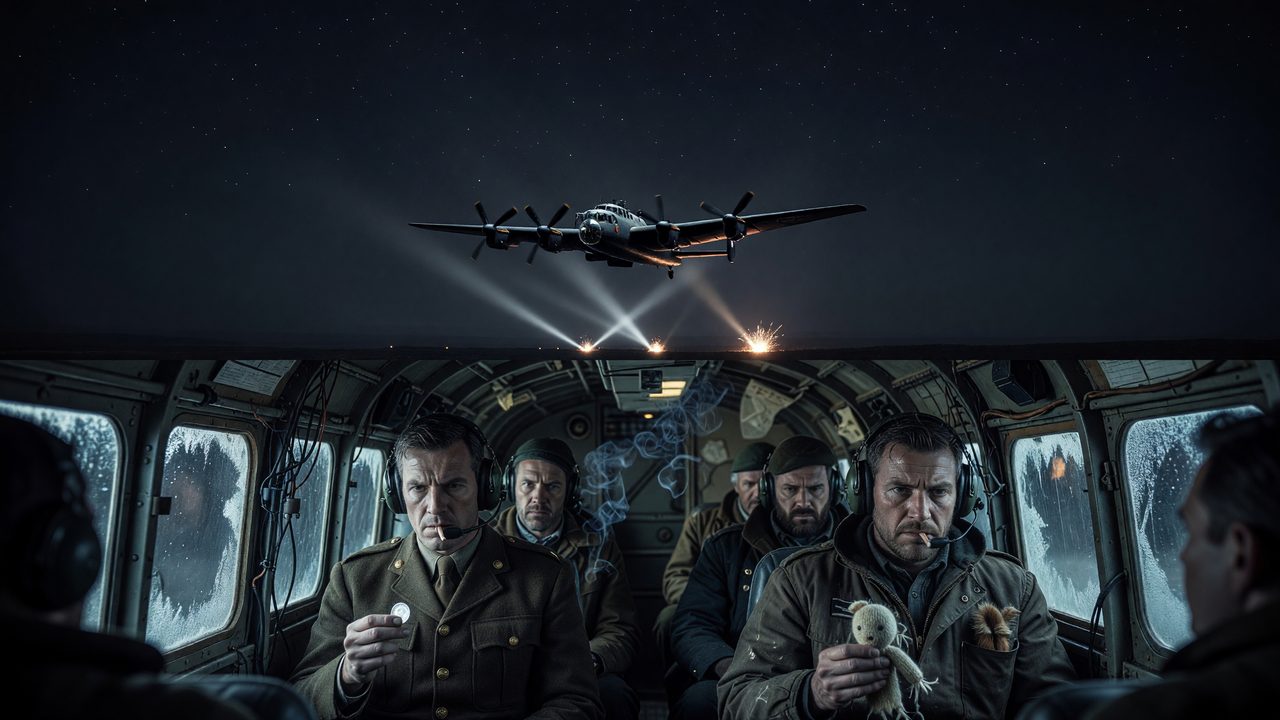
In the pressurized cold above occupied Europe, a Lancaster bomber crew learned quickly that competence was necessary but never sufficient. Flak did not grade on a curve. Fighters did not respect experience. Against that arithmetic, Royal Air Force bomber crews in World War II developed a private grammar of luck — objects carried, habits observed, numbers avoided.
Historical accounts gathered by the Royal Air Force Association, drawing on RAF Museum archives and related records, document a culture thick with charms. Crews tucked rabbits' feet into flight kits. Silver thrupenny bits — small coins of negligible wartime value — rode in pockets as if metal could repel metal. One crew reportedly carried a pair of WAAF blackout knickers aboard their Lancaster, a talisman so intimate it blurred the line between joke and prayer. A navigator might insist on boarding in full dress uniform, as though braid and buttons could summon order from chaos. A gunner might refuse to fly without a knitted doll from the publican's daughter, a handmade doll standing in for everyone waiting below.
These were not eccentricities at the margins. They were crew doctrine, passed mouth to ear in the same way someone might pass along a fuel cross-feed procedure.
Numbers the logbook would not speak
Superstition also lived in what crews refused to write down. The thirteenth operational mission — a milestone that invited attention from forces no instrument could measure — was quietly logged as "12B." Photographs of the full crew were deferred until the tour ended, as if an image taken too soon might fix faces in place for an obituary editor. Death, in that reading, was not random so much as observant. It noticed boastfulness. It noticed premature celebration.
The rituals were not substitutes for training. No rabbit's foot trimmed a bomb run. No coin deflected cannon fire. What they offered was something harder to manufacture in a briefing room: the illusion of agency when agency had been reduced to fractions of a second and yards of altitude. In the lonely hours between sortie and sortie, talisman and ritual gave shape to fear that otherwise had no outlet except paralysis.
Gremlins in the machine
If charms addressed fate from the outside, gremlins personified mischief from within. Roald Dahl's "The Gremlins," first published in Cosmopolitan in December 1942 (with a book following in 1943), gave the legend its most famous civilian audience. Dahl — himself a wartime RAF pilot — described small creatures sabotaging aircraft, a folklore already circulating in RAF mess halls before it reached American readers. The Royal Aviation Museum of Western Canada traces that thread forward: gremlins as a way to externalize mechanical failure and bad luck, to make the inexplicable feel like something you could argue with, bargain with, even laugh at.
Laughing mattered. Humor was itself a charm — a way to keep terror from colonizing the mind completely.
Ritual after the war
The habit did not demobilize with the crews. Sources such as Air & Space/Smithsonian's "One More For The Checklist" (2010) and related spaceflight tradition reporting document how American aviation carried superstition forward in new forms. Pilots flew with Snoopy dolls. Apollo-era astronauts carried playing-card rituals into spacecraft where no gremlin could physically hide, yet the impulse remained: mark the dangerous passage with a private ceremony the official manual would never include.
The objects change. The structure does not. Something small, repeated, personal — a coin, a doll, a card turned face-up in a pocket — becomes a psychological seatbelt alongside the physical one.
Why it matters to you
You will likely never log a mission as "12B" or tuck a thrupenny bit beside your sectional. But the underlying skill those crews were practicing — without naming it — is one every pilot still trains today: crew resource management's human half. CRM teaches you to speak up, cross-check, and distribute workload. Superstition, at its best, taught something adjacent: acknowledge fear honestly, build shared ritual, and never let overconfidence masquerade as professionalism. When the altimeter reads high and the margin for error reads low, skill is not always enough. Knowing that — and giving your crew a vocabulary for it, whether through checklist discipline or a harmless charm in the flight bag — remains a cornerstone of aviation culture. The void does not negotiate. Pilots always have.