Built for the Highway
"Built for Swedish highways, sold to the world."
Built for the Highway
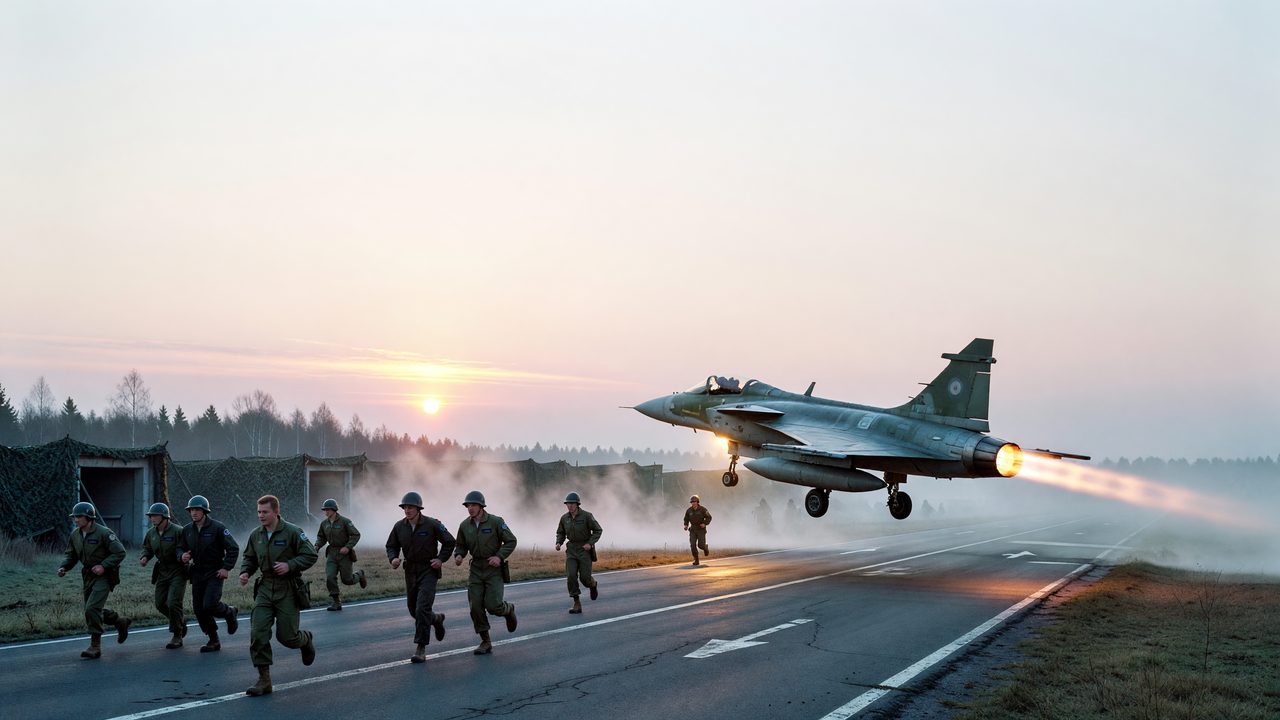
Sweden's Gripen was engineered to touch down on a snowy road, reload under conscript crews, and vanish before an adversary could find it — and two flight-control failures early in the program helped turn that improbable brief into a global export.
A Griffin Takes Shape
In June 1982, Sweden's parliament approved the JAS programme — a single airframe to hunt, strike, and reconnoitre — and that September the public chose its name: Gripen, the griffin of northern mythology, half eagle and half lion. The Swedish Defence Materiel Administration (FMV) recorded the contract for five prototypes and an initial batch of thirty aircraft, with options for more than a hundred to follow. Saab's engineers were not designing a showroom fighter for allied superpower bases. They were answering a geography lesson: in the 1980s, roughly 4,300 Warsaw Pact combat aircraft could reach Swedish airspace within about fifteen minutes. Neutrality demanded a jet that could survive the first strike and keep fighting from places an enemy would never put on a target list.
The result was a lightweight canard-delta — small radar signature, single engine, fly-by-wire from the outset — tuned for Sweden's Bas 90 concept of dispersed operations. Permanent airfields would be obvious targets. Highways, forest clearings, and short strips would not.
First Flight, Hard Lessons
On 9 December 1988, test pilot Stig Holmström lifted the first Gripen prototype above Linköping. Less than three months later, that aircraft was lost on approach when the flight-control software mishandled pilot inputs and the jet entered a pilot-induced oscillation it could not recover from. Saab kept flying. FMV's milestone record shows the programme pressing through radar integration, international airshow debuts, and delivery of the first serial aircraft in June 1993.
Then came a second, more public reckoning. On 8 August 1993, aircraft 39-102 stalled during a slow-speed manoeuvre over Stockholm's Riddarfjärden during a water festival display. The pilot ejected safely; Sweden's accident board traced the crash to an imbalance in the control system — the same software family that had nearly ended the programme five years earlier. Flight testing resumed only after the control laws were rewritten. The lesson was blunt: a digital flight-control system is not an accessory. It is the aircraft. Gripen's export success rests partly on Saab having learned that in front of television cameras, not in a briefing slide.
Ten Minutes on the Tarmac
Gripen entered Swedish Air Force service on 9 June 1996, when the Gripencentrum training facility opened at Skaraborg Wing. By then the operational concept was already written into the metal. Saab's Gripen E Technical Specification for Canada describes the original requirement plainly: operate from remote bases and, in extremis, from the nation's highways — runways as short as 800 metres and as narrow as 16 metres, without the sprawling support architecture a heavy fighter demands.
On the ground, the jet was built for speed. Modular avionics, a design that lets the aircraft taxi under its own power, and canard-assisted braking meant a returning Gripen could be refuelled and rearmed in minutes. Swedish doctrine called for roughly ten-minute turnarounds using a technician and a handful of conscript ground crew — not because shortcuts are heroic, but because every minute on a highway strip is a minute someone else's radar might be looking. Today's Gripen E-series, described on Saab's product pages, advertises combat turnarounds of fifteen to twenty-five minutes from dispersed road bases with minimal equipment — the same philosophy, refined across decades.
From Scandinavian Niche to Six Flags
What began as a national survival project now flies under six national flags and counting. Hungary and the Czech Republic took Gripen into NATO's eastern air-policing rotation. South Africa, Thailand, and Brazil added continents and climates the designers had to prove the jet could master. FMV's archived milestone list tracks the shift: export prototypes flying in 2004, overseas deliveries beginning in 2005, more than 150 million people living under Gripen protection by the time the C-series matured.
The crashes did not derail the programme; they hardened it. Each investigation fed back into control-law revisions, training, and the open-architecture avionics that let operators update mission software in hours rather than years. A fighter born to land on a snowy road and reload beside a fuel truck became, improbably, a template for how smaller air forces stay relevant against larger ones.
Why it matters to you
You will never land your trainer on a public highway, but Gripen's story sharpens skills every rated pilot eventually needs. Dispersed operations are not a party trick — they are a systems mindset. Know your minimum runway. Know your turnaround. Know who on the ground can fuel, inspect, and release you safely, and in what order. When fly-by-wire or automation surprises you, the fix is procedure and understanding, not hope: Sweden's early crashes turned obscure control-law behaviour into flight-test discipline the whole industry absorbed. Next time you brief a short-field landing, run a post-flight debrief, or trace why the autopilot did something you did not expect, you are practising the same logic that kept a highway fighter alive long enough to become an export success — survive the first mistake, learn fast, and be airborne again before the threat finds you.