Born in Flames: How a Gust Lock Gave Aviation Its Silent Copilot
"300 feet"
Born in Flames: How a Gust Lock Gave Aviation Its Silent Copilot
On a crisp Ohio morning in 1935, the Army Air Corps watched Boeing’s most ambitious bomber die in a fireball—and walked away with the tool every rated pilot still carries today.
The demonstration was meant to settle a question the Army Air Corps had been asking for years: Could one exceptionally capable pilot fly an exceptionally capable airplane? On the morning of 30 October 1935, the answer arrived in smoke.
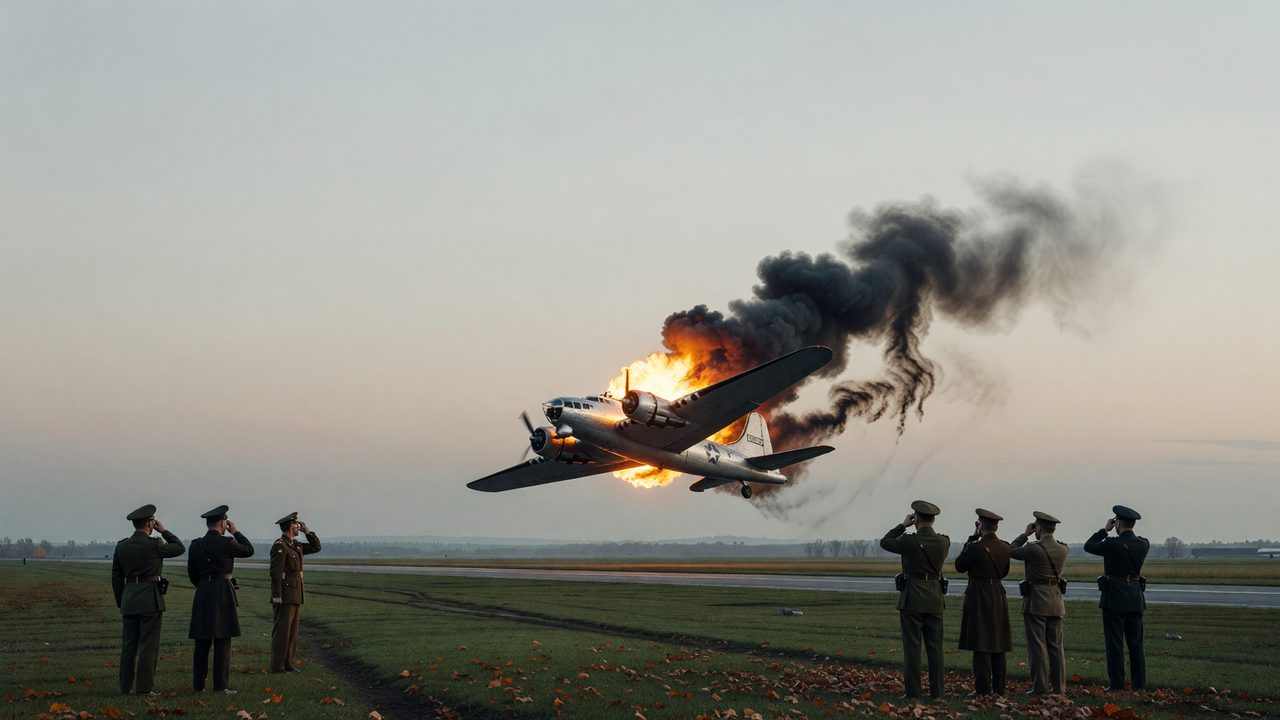
The Boeing Model 299—the prototype of what would become the B-17 Flying Fortress—stood on the ramp at Wright Field, Ohio, before an audience of senior officers who had come to judge a machine built to carry war across oceans. Four Pratt & Whitney R-1690 Hornet engines, a long greenhouse nose, and a promise of range and defensive firepower that no American bomber had yet matched. Major Ployer Peter Hill climbed into the left seat. His copilot took the right. The engines roared. The Model 299 accelerated down the runway and lifted into the autumn sky.
At roughly three hundred feet, the airplane stopped behaving like an airplane. It stalled. The wing dropped. The big Boeing cartwheeled into the ground and erupted in flame while the assembled brass looked on. Hill died of his injuries. Boeing’s gamble—the company’s future tied to a single spectacular prototype—seemed finished before the program had truly begun.
The Board of Officers convened at Wright Field to determine what had killed the flight. Investigators found no structural failure, no engine malfunction, no hidden design flaw in the Flying Fortress concept itself. The direct cause was brutally ordinary: the elevator control surface had remained locked by a gust lock, a simple ground pin meant to hold the tail surfaces still while the airplane was parked. Neither Hill nor his copilot had released it before takeoff. The Model 299 was not too much airplane for one man. It was too complex for any one man’s memory.
That distinction saved the program. The Air Corps did not cancel the bomber. Instead, pilots and engineers sat down and wrote out every step that mattered—takeoff, flight, before landing, after landing—and turned those steps into a pilot’s checklist. The idea was not novel in industry; factories and ships had long used written procedures. What changed that October was aviation’s admission that complexity had outrun individual brilliance. Memory was no longer a sufficient safety system.
The checklist proved it. The twelve evaluation aircraft that followed the crash flew a combined 1.8 million miles without a serious accident, a record that gave the Army confidence to accept the bomber. Production orders followed, eventually totaling 12,731 B-17 Flying Fortresses. From that day to this, no pilot of a complex aircraft has flown without a silent copilot on paper—callouts answered, items verified, the mundane steps that stand between routine and catastrophe.
Historians at the National Air and Space Museum and Air Force historical organizations have traced the same arc: a crash born of a skipped step, an investigation board that looked past the fire to the human factor, and a procedural fix so simple it reads almost insulting in hindsight. Air & Space Forces Magazine and museum scholarship alike treat the Model 299 accident not as a footnote to the B-17’s combat legend but as the moment checklist discipline became inseparable from professional piloting.
The checklist was born in flames. It has since saved more lives than any single invention in aviation—not because it makes pilots smarter, but because it makes forgetting harder.
Why it matters to you
The chain of events from that Wright Field morning is not museum trivia. NTSB and FAA accident files still document the same pattern: a capable crew, a capable aircraft, and a single item left undone—a lock not removed, a switch not set, a configuration assumed rather than confirmed. Checklist discipline is not rote busywork drilled for the checkride and abandoned afterward. It is the skill of treating your own attention as a limited resource and building a system that catches you when attention fails. Read the item. Touch the control. Verify the state. The fire that created the checklist is eighty years gone; the failure mode is not.