Born in a Storm: How Europe Built the Eurofighter Typhoon
"Four nations, one delta, zero compromise."
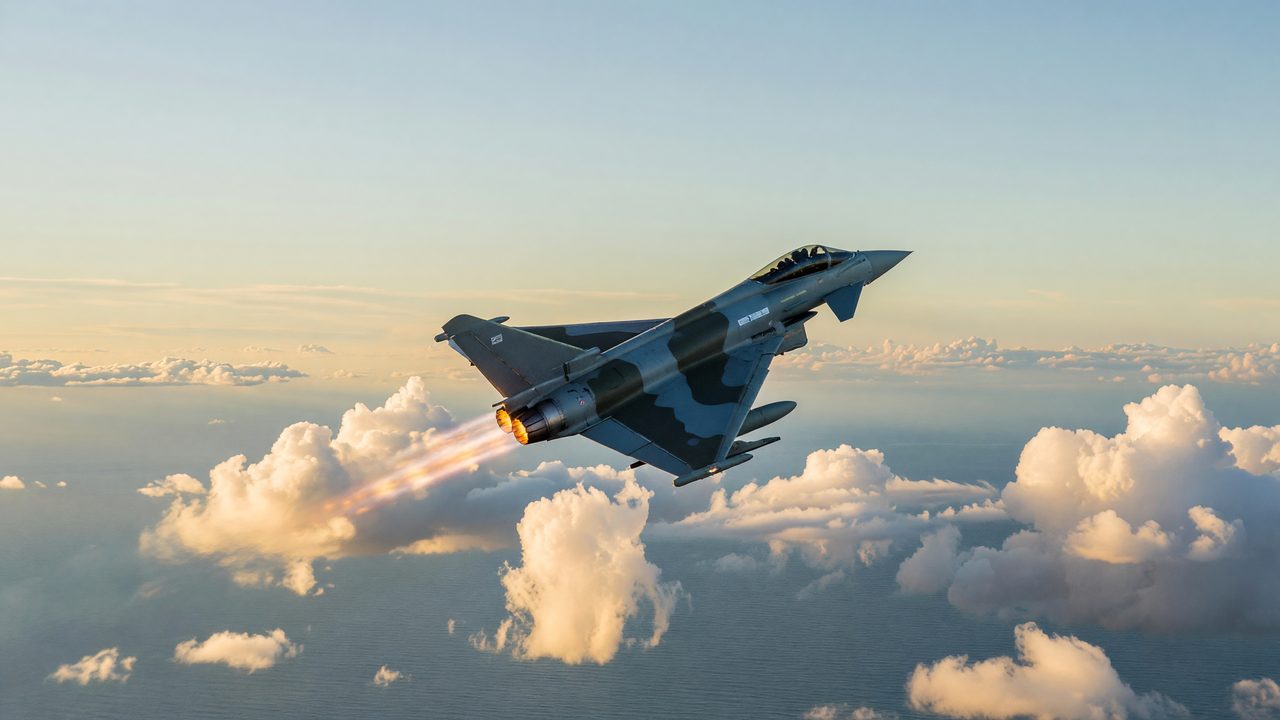
Born in a Storm: How Europe Built the Eurofighter Typhoon
From a British technology demonstrator in the 1980s to more than 600 airframes still flying toward 2060, the Typhoon is the continent’s longest-running bet that four nations can build one fighter—and make it work.
The path from EAP to first flight
Long before the name “Typhoon” appeared on a flight line, British engineers were already proving the aerodynamic ideas that would define the aircraft. The British Aerospace Experimental Aircraft Programme, or EAP, first flew on 8 August 1986 as a technology demonstrator—a flying laboratory for unstable canard-delta handling, advanced composites, and digital flight control. EAP was not the Eurofighter, but it answered questions the collaborative programme could not afford to leave open.
Eight years later, the formal prototype crossed the threshold. The Eurofighter Typhoon prototype flew on 27 March 1994, translating multinational requirements into a twin-engine, canard-delta airframe built for agility and growth. Naming came later, as multinational programmes often demand patience as well as engineering. The aircraft was christened “Typhoon” in September 1998. Royal Air Force type acceptance came in mid-2003, but operational frontline squadron service and quick-reaction duty began in 2006–2007, when the type moved from development rhetoric to squadron rosters.
Four nations, four lines, one standard
What distinguishes the Typhoon programme is not only the airframe but the industrial architecture behind it. According to programme documentation published by Eurofighter Jagdflugzeug GmbH, the fighter is produced on four parallel final-assembly lines spread across Europe, with Airbus, BAE Systems, and Leonardo sharing the manufacturing load among the partner nations. Each line builds complete aircraft for its national customer, yet every jet must meet a single configuration standard, common test procedures, and shared logistics doctrine.
Airbus describes the Typhoon as Europe’s largest military joint programme, representing British, German, Italian, and Spanish industrial capability in one product. That structure is easy to diagram and hard to execute. Subassemblies cross borders constantly—wings, fuselage sections, avionics suites—before converging at Warton, Manching, Turin, and Getafe. The result is not four different fighters, but one type certificate’s worth of interoperability: a German Luftwaffe jet and a Royal Air Force jet share manuals, weapons interfaces, and upgrade paths because the programme was designed that way from the outset.
A swing-role machine built around thrust
The Typhoon’s configuration choices read like a deliberate syllabus in high-performance aerodynamics. The canard-delta layout trades conventional stability for control-authority and sustained turn rate. Two Eurojet EJ200 turbofans provide the power budget. Airbus notes that the EJ200 pair gives the Typhoon an impressive thrust-to-weight ratio and the manoeuvrability expected of a late-twentieth-century air-superiority design, while the aircraft has matured into a swing-role platform able to move between air-to-air and air-to-ground tasking within a single sortie.
Sensor fusion, helmet-mounted displays, and a digital flight-control system mediate between pilot intent and an intentionally unstable airframe. Programme materials emphasize supercruise capability and broad weapons carriage across multiple hardpoints—engineering decisions aimed at keeping the jet relevant as threats evolve. With more than 609 airframes delivered and an estimated service life extending toward 2060, the Typhoon has outlasted many of the political and budget cycles that nearly ended European collaborative combat-aircraft programmes before they left the ground.
Still Europe’s benchmark collaborative fighter
Measured by longevity, export reach, and continuous upgrade, the Typhoon remains Europe’s most successful collaborative combat-aircraft programme. Original partner nations have been joined by additional operators, and orders continue to accumulate even as sixth-generation successors take shape on drafting tables. The type’s persistence is partly industrial—sustaining four assembly ecosystems is politically valuable—and partly operational: a mature fleet with known training pipelines, established tactics, and a roadmap of capability inserts is difficult to retire on a calendar.
Why it matters to you
You will never hand-fly a Typhoon on a private pilot checkout, but two lessons from its story surface in everyday flight training. First, the four-line production model is a case study in systems thinking: complex projects succeed when interfaces are standardized early and verified relentlessly. That is the same discipline behind performance data you consult before flight—weight, balance, power available, fuel flow—where small assumptions propagated across a fleet become large errors. Second, the EJ200’s reputation as a thrust-to-weight benchmark is a reminder that excess power is not merely speed; it is margin. In a trainer, that margin shows up as the ability to recover from a sloppy approach or reject a go-around with confidence; in fighter training, it is energy management—trading altitude for airspeed and back again without bleeding the aircraft into a corner. Studying how the Typhoon’s designers budgeted thrust, drag, and structural load helps you read your own aircraft’s POH figures not as trivia, but as the ledger that defines what is possible on every takeoff roll you will ever run.