Before the Runway: DELAG and the Birth of Commercial Flight
"The first airline flew lighter-than-air. It was German, luxurious, and occasionally on fire."
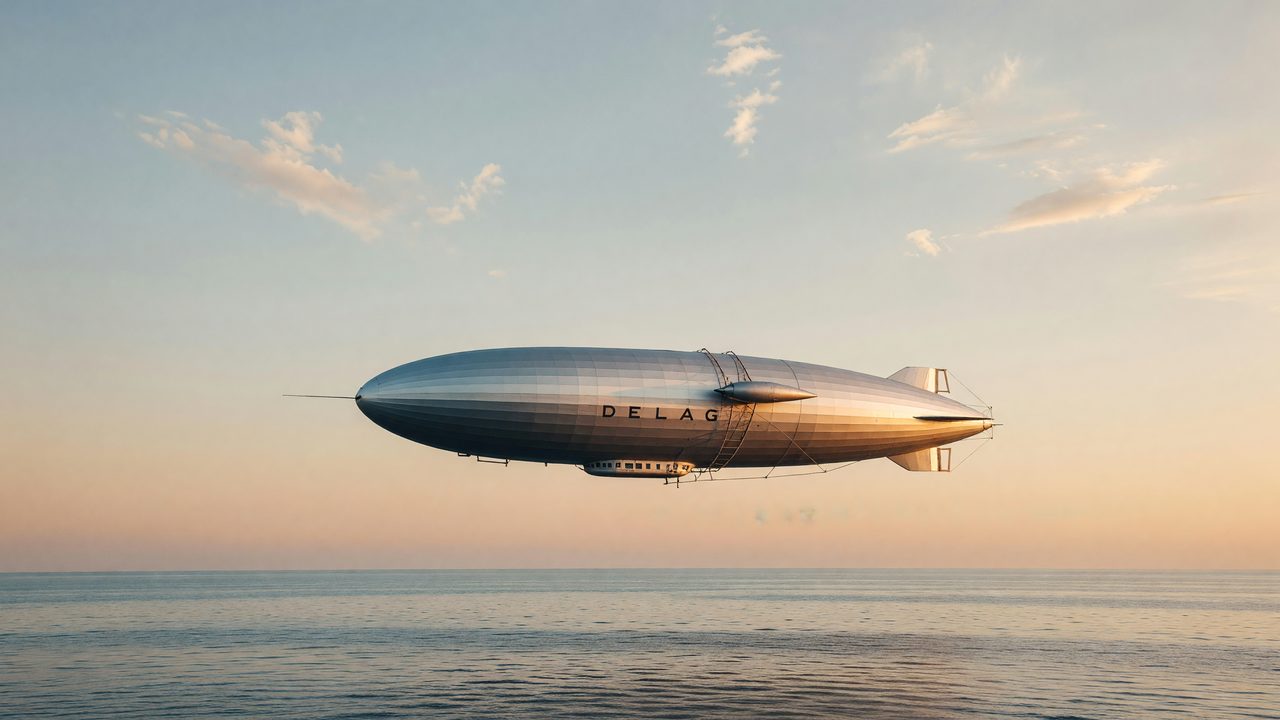
Before the Runway: DELAG and the Birth of Commercial Flight
Long before fixed-wing airlines carried the world, German Zeppelins flew paying passengers on scheduled routes—and rewrote what “airline” could mean.
When student pilots memorize the pioneers of commercial aviation, the names that surface are usually KLM, Pan Am, or United. That list is accurate for the fixed-wing era, but it skips the operation that got there first. In 1909, Deutsche Luftschiffahrts-Aktiengesellschaft—DELAG—was chartered to operate rigid airships built by Ferdinand von Zeppelin’s company. By 1910 it was running scheduled passenger service, years before any airplane airline would claim a comparable record. Corporate records preserved at the Zeppelin Museum Friedrichshafen and in DELAG’s own historical archives document an enterprise that treated flight not as a stunt, but as a timetable.
The scale of those early operations is easy to underestimate from a cockpit built for Cessnas and Citations. Before World War I interrupted civilian flying in Europe, DELAG had carried roughly 34,000 passengers without a single fatality—a safety record that would gratify any modern operator, and one supported by passenger logs and artifacts held in Friedrichshafen. The airships were not cramped capsules; they were flying hotels. The LZ 127 Graf Zeppelin, stretching 776 feet from stem to stern, offered a dining room, sleeping berths, and a lounge appointed with a baby grand piano. Passengers did not merely endure travel; they inhabited it. In 1928 the Graf Zeppelin completed the first transatlantic passenger flight by airship. The following year it circled the globe—the first round-the-world flight with paying travelers aboard. For a brief window, lighter-than-air craft owned the prestige routes that fixed-wing equipment would later dominate.
War and technology reshaped the map. DELAG’s pre-1914 success did not survive the conflict intact, yet the Zeppelin company kept refining passenger airships through the 1920s and early 1930s. Meanwhile, the airline model DELAG pioneered found new expression in heavier-than-air metal. KLM Royal Dutch Airlines, founded in 1919 and still flying today, is widely cited as the first fixed-wing airline; its corporate historical archives trace a continuous line from Dutch colonial mail contracts to the jet age. In the United States, Varney Air Lines began operations in 1926 and eventually folded into the lineage of United Airlines. The hardware changed; the commercial logic DELAG had demonstrated—scheduled departures, ticketed passengers, repeatable service—did not.
The zenith and the catastrophe arrived together. On May 6, 1937, the LZ 129 Hindenburg burst into flame while mooring at Lakehurst, New Jersey. Thirty-six people died. Investigation files in the National Archives, including materials from the disaster inquiry (Department of Commerce / Bureau of Air Commerce civil-aviation records), fixed public attention on hydrogen’s volatility and brought the passenger airship era to an abrupt close. Fixed-wing airlines, maturing rapidly in range and reliability, absorbed the market DELAG had once defined. Aviation crossed from novelty to necessity on aluminum wings and kerosene turbines, and the Zeppelin’s piano lounges became museum pieces.
Why it matters to you
The Hindenburg inquiry teaches a habit every pilot trains for, whether in a simulator or on the line: resist the first plausible explanation. Hydrogen’s flammability looked like an open-and-shut case in 1937, yet later research has pointed to another candidate—the aluminum-powder-doped fabric skin, chemically reactive and capable of sustaining combustion independent of the gas cells. Root-cause analysis is not academic; it is what separates a corrective action that prevents recurrence from a legend that merely satisfies the moment. When you debrief an incident, chase the evidence chain the way investigators eventually had to chase the Hindenburg’s envelope. DELAG proved that airlines could be safe, scheduled, and grand. The disaster proved that the most dangerous assumption in aviation is the one you stop questioning.