Before the Briefing: A Century of Aviation Weather
"Before METARs, there were telegrams. Before DUATS, there was a Weather Bureau clerk with a map."
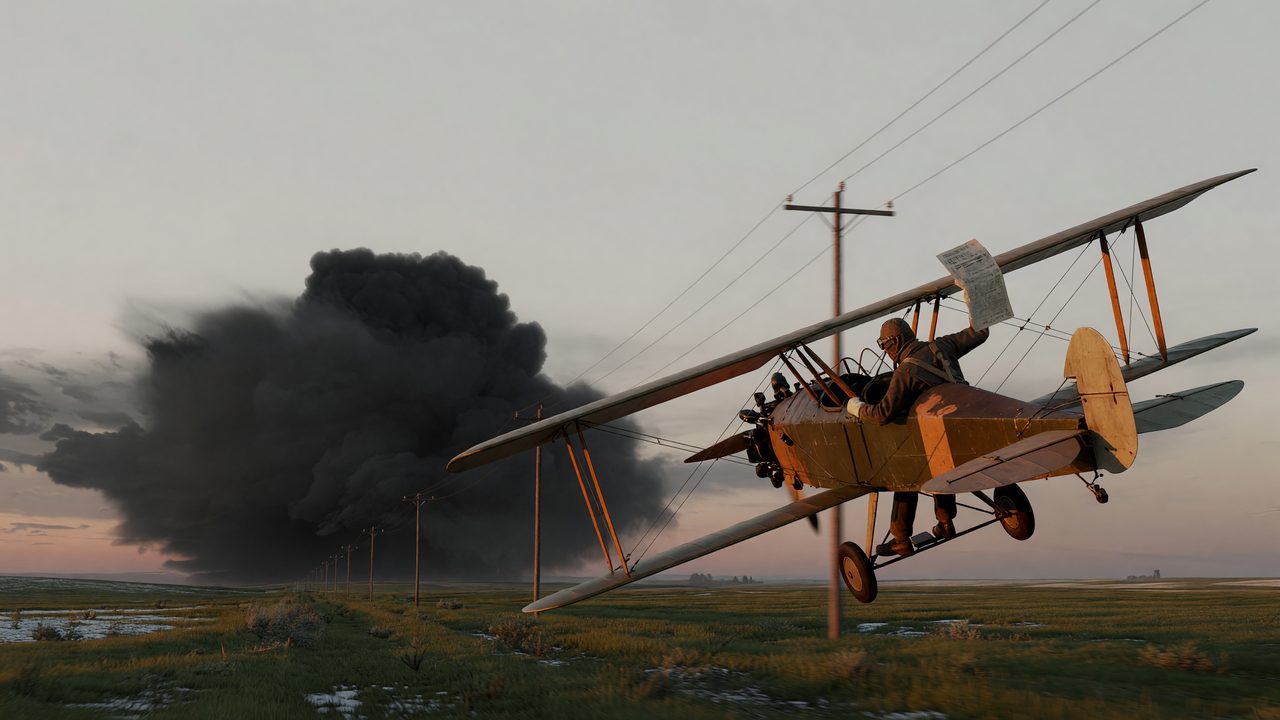
Before the Briefing: A Century of Aviation Weather
From kite stations and Morse-code bulletins to embedded forecasters and graphical hazard cubes, the federal weather service for pilots has always chased one goal: put actionable sky knowledge in the cockpit before the wheels leave the ground.
On December 1, 1918, the U.S. Weather Bureau issued the nation's first routine aviation forecast — a milestone NOAA Heritage records as the starting point of a dedicated air-safety mission that continues today. The forecast targeted the Aerial Mail Service route between New York and Chicago, a corridor where Post Office pilots in open cockpits were learning, often the hard way, that fair weather at the departure field meant nothing about the cumulus building two states ahead. Forecasters drew on a sparse but ambitious observing network: eighteen kite and balloon stations, six operated by the Bureau and the rest by the military, tracking winds aloft while surface observers logged temperature, pressure, and visibility. The product that emerged was not a general public forecast repurposed for flyers. It was weather intelligence shaped for aircraft that could not climb above the weather and could not land on a dime.
The Bureau's "flying forecasts," as National Weather Service Heritage documents describe them, grew directly from wartime cooperation with the Army and Navy. Chief Charles F. Marvin warned in his 1919 annual report that flying "in ignorance or disregard of meteorological conditions" was suicidal — strong language from a government scientist, but mail pilots and Army aviators supplied the evidence. Routine Army forecasts followed in August 1919, telegraphed twice daily from Washington to thirteen districts. When the British dirigible R34 prepared to depart Mineola, New York, in July 1919, Bureau meteorologists issued wind and weather guidance three times a day; an urgent evening warning on July 9 prompted a midnight departure that cleared the airship before a half gale hammered Long Island the next morning. Brigadier General L.E.O. Charleton, the British air attaché, credited those readings with a fair share of the mission's success.
Along the expanding mail routes, weather moved by wire long before it moved by voice. According to Air Traffic Control History's account of Flight Service evolution, Air Mail Radio Stations along the transcontinental airway — seventeen primary fields on the 2,612-mile New York–San Francisco route that opened in August 1920 — made local observations, pulled distant reports by radio, and sometimes produced their own forecasts. Specialists passed information station to station using Morse code, later Phillips shorthand and "Q" signals that echo in modern systems. Any pilot who called or stopped could obtain weather, file a position report, or trigger a search for an overdue aircraft. Those early station keepers were, in practice, general aviation's only link to a nascent national air traffic structure.
Congress formalized the arrangement with the Air Commerce Act of 1926, assigning the Weather Bureau explicit responsibility for aviation observations and forecasts as federal civil aviation came under Department of Commerce control. Airport stations multiplied through the 1930s. Toward the end of World War II, as the Civil Aeronautics Administration stood up twenty-three Air Route Traffic Control Centers, the Bureau opened Flight Advisory Weather Service Centers to feed controllers specialized forecasts for the airspace they managed — the institutional ancestor of today's Center Weather Service Units, established in 1978 after accident investigations underscored the need for meteorologists inside ARTCC facilities.
The briefing desk has changed shape many times since. A 1961 FAA–NWS agreement trained Flight Service specialists as pilot weather briefers who could interpret charts rather than read products verbatim. Automation consolidated hundreds of stations into networked facilities, yet the human contract endured: translate atmospheric science into decisions. At NOAA's Aviation Weather Center in Kansas City — successor to units that have issued convective and turbulence guidance since the late 1970s — forecasters staff dedicated desks for icing, turbulence, ceilings, visibility, and convective hazards around the clock, publishing thousands of graphic products daily for domestic and oceanic domains. Twenty-one Center Weather Service Units now embed NWS meteorologists inside FAA en route centers, issuing Center Weather Advisories and face-to-face briefings tailored to sectors that may span deserts, mountains, and tropical moisture in a single shift. Terminal Aerodrome Forecasts from local Weather Forecast Offices still anchor departure and arrival planning at individual airports. The pipe is faster, the graphics are richer, and datalink can put SIGMETs on a tablet — but the logic is unchanged from 1918: observe the atmosphere, anticipate the threat, and deliver the answer before someone commits to a route.
Why it matters to you
When you sit down for a preflight weather briefing — whether through a digital portal, a briefer on the phone, or your own disciplined read of METARs, TAFs, and graphical hazard forecasts — you are using a system with a birthday you can actually remember. What date marked the first official aviation weather forecast issued by the U.S. Weather Bureau? December 1, 1918. That is not trivia; it is the origin point of your legal and practical expectation that someone in the federal government is producing aviation-specific guidance. The skill worth training is to honor that legacy with skepticism and structure: treat every product as a forecast, not a promise; cross-check multiple sources the way mail pilots once cross-checked telegraph reports; and know which office owns which piece of the puzzle — AWC for en route hazards, your WFO for the TAF, CWSUs for the ARTCC airspace you will traverse. The equipment on the AWC operations floor would be unrecognizable to a 1918 kite observer, but Marvin's warning still applies. The pilots who treat weather as background noise are repeating the oldest mistake in aviation. The ones who brief with history in mind are flying the mission the Weather Bureau began on a December morning more than a century ago.