Before NASA, There Was NACA
"Before there was a space program, there was a laboratory in Virginia that figured out how airplanes actually work."
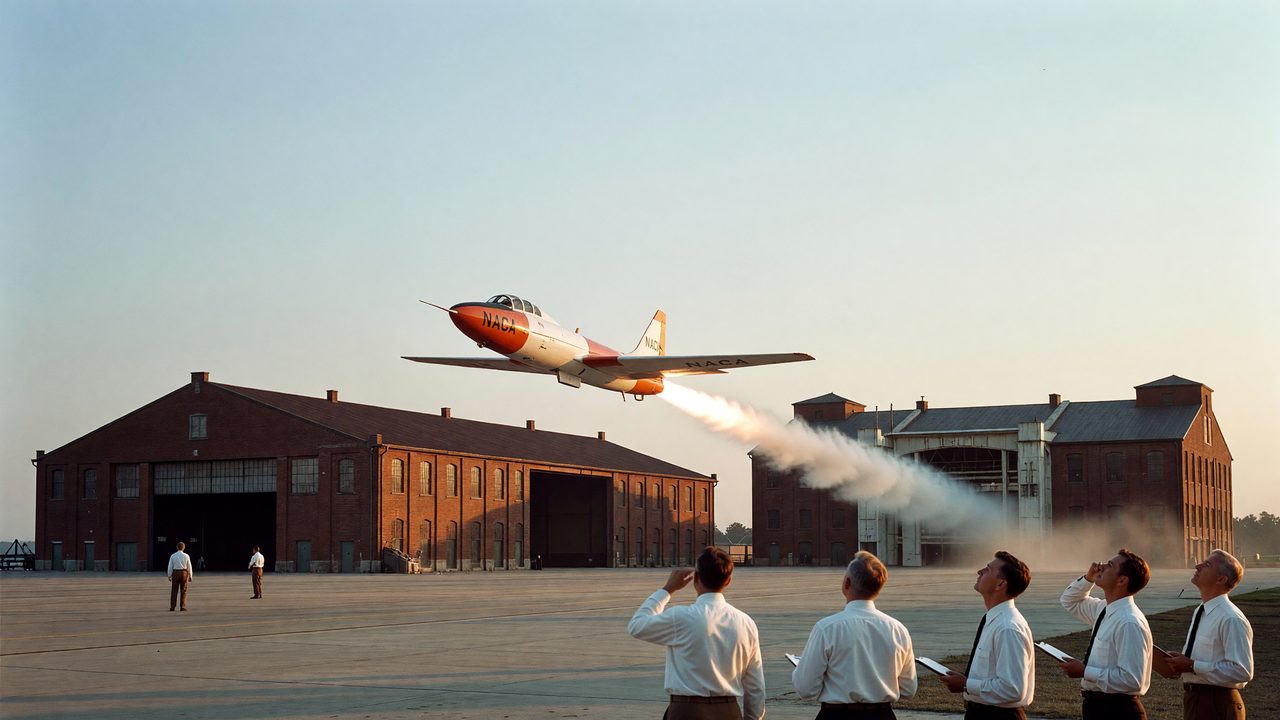
Before NASA, There Was NACA
In 1915, when powered flight was still a fragile experiment, a federal laboratory set out to solve the science of the wing — and laid the foundation for every cockpit you sit in today.
When Congress chartered the National Advisory Committee for Aeronautics in March 1915, aviation was less a mature industry than a collection of daring stunts. The Wright brothers had flown barely a decade earlier. The first nonstop transatlantic crossing came in June 1919, and Lindbergh's solo New York–Paris flight in 1927. Yet lawmakers recognized what pilots and manufacturers already sensed: flight would not scale on courage alone. It needed methodical engineering.
NACA’s mandate was deliberately practical: to “supervise and direct the scientific study of the problems of flight, with a view to their practical solution.” That language sounds bureaucratic, but it launched one of the most productive research institutions in aviation history.
Three Laboratories, One Method
NACA’s first permanent home was the Langley Memorial Aeronautical Laboratory, established at Hampton, Virginia, in 1917. Langley became the nation’s aeronautical proving ground — wind tunnels, flight test aircraft, and engineers who treated every stall, buffet, and pressure distribution as data waiting to be understood.
As American aviation expanded westward and into higher performance, NACA added the Ames Aeronautical Laboratory in California and the Lewis Flight Propulsion Laboratory in Ohio. Together, the three sites formed a research network that industry could not replicate alone. Manufacturers brought problems; NACA brought repeatable experiments and published results.
That openness mattered. NACA technical reports — the famous TR series — circulated findings across military programs, airline engineering offices, and university classrooms. Knowledge moved outward, and aviation moved with it.
From Airfoils to the Sound Barrier
Among NACA’s most enduring contributions was systematic airfoil research. Beginning in the 1920s and 1930s, Langley engineers tested wing cross-sections in wind tunnels, cataloging lift, drag, and pitching moments with a rigor the private sector could not afford. The resulting NACA airfoil families gave designers a shared vocabulary: predictable shapes with documented performance, not guesswork carved into wood and fabric.
In the 1920s, NACA tackled a problem every radial-engine pilot could see and hear. Uncowled engines cooled well but wasted horsepower dragging cylinders through the air. The NACA cowling — a carefully shaped enclosure tested in flight and tunnel work — recovered much of that lost thrust. It was not merely cosmetic sheet metal; it was applied aerodynamics that made existing engines perform as if they had grown stronger overnight.
Decades later, as jet aircraft pushed toward Mach 1, a new obstacle appeared: drag rising sharply near the speed of sound. NACA researcher Richard Whitcomb’s area rule, developed through careful transonic testing, showed that shaping a fuselage to respect cross-sectional area distribution could tame wave drag. The insight helped unlock practical supersonic flight and echoes through every swept, wasp-waisted design that followed.
Research Pilots Who Reached for Space
NACA’s flight-test culture produced more than reports. Its research pilots flew experimental machines to document behavior that tunnels could only approximate — the moment of buffet onset, the fidelity of control forces, the honest limits of a new configuration.
When the Soviet Union launched Sputnik in October 1957, the shock was not only political. It exposed a national assumption that excellence in aeronautics would automatically translate into leadership beyond the atmosphere. Congress and the Eisenhower administration concluded that the United States needed a civilian agency with a broader charter than aircraft alone.
On October 1, 1958, NACA was absorbed into the newly created National Aeronautics and Space Administration. Facilities, personnel, and decades of institutional memory carried forward. Many of NASA’s earliest astronauts had flown for NACA as research pilots — among them Neil Armstrong; John Glenn and Alan Shepard came to the astronaut corps from military test-flying, not NACA — men who had built careers measuring how vehicles behaved at the edge of the envelope long before anyone called that edge “space.”
A Legacy in Every Wing
NACA did not build airliners or fighters for the fleet. It built the understanding underneath them. The airfoil catalogs, the cowling breakthrough, the area rule, and thousands of technical reports became part of aviation’s common inheritance. When NASA inherited NACA’s laboratories and staff, it inherited a culture that treated flight as a solvable engineering problem — a culture that would soon be tested beyond the stratosphere.
Why it matters to you
Walk any flight school ramp and you will see NACA’s fingerprints without a museum placard in sight. The four-digit NACA airfoil series taught in ground school — NACA 2412 is the classic classroom example — descends directly from that tunnel work at Langley nearly a century ago. Your training aircraft’s wing was not drawn from aesthetic preference; it likely relies on airfoil families whose lift and drag characteristics were mapped, numbered, and published so designers and instructors could speak the same language. When you study how camber and thickness affect stall behavior, climb performance, and induced drag, you are applying lessons paid for by federal research long before your logbook existed. NACA proved that fundamental science outlives any single airframe — and that a pilot who understands the wing’s history understands the wing’s behavior.