Authority at the Limit: Eileen Collins and the Command That Launched Chandra
"From the back seat of a T-38 to the left seat of Columbia."
Authority at the Limit: Eileen Collins and the Command That Launched Chandra
On a July night in 1999, an Air Force colonel became the first woman to command a space shuttle — and proved that command authority is earned in the seat, not granted by ceremony.
The Path to the Left Seat
Long before Eileen Collins occupied the commander's seat aboard Columbia, she had already rewritten the flight rules of human spaceflight. Selected as an astronaut in 1990, the former Air Force test pilot and instructor brought the same discipline she had honed in T-38s and C-141s into NASA's pilot-astronaut corps. Her first spaceflight, STS-63 in February 1995, placed her in the pilot's seat for the shuttle program's first rendezvous with the Russian Mir space station — a delicate orbital ballet that demanded precise trajectory management and steady crew coordination. Two years later, on STS-84, she flew the pilot's position again on a Mir docking mission. By the time NASA assigned her to command STS-93, Collins had already demonstrated the technical judgment the agency reserves for its most experienced aviators.
The July 1999 STS-93 Press Kit framed the mission as a dual milestone: NASA would mark advances in both human spaceflight and astronomy. Collins would command a five-person crew — herself, Pilot Jeffrey Ashby, and Mission Specialists Steven Hawley, Catherine Coleman, and Michel Tognini — on a flight to deploy the Chandra X-ray Observatory. At roughly $1.5 billion, Chandra represented one of the most valuable payloads ever entrusted to a shuttle crew. Weighing in as the heaviest payload the orbiter fleet had ever carried to orbit, it would test every limit of the vehicle and the people flying it.
Launch Night at Pad 39B
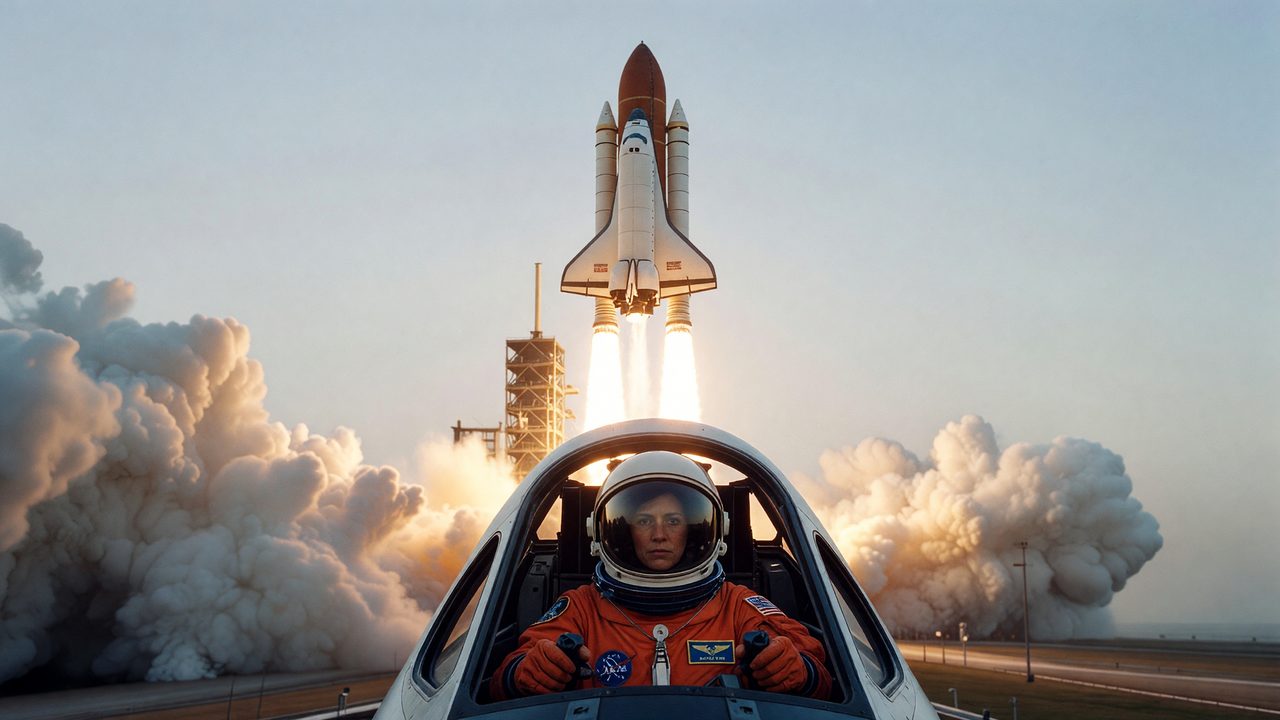
At 12:31 a.m. EDT on July 23, 1999, Columbia lifted off from Kennedy Space Center's Pad 39B. Collins had the left seat — commander — making her the first woman to hold full authority over a shuttle mission from launch through landing. The ascent, however, quickly departed from the script NASA had rehearsed for months.
Seconds into main engine ignition, a gold pin in the No. 3 Space Shuttle Main Engine came loose. The pin struck and damaged hydrogen cooling tubes in the engine's nozzle, degrading the engine's thermal protection. Almost simultaneously, electrical faults knocked out two of the orbiter's six digital engine control units — the center engine's primary DCU-A and the right engine's backup DCU-B. Each main engine normally relied on redundant controllers; with two units offline, the other four DCUs continued operating and the remaining engines continued to burn without full backup. Ground controllers and the flight crew faced a cascade of abnormal indications while the vehicle was still climbing through the atmosphere.
Collins and her crew did what commanders are trained to do: absorb the data, consult with Mission Control, and continue the mission when abort options narrowed and the vehicle remained flyable. The engines kept running. Columbia reached orbit.
Delivering the Universe's New Eye
Once on orbit, the crew turned to Chandra. Hawley, who had helped develop the observatory, used the shuttle's robotic arm to lift the 45-foot-long telescope from the payload bay and release it into space. Chandra's four pairs of nested mirrors would capture X-rays from supernova remnants, black holes, and galaxy clusters — wavelengths no ground telescope can observe through Earth's atmosphere. The deployment completed the primary objective that had survived a harrowing ride uphill.
Four days after launch, Collins brought Columbia home to Kennedy Space Center, landing on Runway 33 on the night of July 27. The mission had lasted just under five days. Chandra would operate for decades, producing imagery that reshaped astrophysics. But the flight's human legacy was equally durable: a woman had commanded a shuttle through a genuine in-flight emergency and brought crew and spacecraft back intact.
A Second Command and a Deliberate Invitation
Collins would command one more shuttle mission. In July 2005, she led STS-114, NASA's return-to-flight effort after the Columbia disaster of 2003. That mission tested redesigned external tank foam, new inspection tools, and procedures born from tragedy — another assignment that placed maximum responsibility on the commander.
At her first command launch in 1999, Collins had extended a personal invitation to the surviving members of the Mercury 13, the women who in the early 1960s had completed the same medical and psychological evaluations as the Mercury astronauts but were denied the chance to fly. Seven of them came to Kennedy and watched from the VIP bleachers as Columbia cleared the tower with Collins in command. The moment linked two generations of women who had met the standards of flight but had not always been given the aircraft.
Why it matters to you
Collins' assignment as commander was more than a symbolic first. NASA had to certify a female aviator for full pilot-in-command authority over a complex crew and a billion-dollar payload — the same institutional gate every rated pilot crosses when assuming responsibility for an aircraft, its occupants, and its mission. Her response to the STS-93 engine anomalies mirrors what flight training drills into every certificate holder: when redundancy disappears and the panel lights up with faults you did not brief, authority does not transfer to hope or hesitation. It stays with the pilot in command. Collins absorbed abnormal indications, coordinated with her crew and controllers, and pressed on within the limits of a flyable vehicle — then landed four days later. That is the standard CRM, systems knowledge, and decision-making under pressure that modern pilot training exists to build. The left seat is not a title. It is a contract to keep flying when the data says the margin has thinned, and to bring everyone home when it has not.